Most Denver offices look clean.
The floors shine. Trash cans are empty. Conference tables appear spotless. Employees walk through Downtown Denver, past Denver Union Station or near Coors Field, and step into offices that seem professionally maintained.
But appearance and sanitation are not the same thing.
Independent ATP surface testing has repeatedly shown that many commercial workplaces contain elevated contamination levels on high-touch surfaces long after routine cleaning has been completed. Shared keyboards, microwave buttons, faucet handles, and conference room tables often carry significantly more organic residue than facility managers expect.
That disconnect is the real issue.
A workplace can pass the “eye test” while still failing basic hygiene standards.
Looks Clean ≠ Is Clean
One of the biggest misconceptions in office cleaning is that visible cleanliness equals sanitation.
It does not.
A reception desk in LoDo may appear spotless under bright lighting, but ATP testing can still detect organic contamination left behind from dozens of employee and visitor interactions throughout the day.
Professional ATP testing measures adenosine triphosphate (ATP), a marker for biological residue found on surfaces.
In general:
- Under 150 RLU = typically considered clean
- Over 300 RLU = elevated contamination risk
- Shared office surfaces frequently test between 200–500 RLU
- Break rooms and kitchen areas often test far higher
The most surprising part?
Many contaminated surfaces show no visible dirt at all.
That is why modern workplace cleaning is shifting toward measurable sanitation instead of appearance-only cleaning.
The Most Contaminated Areas in Many Denver Offices
The dirtiest surfaces in an office are rarely the most obvious ones.
Employees often assume restrooms are the highest-risk areas, but ATP testing frequently identifies contamination in shared workplace spaces instead.
Common office contamination hotspots include:
- Refrigerator handles
- Coffee machine buttons
- Elevator buttons
- Shared keyboards
- Conference room remotes
- Faucet handles
- Microwave touchpads
- Break room counters
- Door handles
- Copy machine touchscreens
In busy Denver buildings near 16th Street Mall or around the business corridors near Civic Center Park, hundreds of surface interactions can happen every hour.
Most of those touchpoints are overlooked during standard nightly cleaning.
Why Offices Often “Feel Clean” Even When They Aren’t
Humans judge cleanliness visually and psychologically.
If floors are vacuumed and trash is removed, most people assume the entire office is sanitary.
But contamination is largely invisible.
A conference room can smell fresh while bacteria remains on shared surfaces. A polished lobby desk can still carry contamination from repeated hand contact throughout the day.
This is why many workplaces develop a false sense of cleanliness.
Visual cleaning focuses on:
- Appearance
- Dust removal
- Trash collection
- Smudge reduction
Hygienic cleaning focuses on:
- Surface disinfection
- Cross-contamination prevention
- Dwell times
- High-touch sanitation
- Verification testing
Many janitorial programs do the first well.
Far fewer consistently do the second.
The Cleaning Mistakes Most Offices Never Notice
Many sanitation failures happen quietly and repeatedly.
1. Disinfectants Are Wiped Too Quickly
Most disinfectants require several minutes of dwell time to properly neutralize bacteria and viruses.
Spraying and immediately wiping a surface dramatically reduces effectiveness.
2. The Same Cloth Gets Used Everywhere
Using one cloth across multiple rooms spreads contamination instead of removing it.
Without separation systems, bacteria from a restroom can transfer to desks, counters, and shared office surfaces.
3. High-Touch Areas Get Skipped
Routine cleaning often prioritizes visible surfaces while missing the places employees touch constantly throughout the day.
That includes:
- light switches
- appliance handles
- shared electronics
- restroom latches
- conference equipment
You can also read: Common Business Mistakes That Lead to Poor Cleaning Results
Employees Notice More Than Managers Realize
One of the most overlooked aspects of workplace cleanliness is perception.
Employees notice subtle hygiene problems quickly:
- lingering restroom odors
- sticky break room counters
- dusty vents
- fingerprints on glass
- dirty elevator buttons
- smudged entry doors
Even if they never formally complain, these details affect how people feel about the workplace.
Cleanliness influences:
- employee comfort
- confidence in workplace safety
- customer impressions
- overall workplace experience
In competitive office environments across Downtown Denver, workplace presentation matters more than many businesses realize.
Denver Offices Face a Unique Dust Problem
Denver’s dry climate creates unusual indoor cleaning challenges compared to more humid cities.
Low humidity contributes to:
- faster dust accumulation
- airborne particulates
- static buildup on surfaces
- quicker re-settling of debris after cleaning
This is especially noticeable in high-traffic office buildings near areas like Larimer Square and the business districts surrounding Denver Civic Center.
During wildfire season, smoke particulates can also settle onto desks, vents, and shared surfaces throughout commercial buildings.
That means offices may appear dusty again only hours after cleaning if filtration and surface protocols are insufficient.
5 Signs Your Office May Not Be as Clean as It Looks
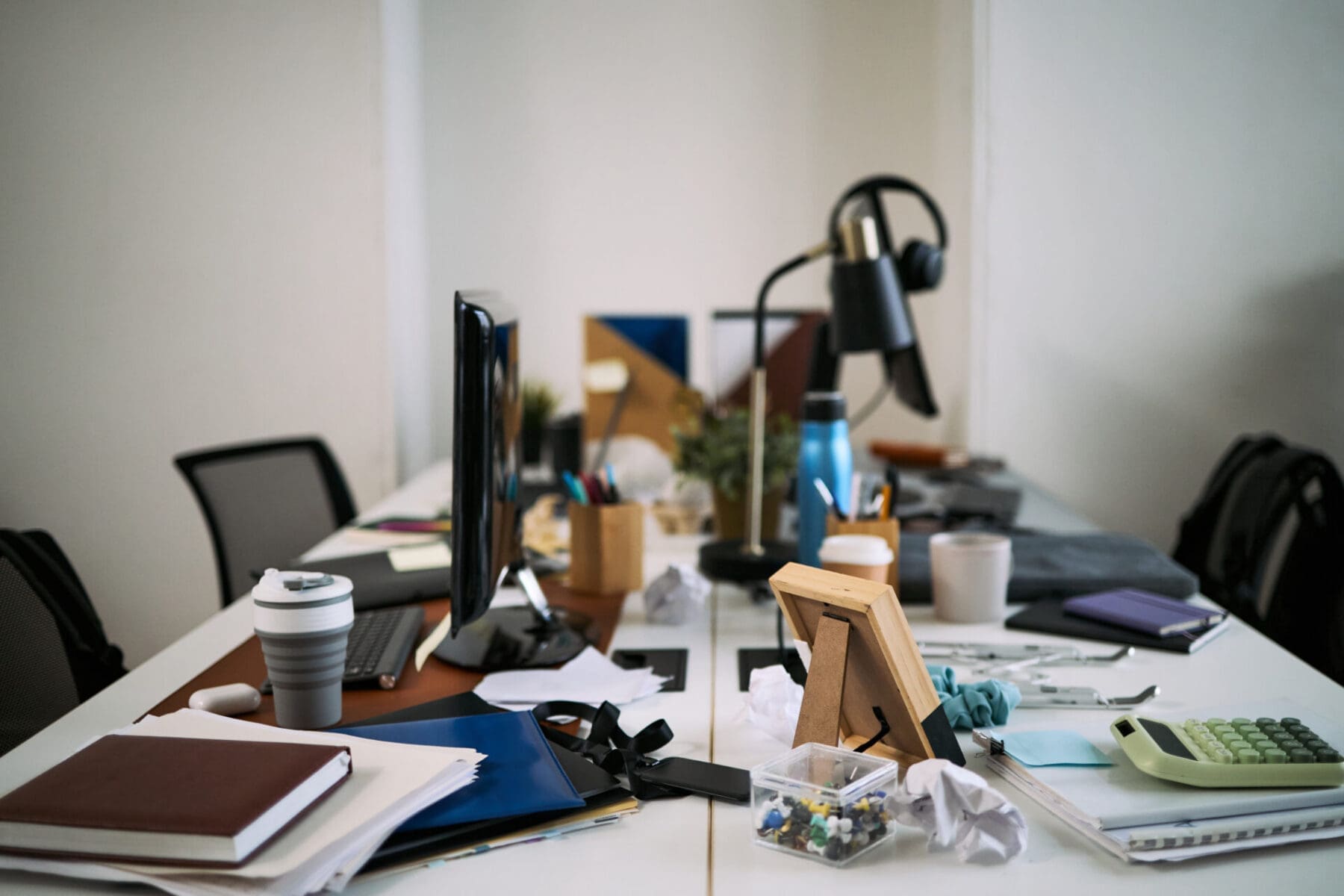
Messy office desk showing scattered documents, coffee cup, computer monitor, calculator, stationery, tangled cables, and personal items awaiting cleaning and organization
Dust returns almost immediately
This often signals incomplete filtration or improper dusting methods.
Break rooms feel greasy or sticky
Food residue and oils build up quickly on shared surfaces.
Employees get sick in waves
Cross-contamination commonly spreads through shared touchpoints.
Restrooms smell clean briefly — then odors return
Odors often indicate bacterial buildup rather than surface appearance.
Fingerprints and smudges remain on glass and doors
High-touch sanitation may be inconsistent or rushed.
Why Verification Matters More Than Appearance
The commercial cleaning industry is shifting toward measurable cleanliness standards.
Businesses increasingly want proof that sanitation is actually happening.
That includes:
- ATP testing
- documented inspections
- quality-control checklists
- high-touch verification
- supervisor audits
This matters because visual inspections alone cannot measure contamination.
An office near the Colorado Convention Center may appear pristine during a walkthrough while still carrying elevated contamination on shared surfaces that employees interact with all day.
Verification closes that gap.
What Professional Office Cleaning Should Actually Include
Effective office cleaning today is less about “making things look nice” and more about reducing contamination consistently.
A professional program should include:
- daily high-touch disinfection
- microfiber separation systems
- HEPA-filtered vacuuming
- proper disinfectant dwell times
- restroom-specific tools
- documented inspections
- consistent touchpoint cleaning
The goal is not simply appearance.
The goal is a healthier and more verifiable workplace environment.
Frequently Asked Questions
What is ATP testing in office cleaning?
ATP testing measures organic contamination on surfaces using a handheld device. It helps determine whether surfaces are actually sanitized rather than only visually clean.
What office surfaces carry the most bacteria?
Break room appliances, shared electronics, door handles, elevator buttons, and faucet handles are commonly among the most contaminated office touchpoints.
Why do offices get dusty so quickly in Denver?
Denver’s dry climate and airborne particulates contribute to faster dust accumulation and static buildup indoors.
How often should high-touch surfaces be disinfected?
Most offices benefit from daily disinfection of shared touchpoints, especially in restrooms, kitchens, lobbies, and conference areas.
Improve Workplace Cleanliness With Professional Office Cleaning Services in Denver
A clean-looking office is not always a hygienic one.
JAN-PRO Cleaning & Disinfecting in Colorado helps businesses improve workplace cleanliness through measurable sanitation protocols, high-touch disinfection, and structured quality verification systems designed for modern office environments.
Businesses looking for professional office cleaning services in Denver can contact JAN-PRO at (720) 962-9060 or visit 1720 S Bellaire St Ste 600, Denver, CO to schedule a facility assessment and learn how science-based cleaning protocols can help create a cleaner, healthier workplace.
About the Author
Scott Hockensmith IV
 Scott Hockensmith IV, owner of JAN-PRO Franchise Development in Colorado, is an entrepreneur dedicated to helping individuals build successful commercial cleaning businesses. With more than 23 years of industry experience, he is passionate about people, growth, and creating opportunities for long-term success. His work focuses on empowering others and supporting sustainable business ownership.