After 22 years of servicing office buildings across Central Alabama, from multi-tenant towers in downtown Birmingham to single-story professional suites in Hoover, Pelham, and Trussville, we’ve picked up lessons you can’t learn from a training manual.
It’s the same experience that shapes our office cleaning services in Alabama today and helps us identify the issues that many cleaning programs overlook. Some of those lessons are about cleaning. Most are about buildings, people, and what actually goes wrong when an office cleaning program quietly stops working.
After thousands of service visits, certain patterns emerge regardless of a building’s size or industry. Here’s what stands out after all these years on the floor.
1. The Breakroom Is the Building’s Early Warning System

If we want to know how a cleaning program is really performing, we don’t start in the lobby. We start in the breakroom.
Breakrooms concentrate everything that makes office cleaning hard: food residue, shared appliances, high traffic, and surfaces nobody claims responsibility for. We’ve seen offices with immaculate reception areas and microwaves that hadn’t been wiped inside in months. The refrigerator door handle in a 50-person office gets touched more times a day than almost any surface in the building, and it’s routinely missing from cleaning scopes.
During one walkthrough of a professional office in Birmingham, employees complained about a persistent odor in the breakroom despite nightly cleaning. The issue wasn’t the trash—it was residue beneath the refrigerator and a neglected floor drain. Once those areas were cleaned and added to the regular maintenance schedule, the odor disappeared within days.
The lesson: when a cleaning program is priced to “hit the visible stuff,” the breakroom is where it shows first — usually as odors, then as pest activity. In Alabama, where warm weather keeps ants and roaches active most of the year, a neglected breakroom doesn’t stay a cosmetic issue for long.
2. Alabama Humidity Changes How Offices Have to Be Cleaned
This is the most location-specific lesson we’ve learned. Office cleaning specs written for a national template don’t account for what our climate does to a building.
High humidity means carpets and mopped floors dry slower, which means moisture lingers — and lingering moisture in low-airflow areas breeds musty odors. We’ve traced “mystery smells” in Birmingham offices to damp mop heads stored in closed janitor closets, to carpet in interior conference rooms that never fully dried after extraction, and to condensation around poorly insulated HVAC vents that kept a ceiling tile perpetually damp.
The fix is rarely more cleaning. It’s smarter sequencing: cleaning floors at the right time of day, using proper extraction equipment instead of over-wetting carpet, and making sure closets and storage rooms get airflow. A cleaning partner who doesn’t think about drying time in Alabama is only doing half the job.
3. Red Clay Doesn’t Stop at the Front Door
We said it about schools, and it’s just as true for offices: Alabama red clay is relentless. Office parks with landscaped grounds, gravel overflow lots, or nearby construction feed a steady stream of clay into the building on every pair of shoes.
What we’ve learned is that the buildings that stay clean aren’t the ones that vacuum the hardest; they’re the ones with a real matting strategy. Enough walk-off matting to capture soil over several steps, matting that gets cleaned or rotated instead of saturating, and hard-surface transition zones before carpet begins. In buildings without that, we’ve watched entry carpet wear out years ahead of schedule, and no amount of spot cleaning brings clay staining back once it sets.
If your entry carpet has an orange cast within ten feet of the door, that’s not a cleaning problem. It’s a design problem a good cleaning partner should have flagged.
4. Restrooms Sink More Office Cleaning Contracts Than Anything Else
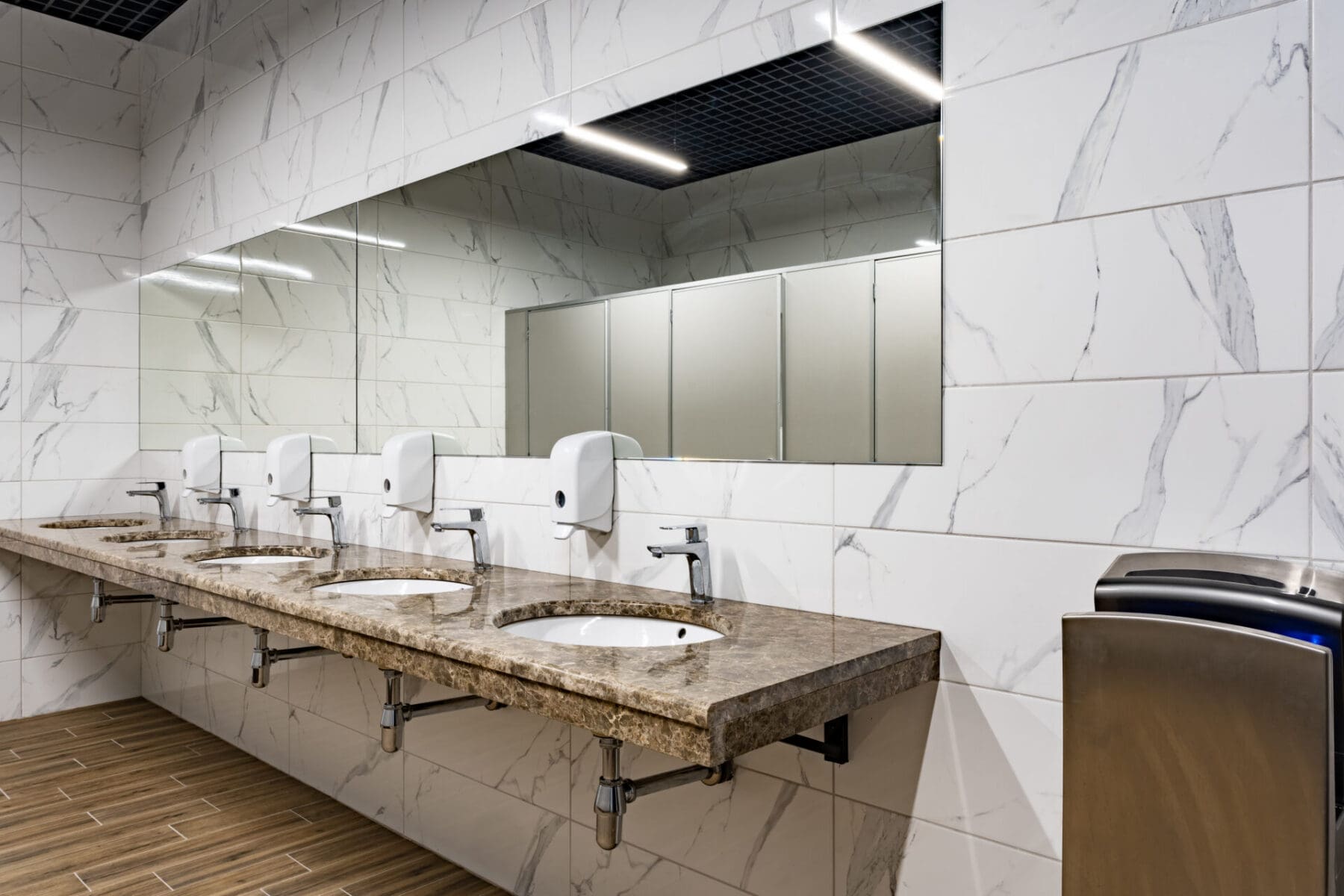
Across every office building we’ve serviced, restroom complaints are the number one reason companies start looking for a new cleaning provider. Not floors, not dusting; restrooms.
And here’s the pattern we’ve seen over and over: the failure is seldom effort; it’s consistency. The same three issues show up in nearly every building we take over:
- Odor treated with fragrance instead of finding the source: usually floor drains, grout, or the caulk line at fixture bases
- One skipped night undoing four good ones: tenants remember the bad visit, not the routine ones
- Consumables running out Friday afternoon: because nobody checks levels against actual usage patterns
5. After-Hours Cleaning Only Works with Real Accountability
Most office cleaning in Alabama happens after tenants leave, which means the people paying for the service rarely see it happen. We’ve learned that this is where trust in a cleaning program lives or dies.
Facility managers have told us stories about previous providers: crews that arrived late or not at all, scopes that shrank quietly over months, security doors left unlocked. None of that gets caught by walking the building at 9 a.m. — everything looks fine until it doesn’t.
What actually works is verification that the client can see:
- Documented inspections scored against the contract scope
- A communication channel that gets a same-day response
- A process for small requests: the conference room that needs attention before a client visit, the spill that can’t wait until tonight
6. Flu Season Is Won in October, Not January
Every winter, Alabama offices deal with waves of seasonal illness moving through open floor plans, shared desks, and conference rooms. What we’ve learned is that the offices that fare best are the ones that adjust their cleaning program before the season starts.
That means shifting from general cleaning to targeted disinfection of the surfaces illness actually travels on:
- Door handles and elevator buttons
- Shared keyboards and phones in hot-desk areas
- Conference room tables and chair arms
And doing it with correct disinfectant dwell times — not a quick spray-and-wipe. It also means having a plan for enhanced disinfection when an outbreak moves through a floor, so the response takes a phone call instead of a scramble.
7. The Cheapest Bid Is Usually the Most Expensive Contract
We’ve walked into a lot of buildings to assess a cleaning program that looked great on paper and failed in practice. Nearly every time, the story is the same: the contract was awarded on price, the price didn’t support the labor hours the building actually needed, and the scope eroded to fit the budget.
The math never lies. A building has a certain number of square feet, restroom fixtures, and trash points, and servicing them takes a certain number of labor hours. When a bid comes in dramatically under everyone else’s, those hours have to come from somewhere, and they come out of the work.
What years of servicing Alabama office buildings have taught us is to be honest about this with prospective clients, even when it costs us a bid. A fair price with a defined scope beats a low price with a shrinking one, every time.
Ready for a Cleaning Program Built for Your Building?
You now know what we look for, so put us to the test in your own building. Call JAN-PRO Cleaning & Disinfecting in Central Alabama at 205-767-7435, and we’ll walk your office with you, no cost and no obligation. If your current program is solid, we’ll tell you. If it’s not, you’ll leave with a written list of exactly what’s slipping.
We’re based right here at 234 Aquarius Dr Ste 106 in Birmingham, and we’d be glad to show you what our commercial cleaning programs in Birmingham or other cities in the metro area can do for your building.
Frequently Asked Questions
What should an office cleaning program in Alabama include?
An office cleaning program in Alabama should cover daily high-touch disinfection, restroom cleaning with a documented checklist, breakroom and appliance cleaning, floor care sequenced for humidity and drying time, and a walk-off matting strategy to control red clay tracking. It should also include scheduled quality inspections that the client can review.
Why do office restrooms still smell after cleaning?
Persistent restroom odors usually come from sources regular cleaning misses: floor drains, grout lines, and the caulk where fixtures meet the floor. Masking odors with fragrance doesn’t fix the problem — identifying and treating the source does.
How does Alabama’s humidity affect office cleaning?
High humidity slows drying on carpets and mopped floors, which allows moisture to linger and cause musty odors in low-airflow areas. Cleaning in Alabama requires proper extraction equipment, smart timing, and ventilation for storage areas — not just more frequent cleaning.
How do you keep red clay from staining office carpet?
The most effective control is walk-off matting long enough to capture soil over several footsteps, cleaned or rotated regularly, with hard-surface transition zones before carpet begins. Once red clay staining sets into the entry carpet, spot cleaning rarely reverses it.
How often should high-touch surfaces in an office be disinfected?
High-touch surfaces — door handles, elevator buttons, shared keyboards, conference tables — should be disinfected daily, and more frequently during flu season or an active outbreak. Disinfectants must stay wet on the surface for their full dwell time to work.
Why do the cheapest office cleaning bids often fail?
A building requires a fixed number of labor hours to be serviced properly. When a bid is priced far below competitors’, those hours get cut from the actual work, and the scope quietly shrinks over time. A fair price with a defined, inspected scope costs less over the life of the contract.
Does JAN-PRO of Central Alabama offer free office cleaning assessments?
Yes. JAN-PRO of Central Alabama offers free, no-obligation walkthroughs for office buildings in Birmingham and across Central Alabama. Call 205-767-7435 to schedule one.
About the Author
Carter James
 Carter James is Vice President of Strategy & Development, leading growth strategy, acquisitions, and multi-market expansion within a facility services platform. His background includes corporate strategy, M&A integration, and franchise development. He partners with senior leadership to drive disciplined execution, scalable operations, and long-term value through data-driven, high-accountability leadership.