Most office managers in Central Alabama would describe their workspace as clean. The floors get vacuumed. The trash gets emptied. The bathrooms get serviced. From a visual standpoint, everything looks fine.
The problem is that office contamination is almost entirely invisible — and the surfaces that look the cleanest are often the ones carrying the highest bacterial loads. Before you assume your office is in good shape, take five minutes to run through this practical cleanliness assessment. The results may change how you think about your current cleaning program.
The Science First: Why Office Surfaces Are Dirtier Than You Think
The gap between how an office looks and how clean it actually is can be significant. Research by Dr. Charles Gerba of the University of Arizona — one of the most frequently cited microbiologists in workplace hygiene research — found that the average office desk harbors 400 times more bacteria than the average toilet seat, with as many as 10 million bacteria present on a typical desktop surface.
That figure surprises most people, and it should. We intuitively treat bathrooms as the germiest part of any building and offices as relatively safe. The research says the opposite. Telephones ranked as the highest-concentration surface in Gerba’s study, followed by desks, water fountain handles, microwave door handles, and computer keyboards. Toilet seats, by contrast, consistently showed the lowest bacteria levels of any surface tested.
Why does this happen? Gerba’s research found that unless desks were wiped down with a disinfectant during the day, bacteria levels climbed continuously, peaking after lunch — driven by food residue, hand contact, and the simple fact that most desk surfaces are never specifically targeted for disinfection.
The business consequences are measurable. The CDC estimates that workplace illness — largely transmitted via contaminated high-touch surfaces — costs U.S. employers approximately $225.8 billion annually in productivity losses, equivalent to $1,685 per employee.
And a study published in the American Journal of Infection Control found that workplaces with routine cleaning and sanitizing protocols saw a 30% reduction in sick days taken by employees.
For a business in Birmingham, Montgomery, Tuscaloosa, or Huntsville — with teams ranging from 10 to 200 people — those numbers translate directly into payroll costs, project delays, and staff morale.
The Office Cleanliness Self-Assessment
Work through each section honestly. For each item, note whether it describes your current situation.
Section 1: Desk and Workstation Surfaces
- Desk surfaces are wiped down with a disinfectant (not just a dry cloth) at least once per week
- Keyboards are cleaned with an appropriate disinfectant regularly, not just dusted
- Computer mice and touchscreens are included in the cleaning routine
- Desk phones — including the handset, dial pad, and cradle — are disinfected at each cleaning visit
- Personal items on desks (monitors, lamps, pen holders) are included in the wipe-down, not worked around
What the research says: Office phones can carry around 25,000 germs per square inch. The area on a desk where hands typically rest contains around 10,000 bacteria per square inch. If your cleaning protocol doesn’t specifically target phones and keyboards — not just the open desktop — those surfaces are being skipped entirely.
Section 2: High-Touch Common Areas
- Door handles throughout the office are disinfected at every cleaning visit, including internal doors
- Light switches and elevator buttons are included in the high-touch surface protocol
- The microwave handle, refrigerator handle, and coffee machine buttons in the break room are disinfected regularly
- Water fountain spouts and handles are cleaned at each visit
- Shared printers, copiers, and scanners — specifically the touchpad panels — are included in the cleaning routine
What the research says: In a study where harmless bacteria were placed on commonly touched surfaces, up to 60% of the office was contaminated with it in as little as two hours. High-touch transition points — door handles, appliance controls, shared equipment — are the fastest vectors for cross-contamination between employees. If these aren’t being specifically targeted, regular cleaning is only addressing the visible surface layer.
Section 3: Break Room and Kitchen
- Break room countertops are disinfected (not just wiped) after each day
- The sink area, faucet, and drain surrounds are cleaned and sanitized regularly
- Shared dishes, mugs, and utensils are washed with hot water and detergent, not just rinsed
- The interior of the microwave is cleaned weekly
- Trash receptacles are emptied, and the bin itself is cleaned to prevent bacterial buildup at the base
What the research says: Research has shown that up to 90% of mugs in office kitchens are coated in germs, and that 20% carry fecal matter — introduced through inadequate hand washing before handling shared items. The break room is one of the highest-risk zones in any office, not because it looks dirty, but because food residue and shared surfaces create ideal conditions for bacterial growth.
Section 4: Restrooms
- Restrooms are cleaned and disinfected daily, not on a weekly or as-needed basis
- Toilet handles, faucet handles, and door handles inside the restroom receive specific attention — not just a general wipe
- Soap dispensers are refilled proactively, not reactively when empty
- Paper towel and toilet paper stock is checked daily
- The floor around toilet bases and under sink units is cleaned at each visit, not just the open floor area
Note: Paradoxically, restrooms in professionally maintained offices often have better cleaning frequency than desk areas — because cleaning staff naturally prioritize them. The risk is assuming that restroom cleaning constitutes an adequate overall cleaning program. As the research above shows, your employees’ desks likely carry more bacteria than the toilets they’re worried about.
Section 5: Floors and Air Quality
- Carpeted areas are vacuumed at minimum twice per week in high-traffic zones
- Hard floors are mopped with a disinfecting solution, not just dry swept
- Entryway matting is cleaned regularly — this is where outdoor contaminants enter the building
- HVAC vents and air returns are dusted during cleaning visits
- There are no visible signs of mold or mildew near windows, vents, or in storage areas
Why this matters in Alabama: Central Alabama’s climate — hot, humid summers and mild but damp winters — creates conditions that accelerate mold and mildew growth in office environments more rapidly than in drier climates. Birmingham, Montgomery, and Tuscaloosa offices that don’t include vent cleaning and moisture-prone area attention in their regular cleaning protocol are at higher risk of air quality degradation that affects employee health over time.
Section 6: Cleaning Frequency and Accountability
- Your office is cleaned by a professional commercial cleaning service (not by employees as an additional duty)
- Cleaning happens on a documented, consistent schedule — not on-call or when it “looks like it needs it.”
- Your cleaning provider uses EPA-registered disinfectants with verified kill claims, not general-purpose all-purpose cleaners
- You have received a service verification record or cleaning log from your provider in the last 30 days
- Your cleaning provider specifically addresses high-touch points as a separate task from general surface cleaning
Scoring Your Results
Count the number of items you checked:
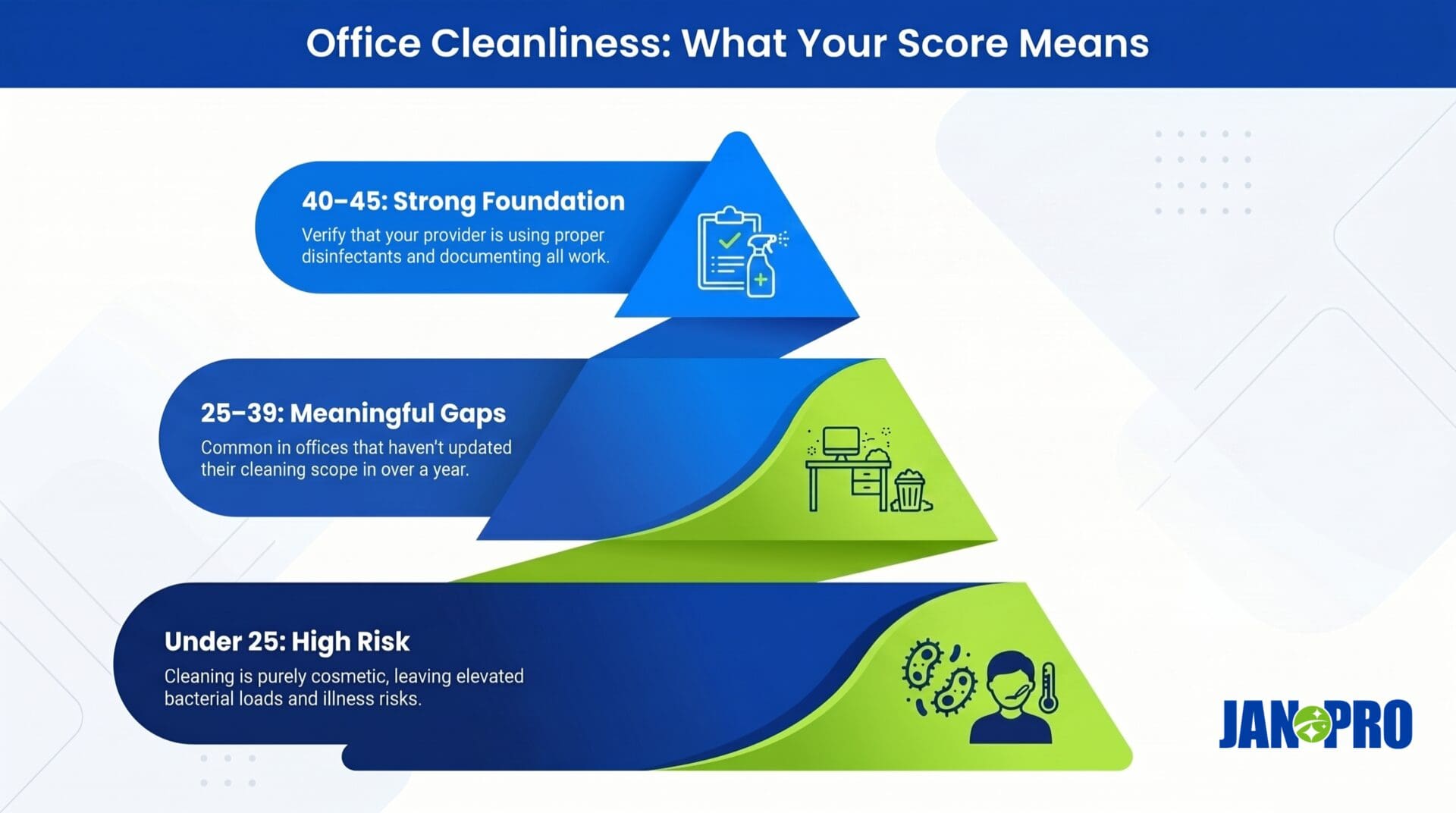
- 40–45 checked: Your office has a strong cleaning foundation. The main question is whether your provider is documenting their work and using the right disinfectants — not just cleaning what’s visible.
- 25–39 checked: There are meaningful gaps in your current program. Specific surface categories are likely being skipped or addressed less frequently than they should be. This is the most common situation for offices that have cleaning service but haven’t revisited the scope in over a year.
- Fewer than 25 checked: Your current cleaning program is primarily cosmetic — it addresses appearance but not contamination. The bacterial load in your office is likely significantly above what a professional disinfection program would maintain, and the risk of illness transmission between employees is elevated.
What “Professional Office Cleaning” Actually Means — and What It Doesn’t
One of the most common sources of confusion for office managers in Central Alabama is the difference between a cleaning service that maintains appearance and one that manages contamination. Both can be described as “office cleaning.” They are not the same thing.
A maintenance-level cleaning program vacuums floors, empties bins, and wipes visible surfaces. It makes the office look clean. It does not systematically target the bacterial hotspots identified in the research above — phones, keyboards, door handles, appliance controls — and it typically does not use EPA-registered disinfectants with verified pathogen kill claims.
A professional commercial cleaning program built around contamination control does all of the above, plus:
- Uses disinfectants registered with the EPA for specific pathogen kill claims (not general-purpose cleaners)
- Follows a documented high-touch surface protocol that treats phones, keyboards, and shared equipment as priority targets
- Provides service verification so you have a record of what was cleaned, when, and with what products
- Adjusts frequency and scope based on your facility’s traffic patterns and risk profile
- Addresses surfaces in sequence to prevent cross-contamination during the cleaning process itself
The distinction matters especially for office environments in Central Alabama’s healthcare-adjacent economy. Birmingham is home to UAB — one of the nation’s leading academic medical centers — along with St. Vincent’s Health System, Children’s of Alabama, and a significant cluster of medical offices, dental practices, and specialist clinics throughout Jefferson and Shelby counties.
Employees in these environments, and in the professional services, financial, and legal offices that serve them, have a higher-than-average awareness of hygiene standards — and a higher expectation of the facilities they work in.
Serving Central Alabama’s Office Market
JAN-PRO of Central Alabama provides office cleaning services in Central Alabama to businesses of all sizes across the region, including:
- Birmingham and Jefferson County — Hoover, Vestavia Hills, Mountain Brook, Homewood, and Irondale
- Shelby County — Pelham, Helena, Chelsea, and Alabaster
- Montgomery — the Capitol Hill corridor, EastChase, and Prattville
- Tuscaloosa — the University Boulevard corridor and Northport
- Anniston and the Calhoun County area
- Gadsden and Etowah County
Our cleaning programs are built around documented protocols, EPA-registered disinfectants, and service verification — not appearance-based cleaning that leaves bacterial hotspots untreated.
Schedule a Free Office Assessment
If the self-assessment above identified gaps in your current cleaning program — or if you’re not confident in the answers — JAN-PRO Cleaning & Disinfecting in Central Alabama offers a free facility assessment with no obligation. We’ll walk your space, identify your highest-risk surfaces, and provide a clear, itemized proposal for what a professional cleaning program looks like for your specific office.
Call us today at 205-767-7435 to schedule your free assessment and find out exactly how clean your office actually is.
About the Author
Carter James
 Carter James is Vice President of Strategy & Development, leading growth strategy, acquisitions, and multi-market expansion within a facility services platform. His background includes corporate strategy, M&A integration, and franchise development. He partners with senior leadership to drive disciplined execution, scalable operations, and long-term value through data-driven, high-accountability leadership.