At first glance, a medical office may look similar to a traditional office building. Both have reception areas, restrooms, break rooms, and daily foot traffic, but the cleaning requirements are fundamentally different.
Medical office cleaning services in Marietta go beyond appearance. They require infection prevention protocols, documented procedures, specialized disinfectants, and trained staff because cleaning directly supports patient safety.
At JAN-PRO Cleaning & Disinfecting in Atlanta, the team has worked with medical practices throughout Marietta and the surrounding communities for years. During healthcare facility assessments, they’ve found that many offices serviced by general commercial cleaners looked clean but were missing critical infection-control practices behind the scenes.
One dermatology clinic in Marietta learned this firsthand after hiring a traditional office cleaning company. During the initial walkthrough, our team found microfiber cloths being reused between exam rooms, disinfectants being wiped away before the required dwell time, and no documentation showing what had been cleaned or when. Although the practice appeared spotless, its cleaning program left significant compliance and infection-control gaps.
In healthcare, appearances are only part of the equation. Effective cleaning in Marietta is measured by documented processes, regulatory compliance, and reducing opportunities for cross-contamination—not simply by whether floors shine or trash bins are empty.
Medical Office Cleaning vs. Standard Office Cleaning
Medical offices typically require cleaning programs that include:
- Healthcare-specific infection prevention protocols
- EPA-registered hospital-grade disinfectants
- Staff trained in bloodborne pathogen awareness and cross-contamination prevention
- Documented cleaning logs for inspections
- Cleaning sequences designed around patient-care areas
- Procedures aligned with OSHA, CDC, and state healthcare guidance
These standards go well beyond what most traditional office cleaning companies provide.
Regulatory Compliance Demands in Healthcare Environments
Unlike standard office buildings, medical offices operate within a regulatory environment where environmental cleaning supports patient safety and compliance.
Healthcare facilities must comply with OSHA bloodborne pathogen standards, CDC infection prevention guidance, EPA disinfectant requirements, and applicable state regulations. During inspections, cleaning logs, staff training records, and chemical usage may all be reviewed.
One East Cobb family practice learned how important documentation can be when an unannounced inspection revealed records that couldn’t be produced quickly, even though cleaning had been performed consistently.
During healthcare facility assessments, we often find practices where cleaning is being completed properly, but documentation systems haven’t kept pace. In healthcare, undocumented procedures may be treated as incomplete procedures.
Regulatory elements healthcare facilities commonly address
- OSHA Bloodborne Pathogen training
- CDC environmental infection prevention guidance
- EPA-registered hospital-grade disinfectants
- Cleaning documentation and inspection logs
- HIPAA awareness when working around patient information
- Ongoing employee training
These responsibilities extend well beyond those of a traditional office cleaning program.
Early in JAN-PRO Atlanta’s healthcare work, one client’s insurance review exposed the differences between standard commercial cleaning requirements and healthcare operations. That experience helped shape the company’s healthcare-specific documentation and risk management processes still used today.
Infection Control Requires a Completely Different Cleaning Process
Unlike traditional office cleaning, healthcare cleaning is designed to reduce cross-contamination. Every decision—from cleaning sequence to microfiber use—is intended to limit the movement of contaminants between patient-care areas.
During first-time walkthroughs, our healthcare teams frequently find every room being cleaned the same way. In reality, waiting rooms, exam rooms, laboratories, treatment rooms, and administrative offices each require different procedures based on patient risk.
Another common issue is disinfectant contact time. Many cleaners spray and immediately wipe surfaces, even though the product must remain wet for the manufacturer’s recommended dwell time to achieve its disinfecting claims. This is one of the first procedures JAN-PRO reviews when transitioning a new healthcare account.
| Cleaning Area | Typical Office Building | Medical Office |
| Surface Disinfection | General appearance cleaning | Timed disinfectant contact |
| Cleaning Sequence | Room-to-room convenience | Clean-to-dirty workflow |
| Microfiber Usage | Reused across workspaces | Color-coded by patient-care zone |
| High-Touch Surfaces | Daily cleaning | Disinfected according to patient activity |
| Waste Handling | General trash | Regulated waste procedures |
| Documentation | Minimal | Cleaning logs for inspections |
Common issues discovered during healthcare facility assessments
Although every practice is different, JAN-PRO frequently identifies:
- Disinfectants removed before the required contact time
- Microfiber cloths reused between exam rooms
- High-touch equipment controls being overlooked
- Cleaning completed but not documented
- Unlabeled secondary spray bottles
- Supply carts moving between patient-care and office areas
Many of these issues are straightforward to correct, but they demonstrate why healthcare cleaning requires specialized procedures rather than simply spending more time cleaning.
Specialized Training Requirements for Medical Facility Cleaning Teams
One of the biggest misconceptions about medical office cleaning is that experienced commercial cleaners can simply switch to healthcare by using a different disinfectant. In practice, healthcare environments require additional training because technicians must understand infection prevention, patient-care workflows, and regulatory expectations.
During training, technicians learn that exam rooms, laboratories, reception areas, and staff offices each require different cleaning procedures. Recognizing those differences is just as important as selecting the right disinfectant.
Healthcare cleaning teams typically receive training in:
- Bloodborne pathogen awareness
- Healthcare surface disinfection
- Proper PPE use
- Spill response procedures
- Waste segregation
- Cross-contamination prevention
- Documentation protocols
The goal isn’t simply to meet training requirements—it’s to build consistent habits that protect patients, staff, and healthcare providers every day.
Practice managers often tell us that one of the biggest improvements after switching to a healthcare-focused cleaning provider is consistency. Standardized procedures help ensure every patient-care area receives the same level of attention, regardless of which technician performs the work.
Chemical Products and Application Methods Are More Specialized Than Many Practices Realize
Selecting the right disinfectant is only part of effective healthcare cleaning. Proper dilution, application, and contact time are equally important.
During facility assessments, we occasionally find medical offices using products that aren’t appropriate for healthcare pathogens or are being diluted incorrectly. In other cases, the right product is used but wiped away before the required dwell time.
A surface may look clean while still failing to meet the disinfectant’s required contact time.
Healthcare facilities often require EPA-registered hospital-grade disinfectants effective against pathogens relevant to patient-care settings, such as MRSA, norovirus, Clostridioides difficile (C. diff), or Mycobacterium tuberculosis.
Products must also be compatible with medical equipment, upholstery, flooring, and other sensitive surfaces. During provider transitions, we have occasionally found harsh chemicals causing unnecessary wear without improving cleaning results.
Important considerations include:
- EPA registration
- Required contact time
- Compatibility with medical equipment
- Proper dilution
- Low-odor options for sensitive patients
- Safe application methods
Another lesson learned through years of servicing healthcare facilities is that visible cleanliness doesn’t always reflect effective disinfection. A room can look spotless while still falling short of infection prevention expectations if disinfectants aren’t used according to their label instructions.
Risk Management and Liability Extend Beyond Cleanliness
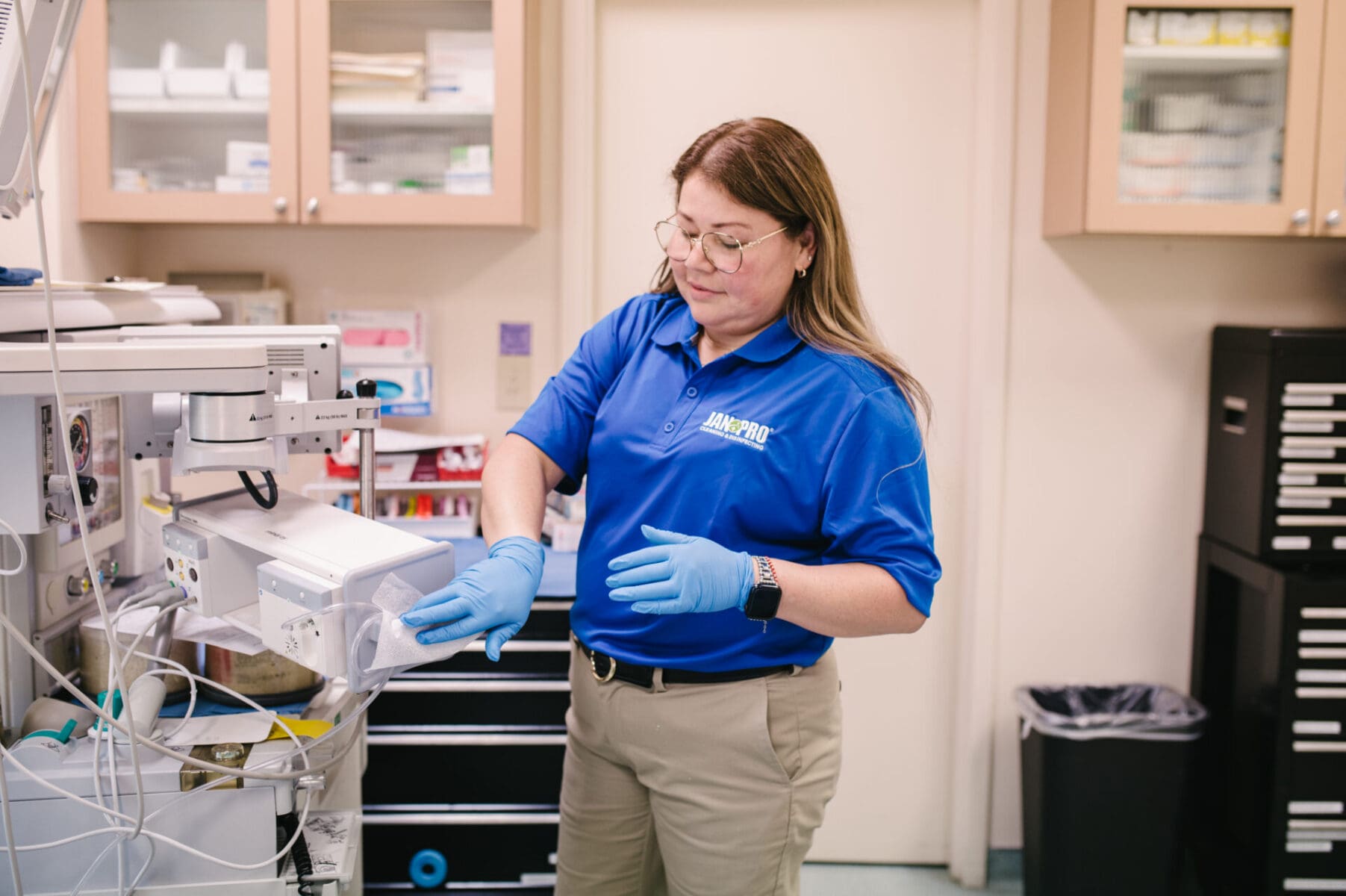
In a traditional office, cleaning issues often affect appearance. In a medical office, they can affect inspections, compliance, and patient confidence.
Because environmental cleaning supports infection prevention, documentation, staff training, and established procedures may all be reviewed during compliance investigations.
Through years of working with healthcare practices, we have seen administrators increasingly evaluate cleaning providers based on healthcare experience, documentation, and quality assurance—not price alone.
Choosing a healthcare cleaning provider is ultimately a risk-management decision as much as a facility maintenance decision.
Why Marietta Medical Practices Choose Specialized Healthcare Cleaning
From medical offices along Roswell Road to specialty practices in East Cobb, healthcare facilities throughout Marietta face cleaning challenges that standard office buildings simply don’t.
Many practices contact us after discovering gaps in their previous cleaning program. While many businesses work with a commercial cleaning company in Atlanta for general janitorial needs, medical offices require additional infection prevention protocols, regulatory documentation, and patient-care workflows.
A healthcare-specific cleaning program helps practices support regulatory readiness, protect patients and staff, and maintain a professional environment that builds confidence from the moment someone walks through the door.
Frequently Asked Questions
Why do inspectors ask to review cleaning logs?
Cleaning logs help verify that required tasks were completed consistently and according to established procedures. During healthcare inspections, documentation is often reviewed alongside the physical condition of the facility. Practices with organized records are typically better prepared to demonstrate compliance.
Why can’t disinfectants be sprayed and wiped immediately?
Every disinfectant has a manufacturer-specified contact time that allows it to effectively disinfect surfaces. During healthcare facility assessments, one of the most common issues we identify is disinfectant being wiped away too soon, reducing its effectiveness even though the surface appears clean.
Can any commercial cleaning company clean a medical office?
Not necessarily. Medical offices require infection prevention procedures, healthcare-specific training, proper documentation, and EPA-registered disinfectants. Many general office cleaning companies are not equipped to meet those additional requirements.
What should I look for when choosing a medical office cleaning company?
Look beyond price. Ask about healthcare cleaning experience, OSHA training, documented quality assurance, infection prevention procedures, liability coverage, and whether the company can provide cleaning documentation for inspections.
Is medical office cleaning regulated differently than standard office cleaning?
Yes. Medical facilities must consider healthcare-specific requirements such as OSHA bloodborne pathogen standards, CDC infection prevention guidance, EPA-registered disinfectants, and documented cleaning procedures. While exact requirements vary by facility type, healthcare environments typically require significantly more oversight than traditional office buildings.
Partner With Medical Cleaning Specialists Who Understand the Difference
Medical offices require more than a clean appearance—they require cleaning programs built around patient safety, consistency, and compliance.
For years, JAN-PRO Cleaning & Disinfecting in Atlanta has helped Marietta healthcare practices implement cleaning protocols tailored to their facilities, staff, and patient care environments. Every program begins with a facility assessment to identify operational needs and develop a customized cleaning plan.
Contact us today at 770-955-9822 to schedule a complimentary assessment and learn how a healthcare-focused cleaning program can help support your practice.
About the Author
Carter James
 Carter James is Vice President of Strategy & Development, leading growth strategy, acquisitions, and multi-market expansion within a facility services platform. His background includes corporate strategy, M&A integration, and franchise development. He partners with senior leadership to drive disciplined execution, scalable operations, and long-term value through data-driven, high-accountability leadership.