
Every facility manager and business owner in Tucson eventually faces the same question: is routine cleaning enough, or does my facility need something more? The answer affects your budget, your staff’s health, your compliance standing, and — in ways that aren’t always visible — the long-term condition of your building.
The difference between deep cleaning and regular cleaning isn’t just about frequency or effort. They serve fundamentally different purposes, target different types of contamination, and are appropriate at different points in a facility’s maintenance cycle. Understanding which one your business needs right now can save you money, prevent compliance issues, and extend the life of your floors, fixtures, and surfaces.
What Regular Commercial Cleaning Actually Covers
Regular commercial cleaning, also called routine or maintenance cleaning, is the recurring service that keeps a facility functional and presentable between deeper interventions. Depending on your facility type and foot traffic, this happens daily, several times per week, or weekly.
A properly executed routine cleaning program for a Tucson commercial facility typically includes:
- Emptying and relining trash receptacles
- Vacuuming carpeted areas and sweeping hard floors
- Damp mopping hard floor surfaces
- Wiping and disinfecting high-touch surfaces — door handles, light switches, elevator buttons, shared equipment controls
- Cleaning and sanitizing restrooms, including fixtures, mirrors, and floors
- Restocking consumables (paper towels, soap, toilet paper)
- Spot-cleaning glass partitions, entry doors, and reception surfaces
- Removing visible debris from common areas
What routine cleaning is not designed to do is address contamination that has accumulated below the surface layer — in grout lines, under furniture, inside floor finish layers, behind fixtures, or in HVAC vents. It maintains a clean facility. It does not restore one.
In Tucson’s climate specifically, routine cleaning needs to account for caliche dust infiltration and the particulate surge that follows monsoon and haboob events between June and September. A provider that doesn’t adjust mop frequency, vacuum filter maintenance, and entry point attention during these periods is delivering a degraded version of routine cleaning regardless of how it’s billed.
What Deep Cleaning Actually Covers
Deep cleaning is a comprehensive, top-to-bottom intervention that targets the contamination routine cleaning cannot reach. It is not simply “more cleaning” — it involves different techniques, different equipment, different dwell times for disinfectants, and significantly more labor hours per square foot.
A professional commercial deep cleaning for a Tucson facility includes everything in routine cleaning plus:
- Floor restoration: Stripping accumulated wax and finish layers from VCT, tile, and vinyl floors, followed by reapplication of fresh finish coats. This cannot be achieved with a mop.
- Grout deep cleaning: Machine scrubbing or steam treatment of grout lines that have absorbed soil, bacteria, and mineral deposits — common in Tucson facilities due to hard water and caliche tracking.
- High and low dusting: Cleaning ceiling vents, light fixtures, ceiling tiles, wall vents, and baseboards that are outside the scope of routine visits.
- Deep restroom sanitation: Descaling fixtures, cleaning behind and beneath toilets and urinals, treating grout and caulk lines, and disinfecting surfaces with appropriate dwell times.
- Furniture and upholstery cleaning: Removing embedded soil and allergens from office chairs, waiting room seating, and soft surfaces.
- Interior window and partition cleaning: Full surface cleaning of glass walls, window sills, and blinds.
- Kitchen and break room deep sanitation: Cleaning inside appliances, behind equipment, under counters, and addressing grease and food residue buildup.
- Disinfection of secondary-touch surfaces: Light fixture pulls, cabinet handles, chair legs, desk undersides — surfaces that accumulate pathogens but rarely appear on routine checklists.
For facilities in Tucson’s healthcare corridor, near Banner – University Medical Center, St. Mary’s Hospital, or Carondelet St. Joseph’s Hospital — deep cleaning also involves terminal cleaning protocols: full room disinfection using EPA-registered products applied with electrostatic systems like EnviroShield, with documented dwell times and surface coverage verification.
The Core Difference: Maintenance vs. Restoration
The clearest way to understand the difference between deep cleaning and regular cleaning is through this distinction:
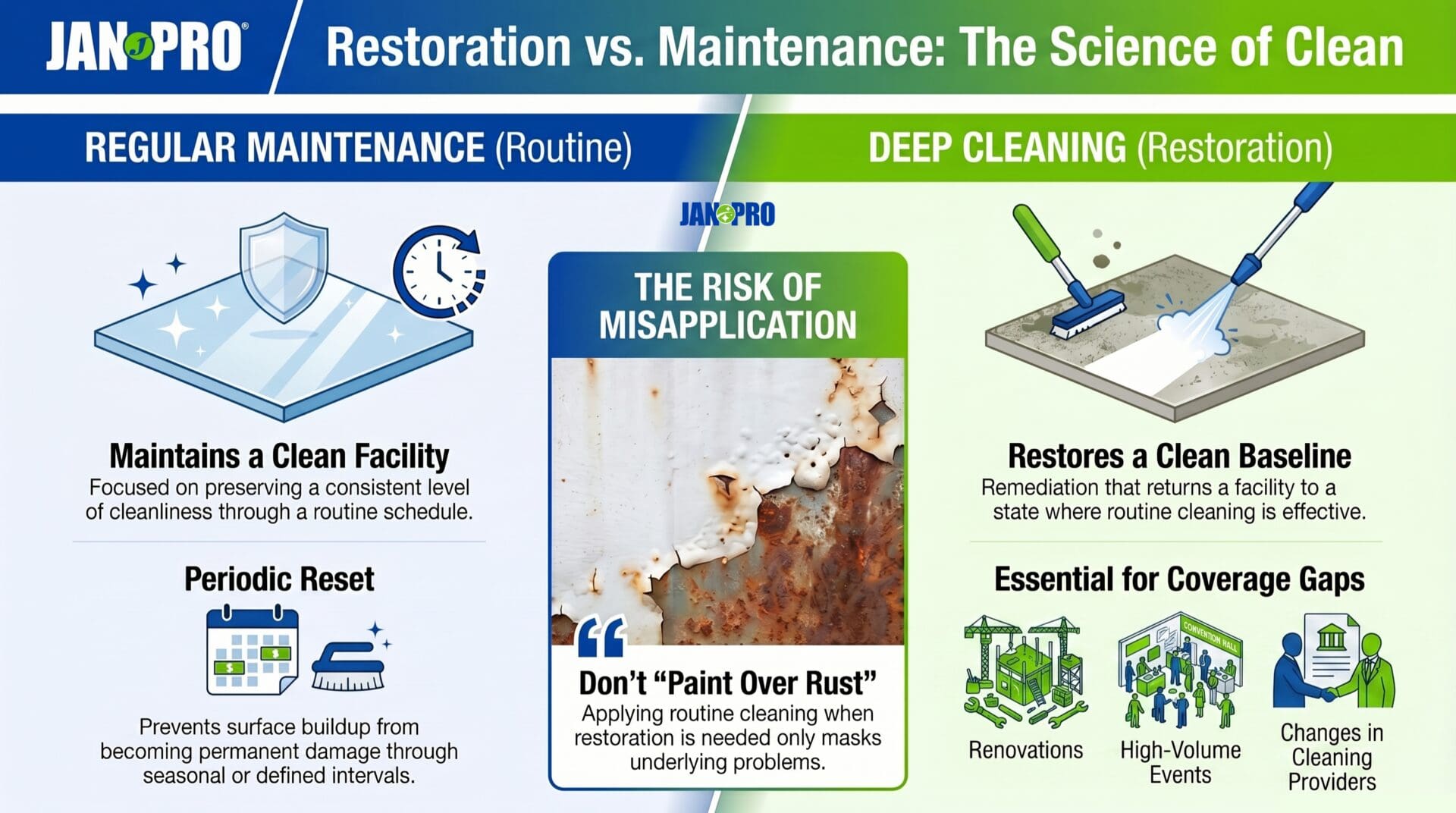
Regular cleaning maintains a clean facility. Deep cleaning restores a facility to a clean baseline.
If your building has been on a consistent routine cleaning program with no lapses, deep cleaning is periodic maintenance, something done seasonally or at defined intervals to reset surfaces before buildup becomes damage.
If your building has had inconsistent cleaning, a coverage gap, a change in providers, a renovation, a high-volume event, or a health incident, deep cleaning is remediation — restoring the facility to a state where routine cleaning can be effective again.
A routine cleaning program applied to a facility that actually needs deep cleaning is like painting over rust. The surface looks better temporarily, but the underlying problem continues to develop.
How to Know Which One Your Tucson Facility Needs Right Now
Use this as a practical diagnostic:
Your facility likely needs deep cleaning if:
- You’ve recently changed cleaning providers and don’t know what the previous program actually covered
- Your floor finish appears dull, yellowed, or uneven despite regular mopping
- Grout lines in restrooms or common areas have visibly darkened
- There is a persistent odor in restrooms, break rooms, or HVAC-serviced areas that doesn’t clear after routine cleaning
- You’ve had a construction or renovation project — post-construction particulate requires a full deep clean before routine maintenance resumes
- You’re entering or exiting Tucson’s monsoon season (June–September), when accumulated particulate from haboob events infiltrates surfaces and vents
- You’ve had a confirmed illness outbreak or elevated sick day rates among staff
- You’re onboarding a new cleaning provider and want a verified starting baseline
- Your facility hasn’t had a documented deep clean in more than six months
Your facility likely needs routine cleaning optimization if:
- Deep cleaning was performed recently and surfaces are in good condition
- The issue is coverage gaps or inconsistency in your current routine program — wrong frequency, missed zones, or undertrained staff
- You’re managing a low-traffic facility where surface buildup is minimal
For most Tucson commercial facilities operating without a documented deep cleaning history, the honest answer is: you need both — a deep clean to establish a proper baseline, followed by a calibrated routine program to maintain it.
Industry-Specific Guidance for Tucson Businesses
Medical and dental offices
Deep cleaning should occur at minimum quarterly, with routine cleaning daily. Facilities near UA Health Sciences or the Rincon Health campus face stricter infection control expectations — deep cleaning frequency should align with your facility’s infection control plan, not a generic schedule.
Corporate offices and professional services
Deep cleaning twice per year is appropriate for standard office environments. High-density open-plan offices along Oracle Road or in the Williams Centre should schedule deep cleans around major seasonal transitions — before monsoon season and after it ends.
Retail and hospitality
Deep cleaning quarterly at minimum, with additional sessions after high-traffic periods. Tucson’s winter tourism season (November through March) and gem show period in February generate significant foot traffic spikes that accelerate surface wear.
Industrial and warehouse facilities
Deep cleaning frequency depends on the nature of operations. Facilities in the Tucson Airport Authority industrial corridor or along Aerospace Parkway handling manufacturing, chemicals, or food products should align deep cleaning schedules with their OSHA compliance calendar.
Fitness centers
Deep cleaning monthly for high-contact surfaces and locker room facilities. Tucson’s heat means equipment surfaces and locker rooms accumulate bacteria faster than facilities in temperate climates — monthly deep cleaning is a baseline, not a luxury.
Educational institutions

Deep cleaning at each major academic break — winter, spring, and summer. Pima Community College and University of Arizona-adjacent facilities also benefit from a targeted deep clean at the start of each semester when occupancy resets.
What to Ask Your Cleaning Provider About Deep Cleaning
Before scheduling a deep clean, these questions separate professional providers from those offering a relabeled routine visit at a higher price:
- What specific tasks are included that are not in our routine program? The answer should be a detailed, written scope — not “we do everything more thoroughly.”
- What equipment will be used for floor restoration? Strip and recoat requires a floor machine, wet vacuum, and finish applicator. If they’re describing a mop, it’s not a deep clean.
- What disinfectants will be used and what are the dwell times? Professional deep cleaning uses EPA-registered disinfectants applied with adequate contact time — typically 3–10 minutes depending on the product and pathogen target.
- How long will the deep clean take for my facility size? A genuine deep clean of a 5,000 sq ft office takes 6–10 hours. A quote of 2 hours for the same space is not a deep clean.
- Will you provide documentation of what was completed? A professional provider delivers a completion report. This matters for regulated facilities and for establishing your new baseline.
JAN-PRO Cleaning & Disinfecting in Tucson: Both Programs, One Provider
JAN-PRO Cleaning & Disinfecting serves Tucson businesses through certified franchise owners trained in both routine maintenance programs and comprehensive deep cleaning protocols.
Every deep cleaning engagement uses the JP Signature Clean system — documented zone-by-zone coverage, EPA-registered disinfectants with verified dwell times, HEPA-filtered equipment, and the EnviroShield electrostatic disinfection system for facilities requiring pathogen-level surface treatment.
Whether your facility needs a one-time deep clean to establish a proper baseline, a seasonal reset before or after Tucson’s monsoon season, or a fully integrated program combining both services on a defined schedule — the program is built around your facility’s actual condition and requirements.
Request a free estimate for janitorial services in Tucson today. Call us at (520) 885-9600 or visit our office at 4221 S Santa Rita Ave, Suite 101, Tucson, AZ.
About the Author
Carter James
 Carter James is Vice President of Strategy & Development, leading growth strategy, acquisitions, and multi-market expansion within a facility services platform. His background includes corporate strategy, M&A integration, and franchise development. He partners with senior leadership to drive disciplined execution, scalable operations, and long-term value through data-driven, high-accountability leadership.