

The Sonoran Desert environment presents a unique set of challenges for the maintenance of commercial flooring. In Tucson, the primary threat to carpet longevity is not merely visible soil, but the microscopic composition of desert dust. This particulate matter, often consisting of fine silica, silt, and caliche, acts as a powerful abrasive.
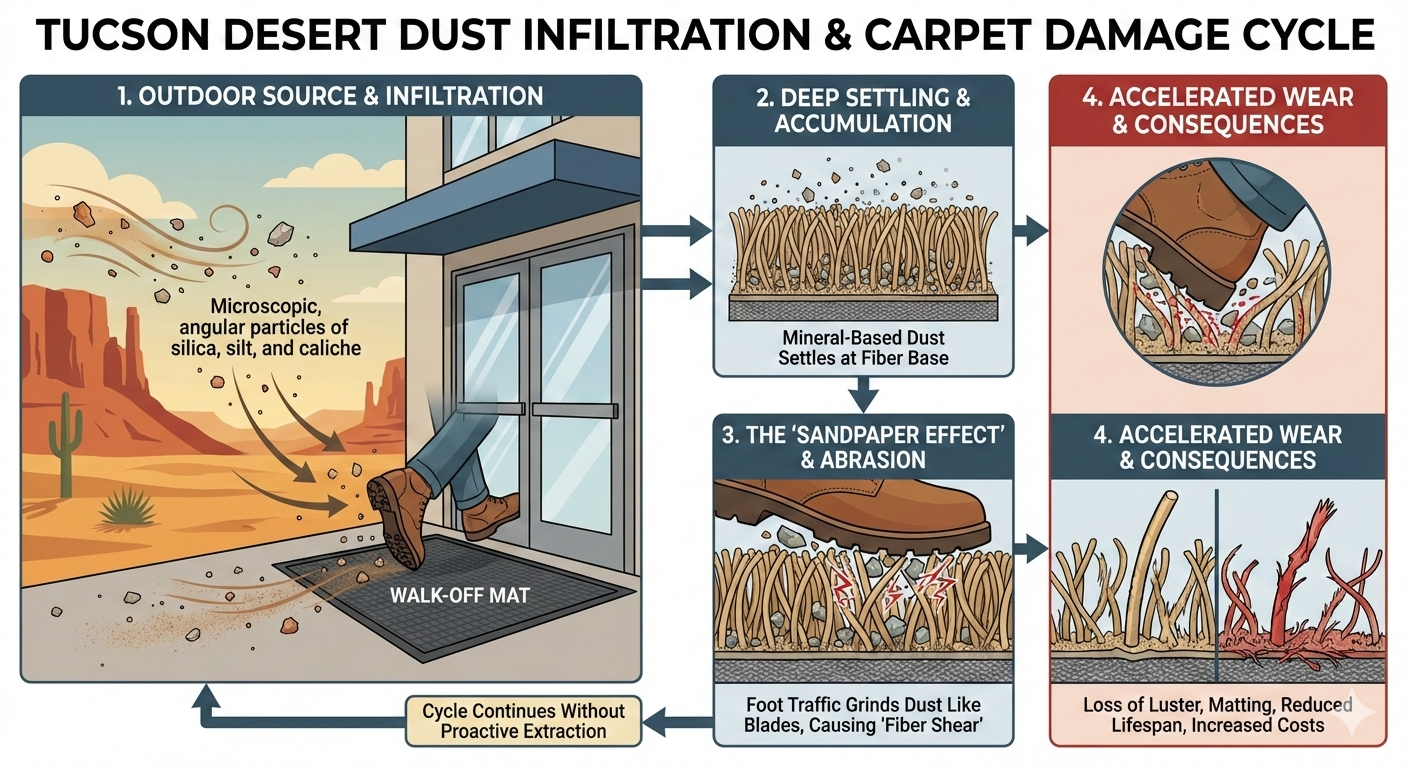
When these particles are tracked into a professional environment, they settle deep within the carpet pile, leading to accelerated physical degradation that standard cleaning routines often fail to address.
The Microscopic Mechanics of Fiber Damage
In regions like Southern Arizona, the outdoor environment is characterized by high concentrations of mineral-based dust. Unlike the organic soil found in more humid or temperate climates, desert dust is comprised of hard, angular particles.
According to the United States Environmental Protection Agency (EPA), indoor pollutants—including tracked-in soil—can significantly impact both the structural integrity of building materials and the overall health of the indoor environment.
When pedestrians walk across a carpeted surface, their weight creates a grinding action between the shoe sole and the carpet fibers. The sharp edges of the trapped desert dust act like microscopic blades. This process causes “fiber shear,” where the individual filaments of the carpet are literally cut or scratched. Over time, this results in:
- Loss of Luster: The scratching of the fiber surface changes how light reflects, making the carpet look dull or “dirty” even after it has been cleaned.
- Matting and Crushing: Weakened fibers lose their resilience and ability to stand upright, leading to permanent traffic lanes.
- Accelerated Thinning: The physical mass of the carpet decreases as sheared fibers are pulled away during routine vacuuming.
The Economic Case: ROI of Preventive vs. Reactive Maintenance
For facility managers in Tucson, carpet care is not just an aesthetic concern; it is a significant financial consideration. Commercial flooring represents one of the largest capital investments in a building’s interior. Understanding the life-cycle costing of commercial flooring is essential for protecting the bottom line.
Consider a standard office suite with a $20,000 carpet installation. In an ideal environment with proper maintenance, this asset should have a functional lifespan of approximately 10 years, resulting in a depreciation cost of $2,000 per year.
However, when reactive maintenance is the only strategy—cleaning only when the carpet looks visibly soiled—the “sandpaper effect” of Tucson’s silt goes unchecked. This abrasion can cut the lifespan of the carpet down to just 4 years.
At this rate, the annual cost of the asset effectively jumps to $5,000 per year. By investing in a consistent, proactive carpet cleaning program, businesses can preserve the structural integrity of the fibers, deferring massive capital expenditures and maximizing their Return on Investment (ROI).
Identifying High-Risk Zones in Tucson Facilities
To mitigate the impact of desert particulates, facility managers must identify “track-off” zones where dust infiltration is highest. Implementing a strategic protocol begins with a defense-in-depth approach to these specific areas.
High-Traffic Zone Checklist
- Primary Entrances: These require reinforced walk-off matting systems (at least 12–15 feet) to capture the initial surge of desert silt.
- Transition Points: Areas where hard surfaces (like tile or concrete) meet carpet are prone to “soil dumping,” where the carpet acts as a brush for the feet.
- Elevator Interiors: Enclosed spaces where dust is trapped and ground into the carpet by pivoting feet.
Cleaning Schedule by Facility Type
| Facility Type | Daily Dust Mitigation | Deep Extraction Frequency |
| Medical Centers | HEPA-filter vacuuming (High Frequency) | Quarterly |
| Auto Dealerships | Daily detailing of showrooms | Bi-monthly (due to heavy silt and oils) |
| General Offices | 3x weekly vacuuming | Semi-annually |
| Education | Daily high-volume vacuuming | 3x Annually (Seasonal breaks) |
The Science of Soil Extraction
Effective floor cleaning in an arid climate requires specialized equipment. Standard household or low-grade commercial vacuums often lack the suction power or the filtration necessary to handle the fine, flour-like consistency of Tucson dust.
Professional-grade systems utilize high-performance motors to create the lift required to remove particles from the very base of the carpet backing. Furthermore, because desert dust often has a high mineral content, it can become “bonded” to fibers.
Professional carpet cleaning services in Douglas and other high-desert areas utilize specific pre-treatments that break these bonds, allowing the abrasive silt to be suspended in solution and extracted completely.
Frequently Asked Questions for Facility Managers
Why does the carpet look dirty again just a week after cleaning?
In the Tucson market, this is often caused by “wicking.” If a deep-seated layer of desert silt is not fully extracted from the base of the carpet, the moisture from cleaning can pull that soil up to the surface as the fibers dry. Additionally, if a high-residue cleaning agent is used, it can act as a magnet for new desert dust, causing rapid re-soiling.
Can a standard commercial vacuum handle desert dust?
Generally, no. The micron size of fine Sonoran dust is so small that it can pass straight through standard vacuum bags and be exhausted back into the air. Effective commercial cleaning in Tucson requires HEPA-rated filtration to ensure that microscopic particulates are trapped and removed from the facility entirely.
How often should high-traffic carpet be professionally extracted?
In high-dust environments like Tucson, deep extraction should occur at least twice a year for general offices and up to four times a year for high-volume retail or medical spaces. This prevents the abrasive “sandpaper” layer from reaching a density that causes permanent fiber damage.
JAN-PRO Cleaning & Disinfecting in Tucson as a Commercial Solution
Maintaining the aesthetic and structural integrity of commercial carpets in the Sonoran Desert requires more than a standard cleaning checklist. It requires an understanding of local geological factors and the right technology to combat them.
JAN-PRO Cleaning & Disinfecting in Tucson provides a systematic approach to facility maintenance, utilizing advanced HEPA-filter technology and specialized extraction techniques designed to remove the abrasive desert silt that shortens the life of flooring assets.
The certified franchisees of the local Tucson team are equipped to handle the unique sanitation requirements of business offices, medical centers, and auto dealerships across the region. By focusing on deep-soil removal and preventative care, they help businesses avoid the high costs of premature carpet replacement.
The local office for JAN-PRO Cleaning & Disinfecting in Tucson is located at 4221 S Santa Rita Ave, Suite 101, and the team can be reached for facility consultations at (520) 885-9600.