

Disinfectant dwell time is the length of time a disinfectant must stay on a pre-cleaned hard surface, usually visibly wet, to deliver the efficacy claims printed on its label. In Phoenix, low humidity, high indoor and surface temperatures, and constant air movement from cooling systems can evaporate a thin layer of product well before that time is reached. For offices, this gap between application and actual contact time is one of the most common reasons a disinfecting routine looks complete but does not meet the product’s directions for use.
What Disinfectant Dwell Time Means
Dwell time, contact time, and wet time describe the same requirement: how long a disinfectant must remain on a surface to act on the organisms listed on its label. Product labels most often use the term “contact time,” and the value appears in the Directions for Use section.
Key points about disinfectant contact time:
- It is product-specific. Listed times commonly range from under a minute to ten minutes, depending on the formula.
- It can vary by organism. A single label may list different contact times for different bacteria or viruses.
- It assumes a pre-cleaned surface. Soil, grease, and residue reduce how well a disinfectant reaches the surface.
- It usually requires visible wetness. The U.S. Environmental Protection Agency’s six steps for safe and effective disinfectant use list following the contact time as a core step and state that the surface should stay wet for the full period.
| Term | Meaning | Where it appears |
| Contact time | Time the product must remain on the surface to meet label claims | Product label, Directions for Use |
| Dwell time | Industry synonym for contact time | Cleaning procedures, training materials |
| Wet time | Emphasizes that the surface stays visibly wet for the full period | Label language such as “allow surface to remain wet” |
Why Disinfectants Dry Too Fast in Phoenix
Evaporation speeds up when air is dry, warm, and moving. Phoenix office environments often combine all three, which makes disinfecting in dry climates a distinct operational challenge rather than a minor variable.
| Factor | Effect on drying | Typical office locations |
| Low relative humidity | Dry air absorbs moisture from treated surfaces faster | Building-wide, most pronounced outside monsoon season |
| Elevated surface temperature | Warm surfaces accelerate evaporation of thin liquid films | Desks near west-facing windows, sunlit lobby counters, exterior door hardware |
| Air movement | Steady airflow strips moisture from exposed surfaces | Conference tables and workstations under supply vents |
| Light application | A fine mist or nearly dry cloth leaves too little liquid to last | Electronics-adjacent surfaces, quick wipe-downs |
| Absorbent tools | Overloaded or dry microfiber pulls solution back off the surface | High-volume wipe routes |
The practical result is that a product with a multi-minute contact time can dry on a sunlit desk or a vent-cooled table in a fraction of that time. The shorter the window between application and drying, the less margin a disinfecting routine has.
What Happens When a Disinfectant Dries Before Its Contact Time
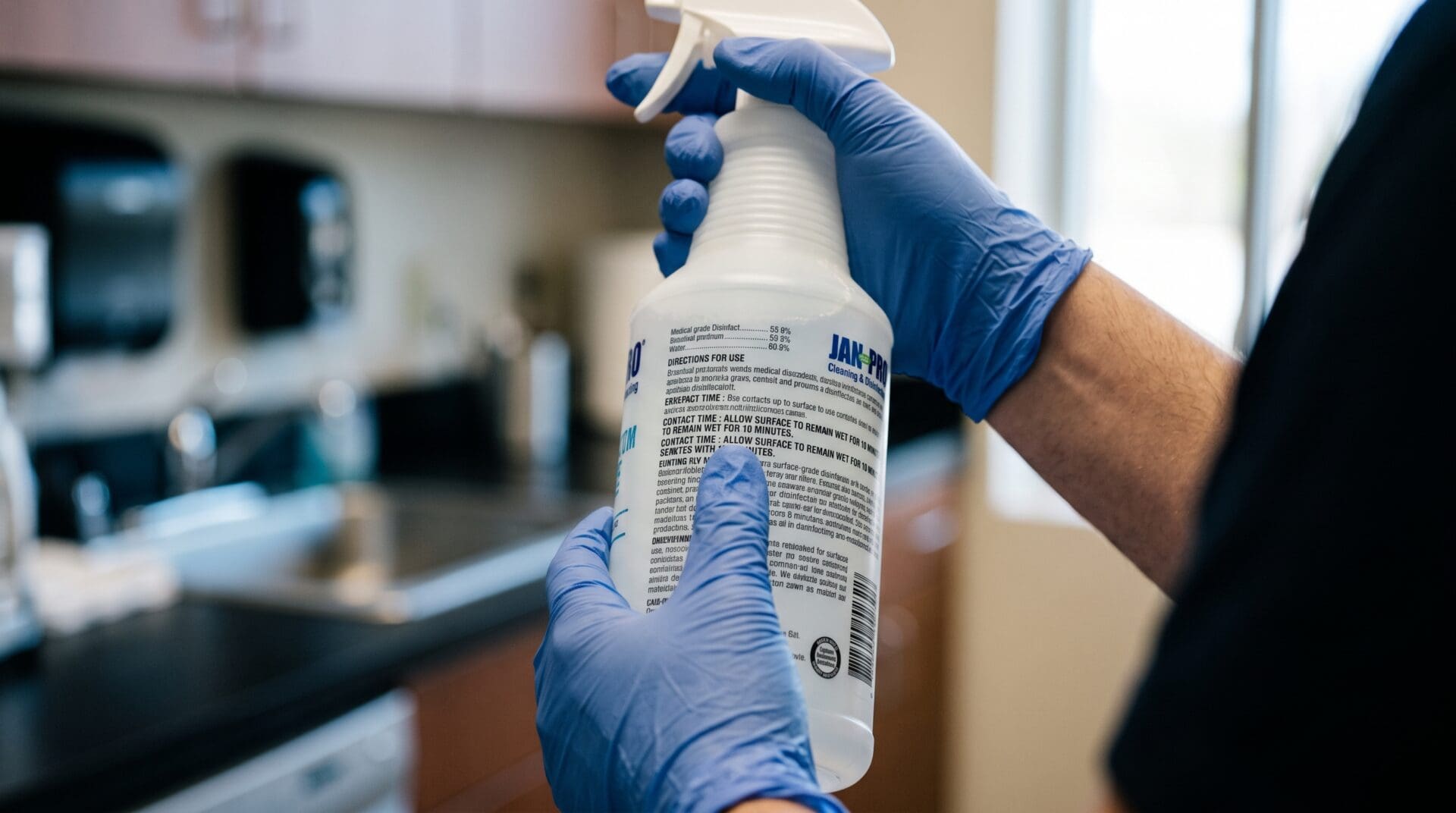
A disinfectant’s label claims are based on use according to its directions. When a surface dries before the listed contact time, the application did not follow those directions, and the stated efficacy cannot be assumed for that surface.
Common consequences of early drying include:
- Incomplete treatment. Organisms listed on the label may not be reduced to the level the product claims.
- False confidence. The surface was wiped and appears clean, so the gap is not visible during a walk-through.
- Residue buildup. Repeated light applications can leave film on surfaces without meeting contact time.
- Inconsistent results across a facility. Shaded interior rooms may meet contact time while sunlit perimeter areas do not.
Many labels address this directly by instructing users to reapply the product if needed so the surface stays wet for the full contact time. The label remains the governing document for every product.
How Offices Can Maintain Disinfectant Contact Time in Dry Climates
Offices and their cleaning providers can adjust procedures so the listed contact time is actually reached. A practical sequence for office disinfecting in Phoenix:
- Pre-clean first. Remove visible soil with a cleaner before applying a disinfectant, unless the label identifies the product as a one-step cleaner-disinfectant.
- Match the product to the environment. Select EPA-registered disinfectants whose listed contact times are realistic for dry, warm surfaces and whose labels cover the organisms of concern.
- Apply enough volume. Spray or wipe until the surface is visibly wet. Avoid wringing cloths nearly dry.
- Work in small sections. Treat a manageable area so it can be monitored and rewetted before it dries.
- Reapply as the label directs. If the surface begins to dry early, add more product to restore visible wetness.
- Time it instead of estimating. Use a timer for products with longer contact times rather than relying on judgment.
- Wait before wiping. Do not wipe or dry a surface until the full contact time has elapsed, unless the label states otherwise.
- Verify dilution. Mix concentrates exactly to the label ratio. An over-diluted solution can fail even when contact time is met.
- Account for timing and location. Schedule high-touch disinfecting for sunlit and vent-exposed areas when those surfaces are cooler, and note them on the cleaning checklist.
High-Touch Office Surfaces That Lose Moisture Fastest
Not every surface dries at the same rate. Mapping the fastest-drying surfaces helps prioritize where reapplication and timing matter most.
| Surface | Why it dries fast | Practical adjustment |
| Exterior and lobby door hardware | Metal heats quickly near entrances and glass | Apply heavier coverage and monitor for early drying |
| Desks near west-facing windows | Afternoon sun raises surface temperature | Disinfect earlier in the cleaning route or after blinds are closed |
| Conference tables under vents | Constant airflow across a large flat surface | Work in sections and rewet as needed |
| Break room counters and appliance handles | Frequent contact plus nearby heat sources | Pre-clean thoroughly, then apply full coverage |
| Elevator buttons and access keypads | Small surfaces hold little liquid | Use the method the product label specifies for electronics and small surfaces |
How Commercial Cleaning Providers Approach Dwell Time
Established commercial cleaning providers build disinfectant dwell time into written procedures instead of leaving it to individual judgment. JAN-PRO Cleaning & Disinfecting in Phoenix is one example of a provider that treats contact time as a defined step within a documented cleaning program.
An approach to contact time used by professional providers typically includes:
- Product selection by label. Disinfectants are chosen based on EPA registration, listed organisms, surface compatibility, and contact times suited to the facility.
- Site-specific checklists. Fast-drying zones, such as sunlit perimeter offices and vent-cooled meeting rooms, are identified during the initial walk-through and flagged on the checklist.
- Application standards. Procedures specify pre-cleaning, adequate coverage, reapplication, and wait times rather than a single quick wipe.
- Training and verification. Certified franchise owners are trained on reading product labels, measuring dilution, and recognizing early drying.
- Consistent assignment. The same certified franchise owner servicing a facility over time becomes familiar with which surfaces dry fastest in that specific building.
For facilities evaluating commercial cleaning services in Phoenix, the provider’s written disinfecting procedure is a useful indicator of whether contact time is actually built into the work.
Facility managers comparing in-house programs with outsourcing janitorial services often weigh how consistently each option can apply label-compliant disinfecting across every shift and every zone of the building.
Key Takeaways
- Disinfectant dwell time, or contact time, is the period a product must stay on a surface, typically visibly wet, to meet its label claims.
- Phoenix’s dry air, warm surfaces, and constant HVAC airflow can evaporate disinfectants before that period ends.
- A surface that dries early has not been treated according to the label, so stated efficacy cannot be assumed.
- Pre-cleaning, adequate coverage, small work sections, reapplication, timing, and correct dilution are the main controls.
- Written procedures and site-specific checklists help commercial disinfecting in Phoenix account for the fastest-drying surfaces.
Frequently Asked Questions About Disinfectant Dwell Time in Phoenix
What is disinfectant dwell time?
Disinfectant dwell time, also called contact time, is the period a disinfectant must remain on a pre-cleaned hard surface, usually visibly wet, to achieve the efficacy claims listed on its label. The required time is printed in the product’s directions for use and can differ by product and by target organism.
Why do disinfectants dry faster in Phoenix?
Low relative humidity, high indoor and surface temperatures, and steady air movement from cooling systems all accelerate evaporation. Surfaces warmed by direct sun or positioned under supply vents can lose a thin layer of disinfectant well before a multi-minute contact time ends.
What should happen if a disinfectant dries before the contact time ends?
Most labels direct users to reapply the product so the surface stays wet for the full listed time. A surface that dries early has not been treated according to the label, so the product’s stated efficacy cannot be assumed for that application.
Is dwell time the same as contact time?
Yes. Dwell time, contact time, and wet time are used interchangeably in the cleaning industry to describe how long a disinfectant must stay on a surface. Product labels typically use the term contact time.
How do office disinfecting services in Phoenix account for dry air?
Providers typically select EPA-registered products with label contact times suited to the environment, apply enough solution to keep surfaces visibly wet, work in small sections, reapply as the label directs, and time each step instead of estimating.
JAN-PRO Cleaning & Disinfecting in Phoenix: Disinfecting Built Around Contact Time
JAN-PRO Cleaning & Disinfecting in Phoenix supports offices and commercial facilities with cleaning and disinfecting programs that account for the conditions that shorten disinfectant contact time in the Valley. Certified franchise owners follow documented procedures covering product selection, pre-cleaning, application, and site-specific checklists for fast-drying areas. Facilities seeking a structured approach to disinfecting in a dry climate can reach JAN-PRO Cleaning & Disinfecting in Phoenix at (602) 438-1000 or at its office at 4511 E Broadway Rd.
About the Author
Carter James
 Carter James is Vice President of Strategy & Development, leading growth strategy, acquisitions, and multi-market expansion within a facility services platform. His background includes corporate strategy, M&A integration, and franchise development. He partners with senior leadership to drive disciplined execution, scalable operations, and long-term value through data-driven, high-accountability leadership.