When our team walks into a school for the first time, whether it’s an elementary campus in Hoover, a private academy in Vestavia Hills, or a K–12 district building outside Tuscaloosa, we’re not there to hand over a generic checklist. We’re there to understand how the building is actually being maintained day to day. After more than two decades of assessing and cleaning schools across Central Alabama, we’ve learned that the first fifteen minutes of a walkthrough usually tell us more than any questionnaire ever could.
A school cleaning assessment isn’t a sales pitch with a clipboard. Done right, it’s a structured inspection of the areas where cleaning problems are most likely to create complaints, increase maintenance costs, and affect the overall learning environment.
We don’t evaluate schools randomly. We start with the areas that reveal the most about the effectiveness of a cleaning program. If those areas are being maintained consistently, the rest of the building usually follows. If they’re being overlooked, it’s often a sign that deeper issues exist throughout the facility.
Here’s exactly what we evaluate first, and why each one matters for Alabama schools.
1. Restrooms: Because They Never Lie
We always start with restrooms, and not just because they’re the highest-complaint area in any school. Restrooms are the most honest room in the building. If the current cleaning program is cutting corners, we’ll see it here first: grout lines that have gone gray, buildup behind toilet bases, dispensers that are stocked but never wiped down.
We’ve seen schools with spotless front lobbies and restrooms that hadn’t seen a deep scrub in a semester. That gap tells us the existing program is cleaning for appearances, not for health — and in a building full of kids, that’s the wrong priority.
One of the first things we notice isn’t the floor; it’s the baseboards and wall edges near restroom entrances. They often reveal whether detailed cleaning is happening consistently or only before inspections. If those areas have months of buildup, it’s usually a sign the rest of the cleaning program has blind spots too.
We also check the details most programs skip: the underside of partition edges, the wall area behind urinals, floor drains, and the caulk lines where fixtures meet tile. These are the spots where odor problems actually start. When a school tells us “the restrooms smell no matter how much we clean,” the answer is rarely more mopping; it’s one of these missed zones.
2. High-Touch Surfaces in High-Traffic Corridors
Door handles, stair rails, water fountain buttons, light switches, and the push bars on exterior doors. During an assessment, we run a simple visual and tactile check on these surfaces along the main traffic routes — the paths students actually take between classes.
What we’ve found in Alabama schools is that high-touch disinfection often stops at the classroom door. Hallway rails and entry push bars get missed because they don’t belong to any one room on the cleaning schedule. Those are exactly the surfaces every student in the building touches daily.
We also ask a question that catches many programs off guard: what’s the dwell time on the disinfectant being used? Every disinfectant needs a specific amount of wet contact time on a surface to actually work. We’ve watched crews spray and immediately wipe, which looks like disinfection but accomplishes very little. An assessment surfaces that gap before flu season does.
3. Cafeteria Floors and the Grease Line
Cafeterias are where we slow down. We evaluate the transition zone between the serving line and the seating area — what we call the grease line — because food-service residue migrates. If floors are being mopped with the same solution and the same water from the kitchen out to the seating area, we can usually see the film under angled light.
In Central Alabama, this matters more than people expect. Humidity keeps floors from fully drying, and a damp, greasy film is both a slip hazard and a pest attractant. We check floor drains, table undersides, and the corners where the floor scrubber can’t reach. We also look at how tables and benches are handled between lunch waves; a quick dry wipe between shifts of two hundred students is not the same as sanitizing a food-contact surface.
4. Gyms, Locker Rooms, and Humidity Damage
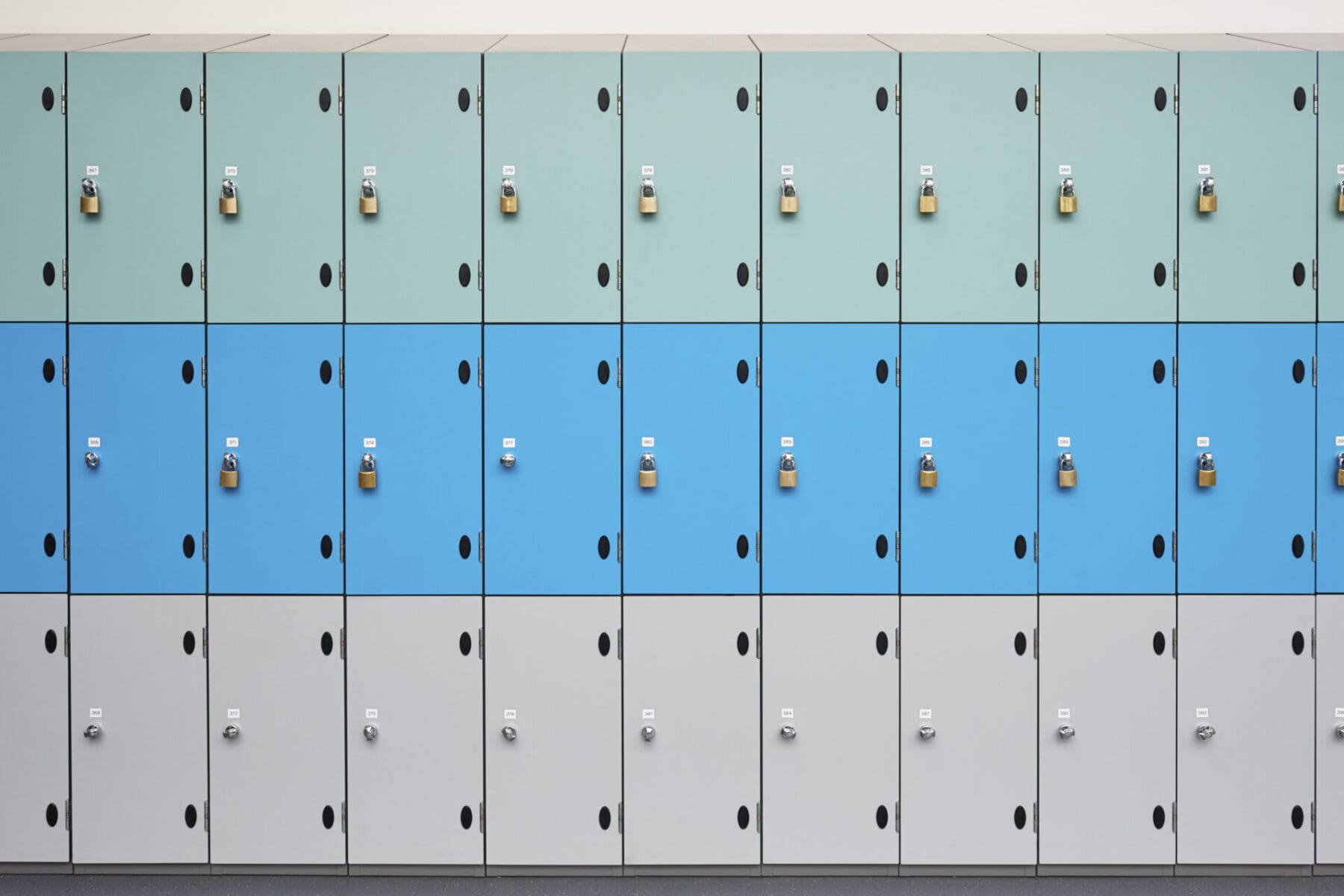
This is the most Alabama-specific part of our assessment. Our summers are long and humid, and school gyms, especially older ones with limited HVAC coverage in storage and locker areas, are where moisture problems show up first.
We inspect locker room grout, equipment storage closets, wrestling and PE mats, and the underside of bleachers. We’ve walked into gym storage rooms in August that smelled like a problem before we ever turned the light on. Catching moisture and mildew issues early is significantly cheaper than remediating them later, and it’s a health issue for student athletes who use these spaces daily.
Shared athletic equipment gets a look too. Mats that are stacked while still damp, pads stored against exterior walls, towels left in closed bins over a weekend — these are the small habits that turn into odor complaints and skin-infection risks. None of it is hard to fix. It just has to be on someone’s schedule.
5. Entryways and What Alabama Red Clay Does to Them
Anyone who has lived here knows what red clay does to carpet. During an assessment, we evaluate entry matting — is it long enough to actually capture soil across several footsteps, or is it a decorative two-foot mat that stops nothing?
We also look at how far soil has tracked into the building. In schools without adequate walk-off matting, we’ve seen clay staining travel thirty feet or more down a main corridor. That drives up carpet replacement costs and makes daily vacuuming a losing battle. Fixing the matting strategy is often one of the cheapest, highest-impact recommendations we make — and after a rainy week in Birmingham, the difference between a school with real walk-off matting and one without is visible from the front door.
6. The Current Program’s Documentation
Finally, we ask to see what’s being tracked. Not to catch anyone, but because a cleaning program without documentation can’t prove anything to a parent, a school board, or a health inspector. We look for cleaning logs, disinfectant dwell-time practices, and whether the products in the janitor’s closet match what the program says is being used.
During one assessment at a Central Alabama school, the cleaning log listed a disinfectant approved for daily classroom use, but the janitor’s closet contained a completely different product. The issue wasn’t the cleaning crew; it was an undocumented supply substitution that had never been reflected in the written procedures. Once the discrepancy was identified, the school updated its documentation so the products being used matched the written cleaning protocols.
We’ve assessed other schools where the closet told a completely different story than the contract. That’s not always the cleaning crew’s fault; it’s usually a management and accountability gap. The good news is that it’s also one of the easiest problems to correct once it’s identified.
What Happens After the Assessment
Every walkthrough ends the same way: a written summary of what we found, ranked first by health impact and second by appearance. No inflated scope, no padding. Schools operate on tight budgets, and our job is to show administrators where cleaning dollars actually protect students — and where they’re being wasted.
Sometimes the honest answer is that a school’s current program only needs a few adjustments. When that’s the case, we say so. An assessment is only useful if you can trust what’s in it.
Why Alabama Schools Choose JAN-PRO of Central Alabama
If you’re an administrator, facilities director, or office manager in the Birmingham metro or anywhere in Central Alabama, we recommend starting with a walkthrough — and we’d recommend doing it with a team that cleans schools for a living, not as a sideline.
That’s what we do at JAN-PRO Cleaning & Disinfecting in Central Alabama. Our certified franchisees follow a documented cleaning and disinfection process built for the environments where it matters most — schools, daycares, and medical facilities — and every account is backed by measurable quality inspections, not promises.
We know what Alabama humidity does to a gym, what red clay does to a hallway, and what a parent expects when they walk into your front office.
Learn more about our school cleaning services in Alabama, or call us at 205-767-7435 to schedule a free, no-obligation school cleaning assessment. It costs you nothing but a walkthrough, and it might be the most revealing thirty minutes your building gets this year.
FAQs
How long does a school cleaning assessment usually take?
Most school cleaning assessments take between 30 minutes and two hours, depending on the size of the campus and the number of buildings being evaluated. During the walkthrough, we inspect priority areas such as restrooms, classrooms, cafeterias, gyms, entryways, and custodial storage areas before providing recommendations.
Who should participate in a school cleaning assessment?
We recommend having a facilities director, maintenance supervisor, school administrator, or another staff member familiar with the building participate in the walkthrough. Their knowledge of recurring concerns, schedules, and operational priorities helps us better understand how the facility is used and where improvements may be needed.
What should a school prepare before a cleaning assessment?
Schools don’t need to prepare the building before the walkthrough, but it can be helpful to have current cleaning schedules, cleaning logs, supply information, and any recent concerns or complaints available. Seeing the building under normal operating conditions often provides the most accurate picture of how the cleaning program is performing.
What happens after the school cleaning assessment?
After the walkthrough, we provide a summary of our observations and recommendations, prioritizing areas based on health, safety, cleaning effectiveness, and long-term facility maintenance. If the current cleaning program is performing well, we’ll say so. If improvements are needed, we’ll explain where they can have the greatest impact.
How often should a school’s cleaning program be evaluated?
Many schools benefit from a comprehensive cleaning assessment at least once a year or whenever there’s a change in cleaning providers, facility usage, or operational needs. Periodic assessments can help identify issues before they become larger maintenance or cleanliness concerns.
Does JAN-PRO of Central Alabama offer free school cleaning assessments?
Yes. JAN-PRO Cleaning & Disinfecting of Central Alabama offers free, no-obligation school cleaning assessments for educational facilities throughout Birmingham and the surrounding Central Alabama communities. Our walkthroughs help administrators understand what’s working, what could be improved, and how to prioritize cleaning resources effectively.
About the Author
Carter James
 Carter James is Vice President of Strategy & Development, leading growth strategy, acquisitions, and multi-market expansion within a facility services platform. His background includes corporate strategy, M&A integration, and franchise development. He partners with senior leadership to drive disciplined execution, scalable operations, and long-term value through data-driven, high-accountability leadership.