Most businesses in the Delaware Valley have some form of disinfection routine in place. The breakroom gets wiped down. The bathrooms get cleaned. The front desk is sprayed at the end of the day. On the surface, the workspace looks clean — and that is precisely the problem.
Looking clean and being disinfected are not the same thing. In a busy commercial environment, the gap between those two states is where illness spreads, liability accumulates, and employee confidence erodes. Understanding what actually gets missed during routine disinfection, and why, is the first step toward closing that gap.
Why Standard Disinfection Routines Leave Gaps
Conventional disinfection relies on a simple principle: a person applies a product to a surface using a cloth, wipe, or spray bottle. The limitation is equally simple — only the surfaces that are directly and deliberately contacted get treated.
In a real-world commercial environment, that constraint creates predictable blind spots. Cleaning staff are working under time pressure. Surfaces that require crouching, repositioning furniture, or disassembling equipment tend to get skipped — not because of negligence, but because the method makes complete coverage physically impractical within a standard cleaning window.
The result is a disinfection routine that covers the obvious surfaces while leaving a consistent set of high-contact areas untreated, session after session.
The 8 Surfaces Most Commonly Missed
Research into surface contamination in commercial environments consistently identifies the same categories of missed surfaces. For Delaware Valley businesses — whether a medical office in Cherry Hill, a childcare center in Voorhees, or a co-working space in Mount Laurel — these blind spots are not hypothetical. They are structural features of manual disinfection.
1. Undersides of surfaces
The underside of a desk, conference table, or reception counter is touched constantly — by hands reaching for items, adjusting chairs, or gripping table edges. These surfaces rarely appear on a standard cleaning checklist because they are not visible during a walk-through inspection.
2. Chair armrests and bases
Seat cushions and backrests are typically wiped. Armrests — one of the most frequently contacted surfaces in any office — are often missed, and chair bases and casters collect debris and biological material that a standing wipe-down cannot reach.
3. Door hardware beyond the handle
Door handles receive attention. The door frame, kick plate, push bar, and hinge-side edge — all contacted by hands and bodies dozens of times per day — typically do not.
4. Light switches and electrical plates
Light switches are among the highest-contact surfaces in any commercial building. Their small surface area and recessed edges make them easy to wipe imprecisely, leaving the surrounding plate and switch mechanism partially treated at best.
5. Shared office equipment
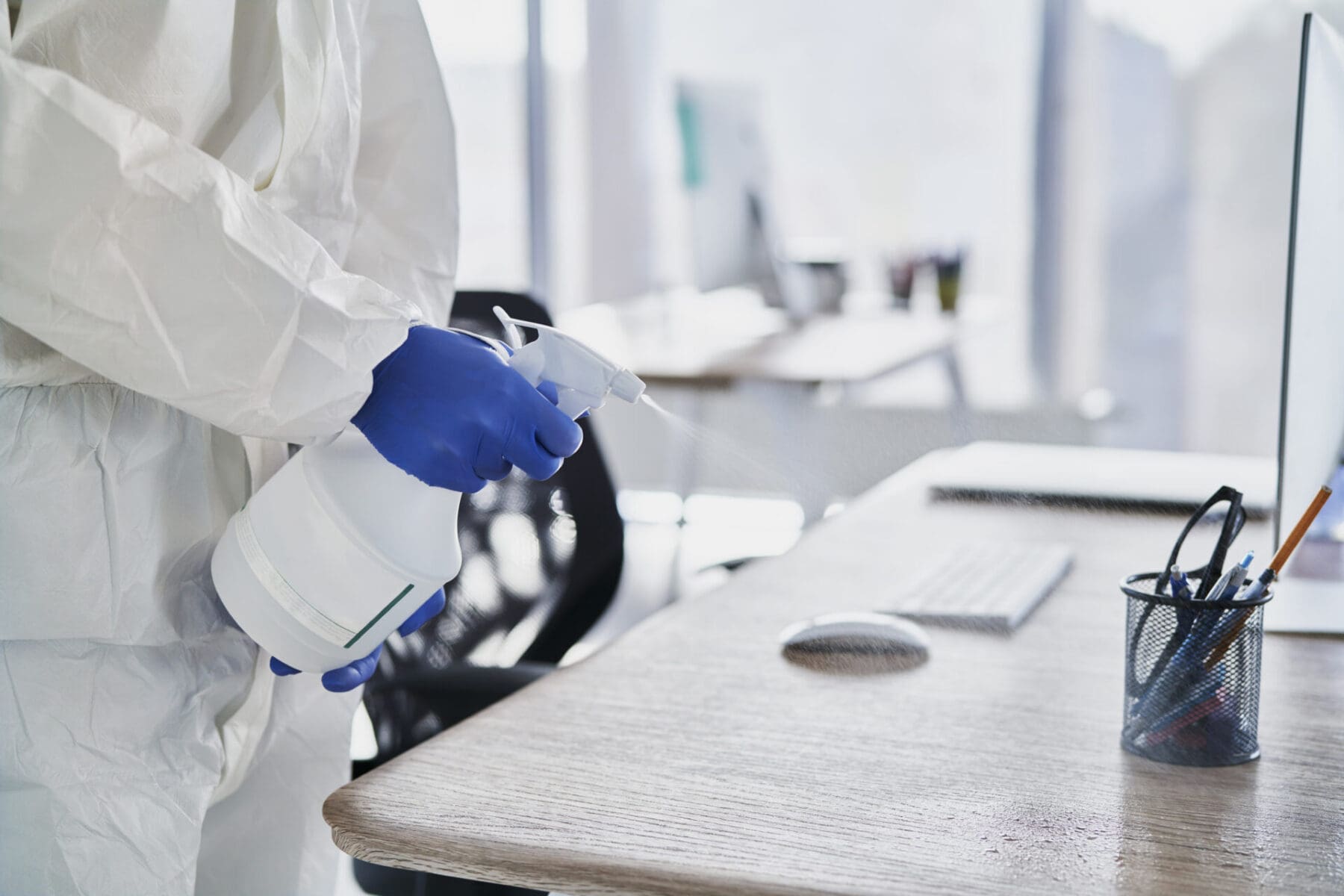
Keyboards, mice, telephone handsets, copier touchscreens, and shared tablets accumulate microbial contamination rapidly. Their irregular surfaces — keys, buttons, seams, and ports — are difficult to disinfect thoroughly with a flat wipe.
6. Waiting room and reception furniture
In medical practices, dental offices, and professional service firms throughout Camden and Burlington Counties, waiting room chairs see dozens of occupants per day. The sides, armrests, and seat-to-back junction of upholstered or hard chairs are rarely addressed in a standard cleaning pass.
7. HVAC vents and air return grilles
Vents and grills accumulate dust, debris, and biological particles. Because they are overhead or near the floor, they fall outside the natural sightline of a standing cleaning technician and are frequently omitted entirely.
8. Restroom surfaces beyond the obvious
Restroom cleaning focuses on toilets, sinks, and mirrors. The stall door latch, toilet flush handle, feminine hygiene disposal unit, paper towel dispenser lever, and the interior face of the entry door are all high-contact surfaces that receive inconsistent attention.
Why It Matters: The Real Cost of Incomplete Disinfection
For a Delaware Valley business, the consequences of these gaps are not abstract.
Employee illness and absenteeism
The CDC estimates that employees in the United States miss approximately 17 million workdays per year due to influenza alone. When high-contact surfaces in shared workspaces go consistently untreated, pathogen transmission between coworkers is not a matter of if — it is a matter of when.
Regulatory and liability exposure
Businesses in regulated industries — healthcare, food service, childcare — are subject to inspection standards that extend beyond visible cleanliness. A documented disinfection gap in a patient area or food preparation zone creates compliance risk that a clean-looking facility does not eliminate.
Client and employee confidence
In the post-pandemic Delaware Valley commercial market, clients and employees make decisions based in part on visible evidence of hygiene standards. A facility that cannot demonstrate a credible disinfection program is at a disadvantage relative to competitors that can.
How Electrostatic Disinfection Addresses the Gap
The structural problem with manual disinfection is that coverage depends entirely on where a technician physically directs a product. Electrostatic disinfection changes the underlying mechanism.
An electrostatic applicator imparts a positive ionic charge to disinfectant droplets as they leave the nozzle. Because most surfaces carry a neutral or negative charge, the charged particles are attracted to those surfaces — wrapping around edges, undersides, and irregular geometries that a spray bottle or wipe cannot consistently reach.
This is the technology behind EnviroShield, the proprietary disinfecting system used by JAN-PRO Cleaning & Disinfecting in Delaware Valley. The electrostatic delivery method does not eliminate the need for trained technicians — every JAN-PRO franchisee is certified on the system before performing any service — but it removes the primary structural limitation of manual methods: the requirement for direct physical contact with every surface.
For businesses that have been operating with a standard spray-and-wipe routine, the difference in surface coverage is not incremental. It is categorical.
What a Complete Disinfection Program Looks Like for Delaware Valley Businesses
A credible commercial disinfection program has three components that work together:
- The right delivery method. Electrostatic application addresses the coverage limitations of manual methods, particularly in complex environments with irregular surfaces, shared equipment, and high-traffic zones.
- An EPA-registered disinfectant. Product registration means efficacy claims have been reviewed by a federal regulatory body — not just asserted by a manufacturer. This matters for regulated industries and provides a defensible record for compliance purposes.
- Certified technicians with a documented protocol. The human element determines whether the technology performs as designed. A certification requirement — not just training, but a structured program with defined standards — is what separates a disinfection program from a cleaning routine.
JAN-PRO’s disinfecting services in Delaware Valley combine all three components through the EnviroShield® system, applied by franchisees who are certified before performing any client service.
Frequently Asked Questions
What are the most commonly missed surfaces in a commercial office?
The most frequently overlooked surfaces in commercial offices are chair armrests, keyboard and mouse surfaces, light switch plates, door hardware beyond the handle, and the undersides of desks and conference tables.
How do I know if my current disinfection routine is leaving gaps?
The clearest indicator is whether your provider can describe specifically which surfaces are treated, with what product, and at what dwell time. A provider that cannot answer those questions precisely is likely relying on a general routine rather than a documented protocol.
Does electrostatic disinfection work on soft surfaces like upholstered chairs?
Electrostatic disinfection is primarily designed for hard, non-porous surfaces. For upholstered furniture, a separate protocol using appropriate products is required. Your JAN-PRO franchisee can advise on the right approach for your specific facility.
How often should a Delaware Valley business schedule professional disinfection?
Frequency depends on industry, occupancy, and risk level. Medical and childcare facilities typically require weekly service. Standard office environments generally benefit from monthly professional disinfection alongside regular janitorial cleaning.
Close the Gap in Your Delaware Valley Facility
If your current disinfection routine depends entirely on manual application, there is a high probability that consistent surface gaps exist in your facility — not because your provider is careless, but because the method has structural limitations that technique alone cannot overcome.
JAN-PRO Cleaning & Disinfecting in Delaware Valley serves commercial clients throughout South Jersey and the greater Philadelphia metro area, including Cherry Hill, Voorhees, Marlton, Mount Laurel, Haddon Heights, Moorestown, and surrounding communities in Camden, Burlington, and Gloucester Counties.
To schedule a facility assessment or request a free estimate, contact the JAN-PRO Delaware Valley team directly at 856-547-5550.
About the Author
 Jon Brodack
 Jon Brodack
Jonathan Brodack is Director of Sales & Marketing at JAN-PRO Franchise Development of the Delaware Valley. Holding an MBA from Rutgers University–Camden, he combines a data-informed approach with a focus on building enduring professional partnerships. He is dedicated to driving franchise growth and market expansion through a strategy centered on long-term relationship development.