
Deep cleaning becomes essential every spring as allergens accumulate rapidly across South Jersey workplaces, from office parks near Cherry Hill to medical facilities around Camden and retail corridors along Route 70. As pollen from trees and grass peaks between March and May in New Jersey, indoor environments often trap and recirculate allergens, worsening symptoms for employees and visitors.
For facility managers overseeing buildings near the Delaware River waterfront or high-traffic business districts in Haddon Heights, the challenge isn’t just visible dust—it’s microscopic particles embedded in carpets, HVAC systems, and shared surfaces.
Without a structured approach, standard cleaning routines fall short. The goal isn’t just cleanliness—it’s controlling indoor exposure, stabilizing air quality, and maintaining a healthier, more productive workspace during peak allergy season.
What Is Deep Cleaning and How Does It Reduce Spring Allergies?
Deep cleaning is a comprehensive, high-detail cleaning process that removes embedded allergens—such as pollen, dust mites, and mold spores—from surfaces, air systems, and high-touch areas that routine cleaning misses. It directly reduces allergen buildup and improves indoor air quality during peak allergy seasons.
Unlike daily janitorial tasks, deep cleaning targets accumulation points where allergens settle and persist. According to the U.S. Environmental Protection Agency (EPA), indoor air can be 2–5 times more polluted than outdoor air when contaminants are not properly managed.
Key Components of Deep Cleaning for Allergy Control
- HEPA-filter vacuuming to capture fine particles
- Carpet and upholstery extraction to remove embedded allergens
- HVAC vent and diffuser cleaning to prevent recirculation
- High-surface dust removal (ceilings, fixtures, vents)
- Disinfection of high-touch areas
The distinction matters: routine cleaning maintains appearance, while deep cleaning actively reduces allergen exposure.
Why Spring Makes It Critical in South Jersey
In South Jersey, tree pollen—particularly oak, maple, and birch—peaks in early to mid-spring. These particles enter buildings through:
- Foot traffic
- Open doors and windows
- HVAC intake systems
Without intervention, they accumulate indoors, creating continuous exposure even after outdoor pollen levels drop.
Where Do Allergens Accumulate Most in Commercial Buildings?
Allergens concentrate in hidden and high-contact areas such as carpets, HVAC systems, upholstered furniture, and neglected surfaces like vents and light fixtures. These zones act as reservoirs, continuously releasing particles into the air when disturbed.
Understanding where allergens build up allows facility managers to prioritize cleaning efforts more effectively.
High-Risk Allergen Zones
- Carpets and Rugs
- Trap pollen, dust mites, and debris
- Release particles during foot traffic
- HVAC Systems
- Circulate allergens throughout the building
- Poor filtration increases exposure
- Upholstered Furniture
- Absorbs airborne allergens
- Rarely cleaned in standard routines
- Ceilings, Vents, and Fixtures
- Collect fine dust over time
- Often overlooked
- Shared Equipment and Surfaces
- Desks, keyboards, and breakroom areas
In practice, a common scenario involves office buildings near major commuting routes like I-295, where employees track in pollen daily. Even if floors are cleaned nightly, embedded allergens remain unless extraction methods are used.
South Jersey Pollen Calendar vs. Deep Cleaning Frequency
Aligning deep cleaning schedules with regional pollen cycles helps reduce indoor allergen accumulation before it peaks. Timing cleaning interventions strategically improves effectiveness and prevents buildup rather than reacting to it.
South Jersey Pollen Patterns & Cleaning Strategy
| Season Period | Dominant Allergens | NJ Regional Data Source | Recommended Deep Cleaning Focus | Frequency |
| Late Feb–March | Tree pollen (maple, elm) | NJ Department of Environmental Protection (NJDEP) | HVAC inspection, vent cleaning | 1x pre-season |
| April–May | Tree pollen peak (oak, birch) | American Academy of Allergy, Asthma & Immunology (AAAAI) | Carpet extraction, high dusting | Monthly |
| June–July | Grass pollen | CDC regional allergy data | Upholstery cleaning, air filtration checks | Every 6–8 weeks |
| August–October | Ragweed pollen | EPA regional air quality reports | Deep floor cleaning, entryway control | Monthly |
| Year-round | Dust mites, indoor allergens | EPA indoor air studies | HEPA vacuuming, surface disinfection | Weekly (enhanced) |
This framework ensures that cleaning efforts align with when allergens are most active—not just when symptoms appear.
What Cleaning Methods Are Most Effective for Allergen Removal?
The most effective deep cleaning methods combine mechanical removal (vacuuming, extraction) with air quality control strategies (filtration, ventilation). These approaches align with industry standards such as the ISSA Cleaning Industry Management Standard (CIMS).
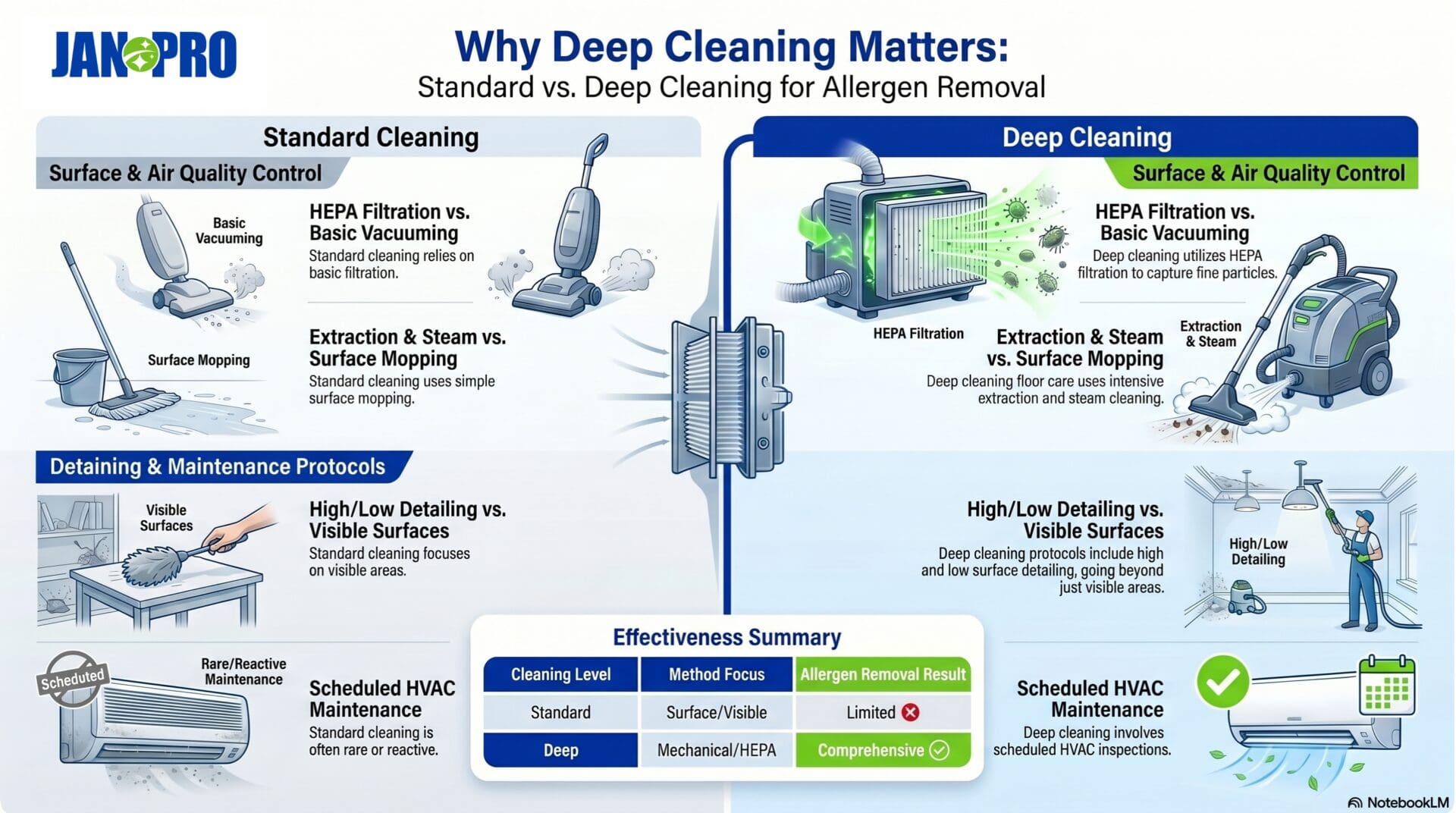
Standard vs. Deep Cleaning Methods
| Method | Standard Cleaning | Deep Cleaning |
| Vacuuming | Basic filtration | HEPA filtration (captures fine particles) |
| Floor Care | Surface mopping | Extraction and steam cleaning |
| Dusting | Visible surfaces | High and low surface detailing |
| HVAC Maintenance | Rare or reactive | Scheduled inspection and cleaning |
| Allergen Removal | Limited | Comprehensive |
Industry Standards That Guide Best Practices
- The Occupational Safety and Health Administration (OSHA) outlines workplace safety requirements under OSHA 1910 standards
- The American Society of Heating, Refrigerating, and Air-Conditioning Engineers (ASHRAE) recommends proper ventilation and filtration for indoor air quality
- The Global Biorisk Advisory Council (GBAC) emphasizes contamination control in shared environments
Situational Example
For instance, medical offices in South Jersey often require more frequent deep cleaning due to higher sensitivity environments. Upholstery and waiting areas must be cleaned more aggressively to prevent allergen accumulation between patient visits.
How Often Should Workplaces Schedule Deep Cleaning in Spring?
Most commercial facilities in South Jersey should schedule deep cleaning monthly during peak spring allergy season, with additional targeted services based on building type, foot traffic, and HVAC performance.
Frequency depends on several operational factors.
Recommended Cleaning Frequency by Facility Type
- Office buildings: Monthly deep cleaning, weekly enhanced maintenance
- Medical facilities: Bi-weekly deep cleaning
- Schools and childcare centers: Monthly with seasonal intensification
- Retail spaces: Every 3–4 weeks due to high foot traffic
Checklist: Spring Deep Cleaning Plan
To align with best practices, facilities should implement:
- Pre-season HVAC inspection and filter replacement
- Scheduled carpet and upholstery extraction
- High dusting of vents, ceilings, and fixtures
- Entryway mat maintenance to reduce pollen tracking
- HEPA vacuuming across all flooring types
Facilities that follow structured plans based on ISSA guidelines typically experience more stable indoor conditions during seasonal transitions.
How Does Deep Cleaning Improve Indoor Air Quality Long-Term?
Deep cleaning improves indoor air quality by removing pollutant sources, reducing airborne particles, and supporting HVAC efficiency. This creates a more stable indoor environment even beyond allergy season.
According to the Centers for Disease Control and Prevention (CDC), improving indoor air quality reduces respiratory irritation and supports overall workplace health.
Long-Term Benefits
- Reduced employee allergy symptoms
- Improved productivity and fewer sick days
- Lower strain on HVAC systems
- More consistent environmental conditions
Businesses working with providers offering commercial cleaning services in South Jersey often integrate these strategies into broader facility maintenance plans. Additionally, adherence to professional certifications ensures that cleaning protocols meet recognized industry benchmarks.
Conclusion
Deep cleaning plays a measurable role in reducing spring allergies across South Jersey workplaces by targeting the root sources of indoor allergens. Unlike routine cleaning, it removes embedded particles from carpets, air systems, and surfaces that continuously affect air quality.
By aligning cleaning schedules with regional pollen patterns, facilities can proactively manage allergen exposure rather than reacting to it. High-risk areas such as HVAC systems and upholstery require specialized attention, while structured cleaning plans ensure consistency during peak seasons.
Following industry standards from organizations further strengthens outcomes, helping facilities maintain healthier indoor environments. Ultimately, deep cleaning supports both operational stability and employee well-being during one of the most challenging seasons for indoor air quality.
When Spring Allergies Disrupt Your Workplace, It’s Time to Act on Deep Cleaning
If your facility is experiencing recurring allergy complaints, visible dust buildup, or inconsistent indoor air conditions during South Jersey’s spring pollen surge, it’s a sign that allergens are accumulating beyond routine cleaning.
JAN-PRO Cleaning & Disinfecting in the Delaware Valley supports facilities across South Jersey, including Camden, Cherry Hill, and Haddon Heights, with tailored deep cleaning programs designed for multi-location consistency.
To implement a plan aligned with your facility’s needs, contact 856-547-5550 or visit 410 White Horse Pike, Haddon Heights, NJ, and coordinate a strategy that stabilizes indoor conditions during peak allergy season.
About the Author
 Jon Brodack
 Jon Brodack
Jonathan Brodack is Director of Sales & Marketing at JAN-PRO Franchise Development of the Delaware Valley. Holding an MBA from Rutgers University–Camden, he combines a data-informed approach with a focus on building enduring professional partnerships. He is dedicated to driving franchise growth and market expansion through a strategy centered on long-term relationship development.