

Start with the thing nobody says out loud about nightly cleaning.
A building cleaned between 6pm and midnight is at its absolute best at seven the following morning. From then on it only declines. By two or three in the afternoon — when your client arrives for a meeting, when a patient sits in your waiting room, when a candidate walks through the lobby, when the tenant rep tours the floor — the building is at its worst point in the entire twenty-four-hour cycle.
Everyone in the building has adjusted to this and stopped seeing it. Nobody visiting has.
That, in one paragraph, is what a day porter is for. Not more cleaning. Cleaning at the hour the building is actually being looked at.
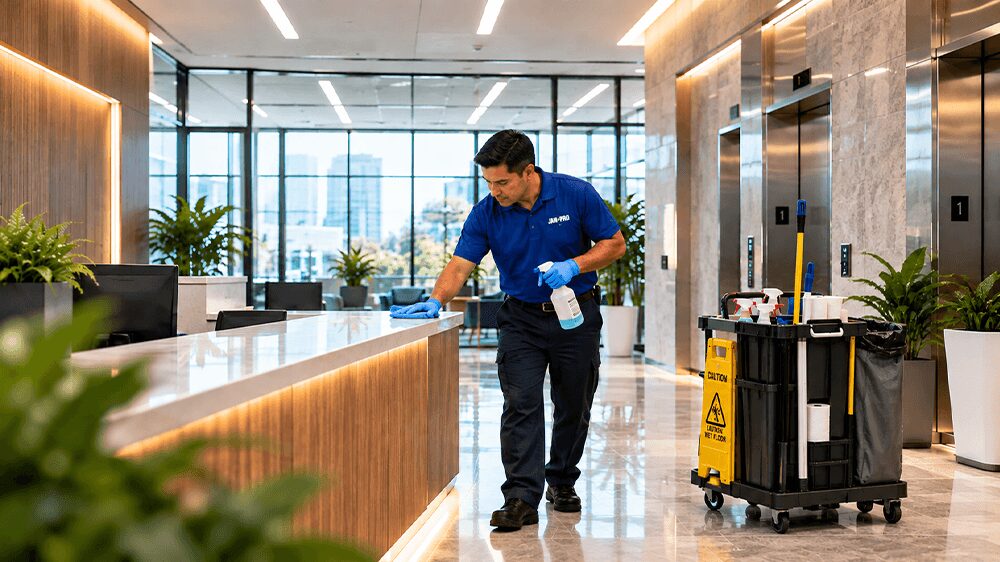
What a day porter actually does
The job is widely mis-sold, usually as a vague “additional presence.” Here is what a real mid-day shift looks like — say 10am to 2pm, four hours, five days a week.
| Function | What it involves | Typically per shift |
|---|---|---|
| Restroom rounds | Restock paper, soap and liners; wipe sinks, counters and mirrors; spot-clean fixtures; empty waste; deal with anything reported | 2–3 rounds |
| Entrance and lobby | Entry glass, mats, spot-mopping track-in, straightening furniture, removing what blew in | 2 passes |
| Break room and kitchen | Counters, tables, sink, coffee station, trash; dishwasher if it is in scope | Post-lunch, plus one earlier pass |
| High-traffic trash and recycling | Common-area bins that fill before end of day | As needed |
| Conference room turnover | Reset between meetings — surfaces, chairs, cups, whiteboard | On schedule or on call |
| Spill and incident response | The on-call function. Wet floor made safe and cleaned within minutes rather than hours | On call |
| Touchpoints | Elevator buttons and handrails, stair rails, main door push plates | 1–2 passes |
| Supply intelligence | Flagging what is running low so the night crew arrives with it | Continuous |
Equally important is what a day porter does not do. No floor machines, no high dusting, no detail work, nothing noisy, nothing that requires moving furniture or closing a space. All of that stays on the night shift, where it belongs. A porter working around occupants is doing light, quiet, visible-surface work by definition.
Which brings us to the first honest warning. A day porter does not replace nightly cleaning. If a provider offers to fold your nightly scope into a day shift for the same money, something has been quietly dropped — and it will be the floor care and the detail work, because those are the lines nobody notices missing for about three months. Our piece on why cleaning quality drops after month three covers exactly this pattern.
The day porter you are already paying for
Before the cost question, the hidden-cost question.
In most buildings without a porter, the work still happens. Someone restocks the restroom when it runs out. Someone wipes the break room counter before the client meeting. Someone finds the mop when the water cooler leaks. That someone is usually an office manager, a practice coordinator, a front-desk lead — a person whose job description says nothing about any of it.
The Sacramento numbers make the trade visible. BLS puts the metro mean hourly wage for office and administrative support work at $28.38, and for building and grounds cleaning work at $22.90. So the cleaning task is being done by someone costing about 24% more per hour — by someone who was not trained for it, does not have the right equipment, and is being pulled off the work you actually hired them for.
Be careful with this argument, though, because it does not stretch as far as vendors pretend. Forty-five minutes a day of an office manager’s time is roughly 16 hours a month, or about $460 of admin cost. A four-hour daily porter costs several times that. The hidden cost is real, and it is not the business case on its own. It is the tiebreaker, not the argument.
The actual business case: who sees your building
The case that does hold up is about the people walking through during business hours.
Bradley’s 2026 Healthy Handwashing Survey of 1,020 US adults found 86% expect the quality of a business’s restroom to reflect the quality of the business itself. 73% said they would reconsider returning after an unclean restroom experience. 68% said they are more likely to return, and to spend more, where restrooms are clean. Around 40% said they check the restroom before deciding whether to do business somewhere.
A restroom cleaned at 8pm and then used by 120 people across the following day is not the restroom your cleaning contract describes by three in the afternoon. It is a different room. The supplies are the visible part — an empty towel dispenser at 2pm is the single most common thing a visitor notices and the single easiest thing to prevent.
Then the liability side. Liberty Mutual’s Workplace Safety Index puts falls on the same level at $10.5 billion a year in direct US employer cost, second only to overexertion among the causes of serious workplace injury, inside a top-ten total of $58.78 billion. Same-level falls are, overwhelmingly, wet floors, spills and tracked-in water. In a building cleaned only at night, a spill at ten in the morning is managed by whoever happens to find it, with whatever is to hand, and stays on the floor until the evening.
In Sacramento this has a season. From November through March, every entrance in the region is a track-in problem from opening to close, and that water does not wait for the night crew.
A six-signal test
Score your own building. Be honest about it — a low score is a useful answer, not a failure.
| # | Signal | Points if yes |
|---|---|---|
| 1 | People who are not your employees are inside the building during business hours — clients, patients, tenants, the public | 2 |
| 2 | Restroom supplies run out before the end of the day, or anyone has complained about restrooms in the afternoon | 2 |
| 3 | You are contractually responsible for common areas that other people use — a shared lobby, elevators, shared restrooms | 2 |
| 4 | A named employee who was not hired to clean currently does cleaning tasks | 2 |
| 5 | Food is consumed on site by a meaningful number of people — a café, catering, or a break room serving 30+ | 1 |
| 6 | Your entrance takes weather directly — no covered walkway, parking lot exposure, or heavy rain-season traffic | 1 |
5 or more: a day porter will almost certainly pay for itself, and the question is only how many hours.
3 to 4: you need part of one. A two-hour split shift, or restroom rounds only, usually solves the actual problem at a fraction of the cost.
2 or less: do not buy one. A well-specified nightly clean plus a sensible supply-stocking routine is enough, and a porter would be a luxury rather than a fix. Any provider telling you otherwise is selling hours.
What it costs
These are modelled market ranges, not a quote from us, and the build is shown so you can check it.
Start with what it costs to employ a porter in Sacramento. At the BLS metro mean of $22.90 an hour, a part-time porter at 1,040 hours a year costs an employer $23,816 in wages, plus FICA at 7.65% ($1,822), California UI at 3.4% and ETT at 0.1% on the first $7,000 ($245), FUTA at 0.6% on the first $7,000 ($42), and workers’ compensation at the janitorial advisory rate of $4.19 per $100 of payroll ($998). That is $26,923, or $25.89 per hour fully burdened — before supervision, absence cover, equipment or supplies.
A contractor’s billing rate has to carry those too. At the 50–60% labour share typical of the industry, that puts a market rate at roughly $43 to $52 an hour, which is consistent with the range in our Sacramento pricing guide.
| Shift | Hours per month | Modelled monthly cost |
|---|---|---|
| 2 hrs/day, 5 days | 43 | $1,850 – $2,250 |
| 4 hrs/day, 5 days | 87 | $3,700 – $4,500 |
| 6 hrs/day, 5 days | 130 | $5,600 – $6,800 |
| 8 hrs/day, 5 days | 173 | $7,450 – $9,000 |
Note how the two-hour option changes the conversation. A lot of buildings that were told they needed a full-time porter needed ninety minutes of restroom rounds and a spill response number.
How to buy one properly
If you do go ahead, six things belong in the scope. Their absence is how day porter contracts quietly become nothing.
- Fixed hours and a stated shift window. Not “as needed.” “As needed” means whenever there is spare labour, which is never.
- A named person and a named backup. Continuity is most of the value — a porter who knows your building, your supply closet and your meeting rhythm is worth considerably more than a rotating body.
- A written round schedule, with restroom check times. So you can tell whether it happened.
- A response-time commitment for spills during the shift window. Fifteen minutes is a reasonable ask.
- An explicit list of what stays with the night crew. This is the clause that stops your floor care disappearing into a day shift.
- Consumable supply responsibility, in writing. Who buys the paper and soap, and what happens when stock runs out.
Frequently asked questions
What is a day porter?
A day porter is a cleaner who works during business hours rather than overnight, handling restroom rounds and restocking, entrance and lobby upkeep, break room cleaning, common-area trash, conference room turnover and immediate spill response. They do light, quiet, visible-surface work around occupants; floor machines, high dusting and detail work stay with the night crew.
What is the difference between a day porter and night cleaning?
Night cleaning is the full scope — floors, detail work, everything disruptive — performed when the building is empty. A day porter maintains the condition of the building while it is occupied and is on call for spills. They are complements, not alternatives: a day porter does not replace nightly cleaning, and any provider offering to fold nightly work into a day shift at the same price has dropped something from the scope.
How much does a day porter cost?
Based on Sacramento wage and payroll data, a fully burdened porter costs an employer about $25.89 an hour, which puts a contracted market rate at roughly $43–$52 an hour. That works out to about $1,850–$2,250 a month for a two-hour daily shift, $3,700–$4,500 for four hours, and $7,450–$9,000 for a full eight-hour day, five days a week. These are modelled ranges rather than quotes.
Does my building need a day porter?
The strongest signals are outside visitors inside the building during business hours, restroom supplies running out before end of day, contractual responsibility for shared common areas, and a non-cleaning employee currently doing cleaning tasks. If none of those apply — a small single-tenant office whose only occupants are its own staff — a well-specified nightly clean is usually enough and a day porter is a luxury rather than a fix.
How many hours should a day porter work?
Fewer than most buildings are sold. Two hours a day, or a split shift covering the morning restroom round and the post-lunch reset, solves the actual problem in a lot of buildings. Full eight-hour coverage makes sense where there is continuous public traffic, a café, or a multi-tenant lobby — not simply because a vendor offered it.
Find out which answer applies to your building
JAN-PRO Commercial Cleaning in Sacramento will walk your building during business hours — not at night — and tell you honestly whether a porter is worth it, and if so for how many hours. Sometimes the answer is two hours. Sometimes the answer is that your nightly scope needs fixing instead.
Call (916) 376-8977 or request a facility visit online.