
When a Bellevue school’s attendance numbers drop during winter months, the conversation usually turns to illness. Which students are out. Which classrooms are affected. Whether a particular virus is circulating through the district.
What rarely enters that conversation is the building itself.
The cleanliness of a school facility — not just how it looks, but how thoroughly it is disinfected, how well its ventilation system is maintained, and how consistently its highest-risk surfaces are treated — has a direct and measurable relationship to how often students and staff get sick, how quickly illness spreads through a building, and how many instructional days are lost as a result.
For Bellevue schools, this is not a theoretical concern. The Puget Sound region’s wet climate, combined with the density of students in Bellevue’s high-performing and often heavily enrolled schools across the Bellevue School District, creates conditions where poor cleaning practices have consequences that show up in attendance data, health office visits, and staff absenteeism within weeks.
What the Research Says About School Cleanliness and Attendance
The connection between school facility conditions and student health outcomes is well-documented. Studies published by the Environmental Protection Agency and the Centers for Disease Control and Prevention have identified school indoor environments as a significant factor in respiratory illness, asthma triggers, and the transmission of communicable diseases among school-age children.
Key findings relevant to school administrators and facility managers:
Absenteeism is directly tied to illness transmission rates
The EPA estimates that poor indoor air quality in schools contributes to increased asthma symptoms, which is one of the leading causes of school absenteeism nationwide. In Washington State, where damp conditions elevate mold and allergen risk in school buildings, this connection is particularly relevant.
High-touch surface contamination drives outbreak spread
Research on norovirus and influenza transmission in school settings consistently identifies shared surfaces — desks, door handles, restroom fixtures, cafeteria tables — as primary transmission vectors. The frequency and quality of surface disinfection directly affect how quickly an illness moves through a building once it enters.
Teacher absenteeism compounds the problem
Poor indoor air quality and high illness transmission rates do not only affect students. Staff absenteeism tied to facility conditions disrupts instructional continuity and creates substitution costs that add up quickly across a school year.
For Bellevue schools — where families and the community hold academic outcomes to a high standard — the instructional cost of preventable absenteeism is a real and quantifiable consequence of inadequate facility maintenance.
What Poor School Cleaning Actually Looks Like
Poor school cleaning is rarely obvious. A building can appear clean — floors swept, trash emptied, surfaces wiped — while harboring conditions that directly affect occupant health. Understanding what inadequate cleaning looks like in practice helps school administrators identify problems before they show up in health office data.
Surface Cleaning Without Disinfection
This is the most common failure mode in school cleaning programs. Wiping a surface removes visible soil. Disinfecting it kills pathogens. These are not the same action, and many cleaning programs — particularly those using generic commercial products not registered with the EPA for use in educational environments — perform the first without reliably achieving the second.
In a Bellevue elementary school where one classroom shares thirty desks across multiple groups of students daily, the difference between cleaning and disinfecting those surfaces is the difference between managing transmission risk and ignoring it.
Inconsistent High-Touch Surface Protocols
High-touch surfaces — door handles, light switches, elevator buttons, shared technology, cafeteria tables, restroom fixtures — require disinfection at a frequency that most standard janitorial programs do not match. During cold and flu season, or during any period when illness is circulating in a building, the dwell time and frequency of high-touch surface treatment becomes critical.
Schools with rotating cleaning crews — where a different person cleans the building each visit — rarely maintain consistent high-touch surface protocols. The protocol exists on paper. Whether it is followed depends entirely on who shows up that night and how well they know the building.
Deferred Restroom Deep Cleaning
Restroom maintenance during the school year is necessarily surface-level. Full descaling, grout cleaning, fixture base cleaning, and drain treatment require time and access that routine nightly maintenance does not allow. When these tasks are deferred indefinitely — as they are in many school cleaning programs that lack a structured deep cleaning schedule — restrooms become a sustained source of pathogen load that routine cleaning cannot offset.
In Bellevue’s high-enrollment schools, where restroom occupancy is heavy throughout the day, this compounds quickly.
Neglected Ventilation and HVAC Maintenance
This is the invisible failure — the one with the longest-lasting consequences and the least visible warning signs until the problem is significant.
Dust accumulation in HVAC systems, mold growth in poorly ventilated restrooms and locker rooms, and inadequate air exchange in older buildings all degrade indoor air quality in ways that affect every occupant of the building, every day. Students with asthma or allergies are most immediately affected, but the impact on general respiratory health and illness susceptibility extends to all building occupants over time.
In the Puget Sound region, where Bellevue school buildings manage damp conditions for much of the academic year, ventilation maintenance is not optional maintenance. It is the difference between a building that manages moisture effectively and one that accumulates it in the walls, ceilings, and ductwork until the problem becomes visible — and expensive.
High Crew Turnover and Inconsistent Assignment
The operational failure that underlies most of the cleaning failures above is crew inconsistency. A cleaning professional who is assigned to the same building every visit learns that building — its problem areas, its floor types, its ventilation quirks, the classrooms that need extra attention. A rotating crew does not.
High turnover in school cleaning programs is both common and consequential. It means protocols are never fully internalized, problem areas are never identified, and the institutional knowledge that makes a cleaning program genuinely effective never develops. In Bellevue schools, where facility conditions are visible to engaged parent communities and school board oversight, this is a reputational risk as much as a health one.
Indoor Air Quality in Bellevue Schools: The Specific Risk Factors
Poor indoor air quality operates differently from surface contamination — it degrades the building environment slowly, affects every occupant continuously, and is harder to trace to a single source until the problem is significant.
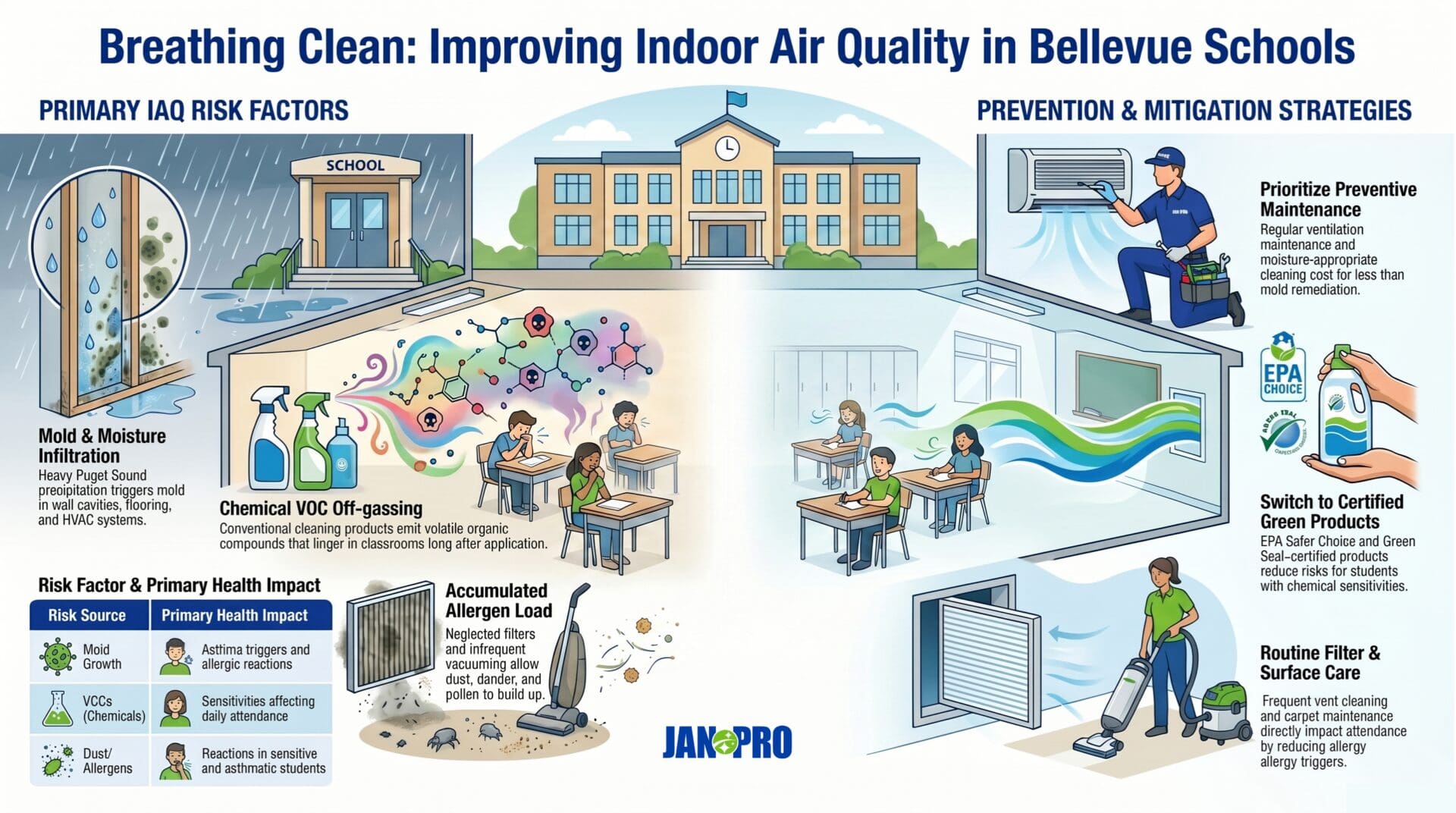
Mold and moisture
The Puget Sound region receives heavy precipitation from October through May. Bellevue school buildings that do not actively manage ventilation, moisture infiltration, and cleaning practices risk mold development in wall cavities, flooring, and HVAC systems. Mold triggers asthma, causes allergic reactions, and in serious cases requires remediation that closes classrooms. Prevention — proper ventilation maintenance, moisture-appropriate cleaning techniques — costs far less than remediation.
Chemical off-gassing from cleaning products
Conventional cleaning products emit volatile organic compounds (VOCs) that linger in the air after application. In a school cleaned at night for daytime occupancy, high-VOC products affect the air students and teachers breathe the following day. For Bellevue schools with students who have asthma or chemical sensitivities — a population present in every building — this has direct attendance implications. EPA Safer Choice and Green Seal–certified products significantly reduce this risk.
Dust, allergens, and filter neglect
Dust in classrooms, hallways, and HVAC systems carries allergens — pollen, pet dander, dust mites — that trigger reactions in sensitive students. Schools that skip vent cleaning, vacuum infrequently, or defer carpet and rug maintenance accumulate allergen load throughout the year. The students most affected are those with allergies and asthma, who are also among the most frequently absent.
The Bellevue School District Context
Bellevue Public Schools serves one of the most academically engaged communities in Washington State. The district’s schools — including Bellevue High School, Newport High School, Interlake High School, and the district’s numerous elementary and middle school campuses — operate under significant community scrutiny and high expectations for facility standards.
Several factors make indoor air quality and cleaning standards particularly relevant for Bellevue specifically:
- Building age variation: The Bellevue School District’s portfolio includes buildings of varying ages, from recently constructed facilities with modern HVAC systems to older buildings where ventilation infrastructure requires more active maintenance to perform adequately.
- High enrollment density: Bellevue’s schools serve a dense, growing population. Higher enrollment means higher surface contact rates, higher restroom occupancy, and faster illness transmission when cleaning protocols are inadequate.
- Community expectations: Bellevue’s parent community is engaged, informed, and attentive to facility conditions. Visible cleaning failures — or attendance patterns that suggest a facility hygiene problem — generate community concern and administrative pressure in a way that less engaged communities may not.
- Student health diversity: Like all large school districts, Bellevue serves students with a wide range of health conditions, including asthma, allergies, and immune system vulnerabilities. The indoor environment quality of the building has a disproportionate impact on these students’ attendance and academic continuity.
What Adequate School Cleaning Actually Requires in Bellevue
Given the specific risk factors above, here is what a cleaning program adequate for Bellevue’s school environment actually needs to include:
- EPA-registered disinfectants applied correctly. Not just present on the supply shelf — applied at the right dilution, with the correct dwell time, on the right surfaces, at the right frequency. This requires trained cleaning professionals who understand the difference between cleaning and disinfecting and apply that knowledge consistently.
- Consistent crew assignment. The same cleaning professional assigned to the same building on every scheduled visit. This is how institutional knowledge develops, how problem areas get identified, and how protocols get followed rather than approximated.
- Structured deep cleaning schedule. Restrooms, gymnasium floors, cafeteria surfaces, and ventilation components cannot be adequately maintained through nightly maintenance alone. A structured deep cleaning schedule — aligned to school breaks and low-occupancy periods — is required to prevent the accumulation that drives the health outcomes described above.
- Green cleaning products appropriate for occupied school environments. Particularly in Bellevue, where community awareness of chemical exposure is high and student health diversity requires attention to VOC off-gassing, cleaning product selection matters.
- Moisture-aware cleaning practices. In the Puget Sound region, cleaning practices that introduce moisture without adequate drying — improper mopping, over-wet carpet cleaning — contribute to the mold risk that the climate already elevates. Cleaning professionals working in Bellevue school buildings should understand and apply moisture-appropriate techniques.
- Ventilation and HVAC attention as part of the cleaning scope. Accessible vent cleaning, exhaust fan maintenance in restrooms and locker rooms, and identification of areas showing moisture or mold indicators should be part of a complete school cleaning program — not excluded from scope because they are less visible than floor and surface work.
How JAN-PRO Approaches School Cleaning in Bellevue
JAN-PRO Cleaning & Disinfecting provides school cleaning services in Bellevue and throughout the greater Puget Sound region. Our approach is built around one premise: a Bellevue school is not a generic commercial building, and it should not be cleaned like one.
Every JAN-PRO school cleaning program includes:
- Facility assessment before any program is built — floor types, ventilation conditions, and high-risk areas are identified first, not assumed
- Consistent crew assignment — the same certified, background-verified cleaning professional services your building every visit, no rotating pool
- Moisture-aware cleaning practices — specifically designed for the Pacific Northwest’s damp conditions, not adapted from a dry-climate program
- EPA-registered disinfectants — applied at the correct dilution and dwell time for educational environments, not general commercial use
- Green cleaning options — available for schools with student health considerations or district sustainability commitments
- Deep cleaning scheduled around your academic calendar — summer break, winter break, and low-occupancy windows built into the program from day one
The goal is not a building that looks clean at the end of a visit. It is a building that measurably reduces the transmission conditions that drive absenteeism — and holds that standard across the full school year.
Ready to Improve Cleaning Standards at Your Bellevue School?
If your school is experiencing attendance patterns that suggest a facility hygiene problem, if your current cleaning vendor is not delivering consistent results, or if you are evaluating school cleaning services in Bellevue for the first time, JAN-PRO will assess your facility and build a program around what it actually requires.
No rotating crews. No generic protocols applied without thought. No falling off after the first month.
Call (253) 589-9110 to schedule a free facility assessment. JAN-PRO serves schools and educational facilities throughout Bellevue, Redmond, Kirkland, Issaquah, Renton, and the greater King and Pierce County area.
Main office: 500 South 336th St, #201, Federal Way, WA.
About the Author
Aaron Hurlburt
 Aaron Hurlburt is the Regional Developer for JAN-PRO, a commercial cleaning company. He is grateful for the opportunity to serve the Puget Sound these past 25 years. Aaron’s primary focus is operational excellence by pairing the ideal franchisee with the appropriate client. Mr. Hurlburt’s office deploys Field Service Consultants to routinely quality control the service and drive greater operational synergies.