In Puget Sound, cleaning issues rarely show up all at once. They tend to build over time. A lobby near downtown Tacoma starts to lose its appearance sooner than expected. Offices in Federal Way notice lingering odors by midweek. Facilities in Kent deal with dust and moisture that keep coming back, even with regular service. On paper, everything is being cleaned, but the results don’t always last.
That’s where the difference between deep cleaning and regular cleaning becomes clear. If you manage a medical suite in Lakewood, an office near Commencement Bay, or a retail space along Pacific Highway, you’ve likely seen the pattern. Routine cleaning helps maintain the space, but certain problems continue to return. The issue isn’t doing more cleaning. It’s knowing when your facility needs a more thorough approach.
What Is the Difference Between Deep Cleaning and Regular Cleaning?
The difference between deep cleaning and regular cleaning comes down to scope, frequency, and purpose. Regular cleaning maintains surface-level cleanliness through routine tasks, while deep cleaning targets hidden contaminants, buildup, and high-touch areas that accumulate over time, improving hygiene, safety, and long-term facility conditions.
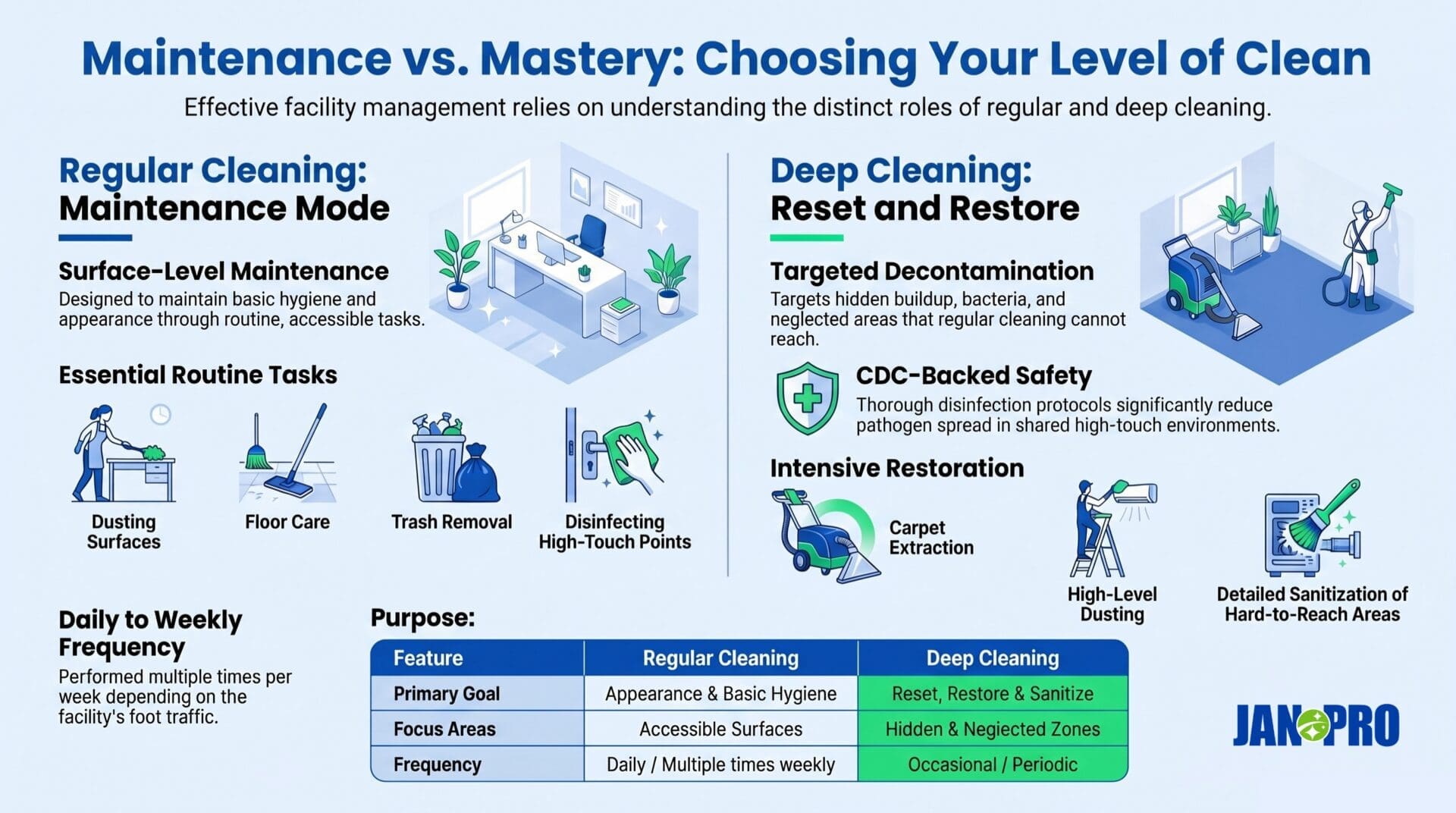
Regular Cleaning: Maintenance Mode
Regular cleaning is designed to maintain appearance and basic hygiene. It typically includes:
- Dusting accessible surfaces
- Vacuuming carpets and mopping floors
- Emptying trash and recycling
- Cleaning restrooms and break areas
- Disinfecting high-touch points (handles, switches)
This type of cleaning is usually performed daily or several times per week, depending on traffic levels.
Deep Cleaning: Reset and Restore
Deep cleaning goes further by addressing accumulated dirt, bacteria, and neglected areas. It often includes:
- Carpet extraction and upholstery cleaning
- Baseboard, vent, and grout cleaning
- High-level dusting (ceilings, fixtures)
- Detailed disinfection beyond visible surfaces
- Sanitizing hard-to-reach areas
According to the Centers for Disease Control and Prevention (CDC), thorough cleaning and disinfection protocols reduce the spread of pathogens in shared environments, especially in high-touch spaces.
When Should a Business Choose Deep Cleaning Over Regular Cleaning?
Businesses should choose deep cleaning when routine maintenance is no longer sufficient to control buildup, odors, or contamination risks. This typically occurs after seasonal changes, high-traffic periods, illness outbreaks, or before inspections, ensuring the environment meets health, safety, and operational standards.
Common Triggers for Deep Cleaning
- Seasonal transitions: Puget Sound’s wet climate increases indoor moisture and mold risk
- Post-illness outbreaks: Offices and schools need enhanced sanitation
- High foot traffic periods: Retail and event spaces accumulate faster buildup
- Before audits or inspections: Compliance with hygiene standards becomes critical
- Visible signs: Stains, odors, or dust accumulation beyond surface level
Situational Example
A common scenario in Puget Sound involves medical offices preparing for regulatory inspections. Even with daily cleaning, overlooked areas like vents, grout lines, and upholstery can harbor contaminants. A scheduled deep cleaning ensures compliance with standards such as those outlined by the Occupational Safety and Health Administration (OSHA).
How Do Cleaning Standards Define “Deep” vs “Routine” Cleaning?
Industry standards define regular cleaning as ongoing maintenance aligned with daily hygiene requirements, while deep cleaning aligns with periodic, intensive cleaning protocols designed to meet higher sanitation benchmarks and reduce long-term contamination risks.
Key Industry Standards
- The Occupational Safety and Health Administration (OSHA) requires workplaces to maintain sanitary conditions under OSHA 1910 guidelines
- The Environmental Protection Agency (EPA) regulates disinfectant use and effectiveness
- The ISSA Cleaning Industry Management Standard (CIMS) outlines measurable cleaning performance benchmarks
- The Global Biorisk Advisory Council (GBAC STAR) focuses on infection prevention and contamination control
According to the EPA, using approved disinfectants correctly is critical for eliminating pathogens, particularly in shared commercial spaces.
Practical Interpretation
- Regular cleaning = compliance baseline
- Deep cleaning = risk mitigation and performance optimization
Facilities that only rely on routine cleaning may meet minimum standards—but often fall short in long-term hygiene and indoor air quality.
Puget Sound Cleaning Needs: Local Conditions That Impact Your Strategy
Cleaning strategies in Puget Sound must account for regional factors like humidity, rainfall, and seasonal allergens, which increase indoor contamination risks. Facilities in Tacoma, Federal Way, and surrounding areas often require more frequent deep cleaning to maintain consistent indoor conditions.
Cleaning Frequency Framework
| Facility Type | Local Risk Factor (Puget Sound) | Recommended Regular Cleaning | Recommended Deep Cleaning | Source/Standard |
| Medical Offices | High patient turnover, infection risk | Daily | Monthly | CDC / OSHA |
| Office Buildings | Moderate traffic, HVAC dust buildup | 3–5x per week | Quarterly | ISSA CIMS |
| Retail Stores | Heavy foot traffic, seasonal spikes | Daily | Monthly or bi-monthly | Industry avg |
| Schools & Daycares | High contact surfaces, illness spread | Daily | Monthly | CDC guidance |
| Industrial Facilities | Dust, debris, safety compliance | Weekly | Quarterly | OSHA standards |
Note: Frequency recommendations align with federal guidance and regional environmental conditions in Washington State.
Why Local Conditions Matter
- Moisture: Encourages mold and mildew growth
- Pollen seasons: Affect indoor air quality, especially in spring
- Urban traffic: Brings in dirt and pollutants from outside
In practice, facilities near busy corridors like I-5 or industrial zones in Tacoma often see faster buildup than suburban offices, requiring a more aggressive cleaning schedule.
What Tasks Are Included in Deep Cleaning That Regular Cleaning Misses?
Deep cleaning includes specialized tasks that remove embedded dirt, bacteria, and contaminants from areas not addressed during routine cleaning, such as carpets, ventilation systems, and detailed surface sanitation, significantly improving hygiene and air quality.
Side-by-Side Comparison
| Area | Regular Cleaning | Deep Cleaning |
| Floors | Vacuum/mop | Extraction, polishing, grout cleaning |
| Surfaces | Wipe-down | Detailed sanitization, edge cleaning |
| Air Vents | Not included | Dust and debris removal |
| Upholstery | Spot cleaning | Full steam or extraction cleaning |
| Restrooms | Surface cleaning | Tile, grout, and fixture detailing |
Practical Insight
For instance, in an office setting, routine cleaning may keep desks and floors looking clean, but air vents and carpets continue to trap allergens and dust, impacting employee comfort and productivity.
This is why many businesses working with commercial cleaning services in Puget Sound integrate periodic deep cleaning into their maintenance plans to avoid long-term buildup and inconsistent results.
How Often Should You Schedule Deep Cleaning vs Regular Cleaning?
Regular cleaning should be performed daily or weekly, depending on facility use, while deep cleaning should be scheduled monthly, quarterly, or seasonally based on traffic levels, industry requirements, and environmental conditions to maintain consistent hygiene and prevent long-term buildup.
Decision Checklist for Facility Managers
Use this framework to determine your cleaning needs:
- Do you notice recurring dust or odors despite routine cleaning?
- Has your facility experienced increased foot traffic recently?
- Are you preparing for an inspection or audit?
- Do employees or visitors report air quality concerns?
- Has it been more than 3 months since your last deep cleaning?
If you answered “yes” to two or more, a deep cleaning is likely overdue.
Situational Example
In practice, a corporate office in downtown Tacoma may operate efficiently with routine cleaning during most of the year. However, after winter—when windows stay closed, and HVAC systems circulate dust—a deep cleaning becomes necessary to reset indoor conditions.
Businesses evaluating their options often compare providers, especially when searching for a commercial cleaning company in Tacoma, to ensure their cleaning plan aligns with both daily operations and long-term facility health.
Conclusion
Understanding the difference between deep cleaning and regular cleaning helps businesses maintain healthier, more consistent environments. Regular cleaning handles daily upkeep, while deep cleaning addresses hidden buildup and long-term risks. In Puget Sound’s climate, combining both approaches ensures better air quality, compliance, and overall facility performance.
If You’re Seeing Recurring Dust, Odors, or Inconsistent Cleaning Results, It’s Time to Adjust Your Strategy
When routine cleaning no longer keeps up with your facility’s demands—whether it’s moisture buildup, high traffic, or seasonal changes—it’s time to implement a plan tailored to your environment. Align your cleaning strategy with your operational needs by combining consistent maintenance with scheduled deep cleaning.
JAN-PRO Cleaning & Disinfecting in Puget Sound works with businesses across Tacoma, Federal Way, Kent, and surrounding areas to create structured cleaning programs that address both daily upkeep and long-term performance. From offices to medical facilities, the goal is to stabilize indoor conditions and reduce variability in results.
To move forward, contact the team at (253) 589-9110 or visit 500 South 336th St #201, Federal Way, WA 98003 to coordinate a cleaning plan that reflects your facility’s actual usage, not just a standard schedule.
FAQs Schema Markup Block
How often should deep cleaning be done in commercial spaces?
Most facilities benefit from deep cleaning monthly or quarterly, depending on usage and industry requirements.
Is deep cleaning necessary if regular cleaning is done daily?
Yes, because routine cleaning does not address buildup in carpets, vents, and hard-to-reach areas.
What industries need deep cleaning most frequently?
Healthcare, education, and high-traffic retail environments typically require more frequent deep cleaning.
Does deep cleaning improve indoor air quality?
Yes, by removing dust, allergens, and contaminants from HVAC systems and surfaces, it contributes to better air quality.
About the Author
Aaron Hurlburt
 Aaron Hurlburt is the Regional Developer for JAN-PRO, a commercial cleaning company. He is grateful for the opportunity to serve the Puget Sound these past 25 years. Aaron’s primary focus is operational excellence by pairing the ideal franchisee with the appropriate client. Mr. Hurlburt’s office deploys Field Service Consultants to routinely quality control the service and drive greater operational synergies.