

Hard water stains are white, chalky, or crusty mineral deposits left behind when water evaporates from a surface and its dissolved calcium and magnesium stay behind. In a commercial restroom, those deposits build on faucets, sinks, toilets, urinals, glass, and partitions, and they harden into scale that routine wiping does not remove. In Phoenix, where municipal water is mineral-rich and the dry air speeds evaporation, hard water stains are one of the most persistent appearance problems in office, medical, retail, and industrial restrooms.
The problem matters beyond looks. Restroom condition is one of the first signals visitors and employees use to judge how well a building is maintained. Scale also traps soil and soap residue, narrows faucet aerators, and wears down fixture finishes when it is removed with the wrong products or tools.
What Makes Water “Hard”
Water hardness is the concentration of dissolved minerals, mainly calcium and magnesium, measured as milligrams per liter (mg/L) of calcium carbonate. The U.S. Geological Survey classifies water above 180 mg/L as very hard and notes that the EPA sets no legal limit for hardness, because the minerals are not a health risk. The issue is operational: hard water causes scaling in equipment and requires more soap and detergent to clean effectively.
Phoenix draws on the Colorado River, Salt and Verde River, and groundwater supplies that pass through mineral-rich desert geology. Water delivered across the Valley commonly falls in the hard to very hard range, which means every splash in a restroom carries a measurable load of minerals.
Why Phoenix Restrooms Show Scale Faster
Two local conditions accelerate mineral deposits on restroom fixtures:
- High mineral content. More dissolved calcium and magnesium per gallon means more residue left behind per droplet.
- Low humidity and heat. Water evaporates quickly in the desert air, so droplets dry in place before anyone wipes them, leaving a mineral ring each time.
Hot water adds a third factor. Heating water drives carbon dioxide out of solution, which makes calcium carbonate less soluble and pushes it to deposit on surfaces. Hand sinks, hot-water taps, and fixtures near water heaters tend to scale first.
Where Mineral Deposits Form in Commercial Restrooms
Scale concentrates wherever water splashes, pools, or drips repeatedly. Each fixture type builds deposits for a slightly different reason.
| Fixture or surface | Why scale forms there | What it looks like |
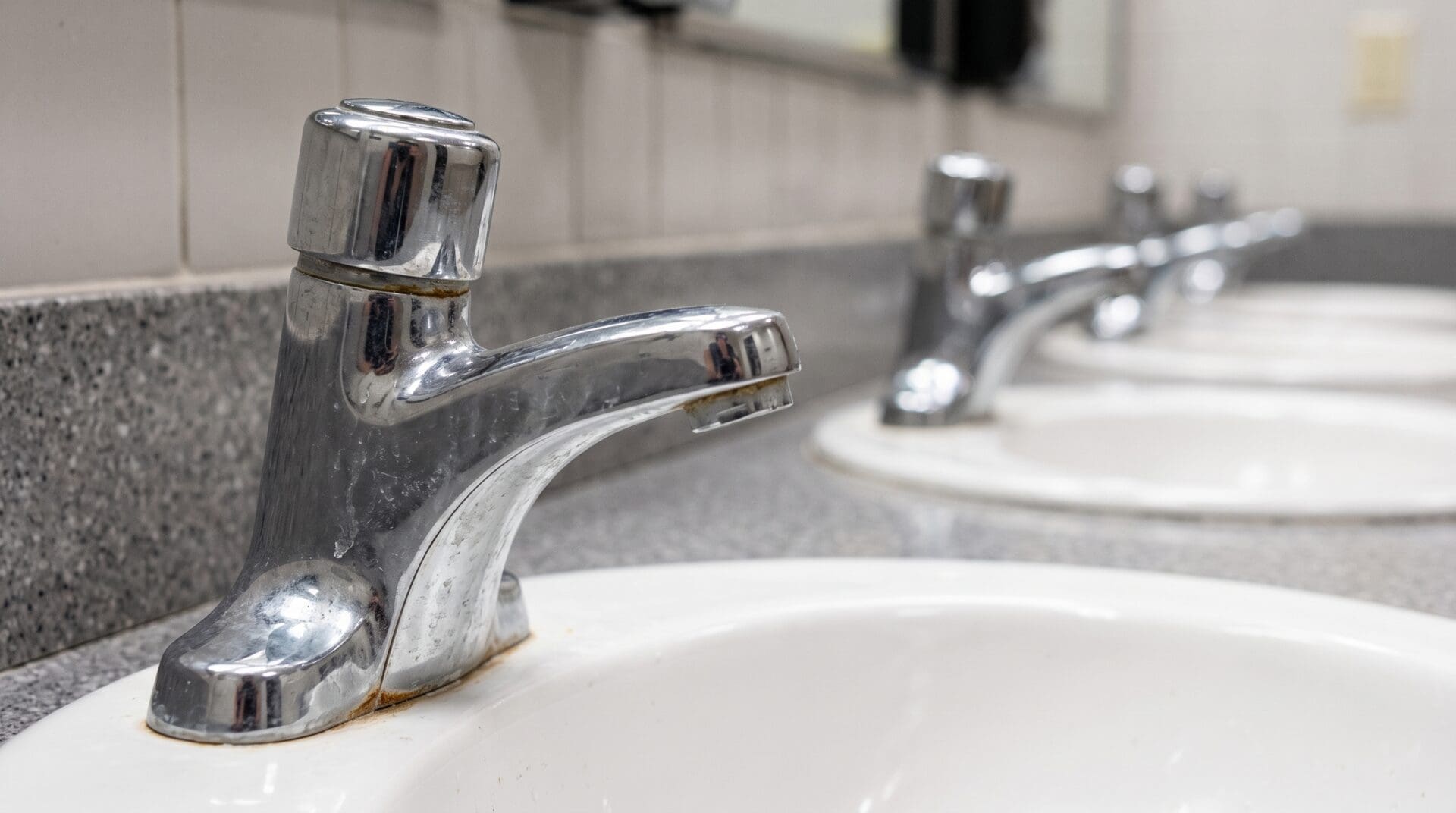
| Faucets and aerators | Constant drips and splash dry on chrome and inside the aerator screen | White crust at the spout base; reduced or uneven flow |
| Sink basins and drains | Standing water evaporates around the drain and overflow | Chalky rings and rough patches on porcelain |
| Toilet bowls | The waterline stays wet while the area above it dries | Gray or brown rings that hold stains and odor |
| Urinals and traps | Hard water minerals combine with urine scale | Hard, discolored buildup in the trap and outlet |
| Glass, mirrors, and partitions | Splash and overspray dry in visible spots | Cloudy film and water spots that streak when wiped |
| Touchless fixtures and sensors | Splash lands on sensor windows and housings | Hazy residue that can interfere with sensor response |
| Tile and grout near sinks | Repeated wetting of porous grout | White efflorescence-like haze and rough grout lines |
Why Hard Water Stains Keep Coming Back
Scale returns because the source is the water itself, not a lapse in cleaning. Every time a fixture is used, a new layer of minerals is deposited. Several common practices make the cycle worse:
- Cleaning with neutral or alkaline products only. General-purpose cleaners lift soil but do not dissolve calcium carbonate, so a thin mineral film is left behind after every pass.
- Leaving surfaces wet. Fixtures that are cleaned but not dried get a fresh mineral ring as the rinse water evaporates.
- Treating scale only when it is visible. Thin deposits dissolve easily. Thick, layered scale bonds to the surface and requires stronger chemistry and more dwell time.
- Soap scum layering. Hardness minerals react with soap to form an insoluble film that mineral deposits then bind to, building a stubborn composite layer.
- Using abrasive pads. Scouring removes scale but scratches chrome, glass, and porcelain glazes. Scratched surfaces give new deposits more texture to grip.
How Hard Water Stain Removal Works
Calcium carbonate is alkaline, so it dissolves in acid. Effective hard water stain removal in Phoenix facilities relies on matching the acid strength and dwell time to the surface and the thickness of the deposit.
Common descaling chemistry
- Mild acids (citric, lactic, or acetic-based products) for light, routine scale on chrome, glass, and porcelain.
- Stronger acid descalers (phosphoric, sulfamic, or hydrochloric-based bowl cleaners) for heavy buildup in toilets and urinals, used only where the manufacturer approves them.
- Dwell time to let the product break down the mineral bond before agitation, instead of relying on scrubbing force.
Surface and safety precautions
- Natural stone such as marble, travertine, and limestone is itself calcium carbonate. Acid descalers etch it permanently, so stone counters and floors need stone-safe, pH-neutral products and separate scale-control methods.
- Specialty finishes such as brushed nickel, matte black, and PVD-coated fixtures can discolor under strong acids. Fixture manufacturer care guidance should be checked first.
- Never mix acid cleaners with bleach. The combination releases toxic chlorine gas. Acid and chlorine products must be used separately, with rinsing in between.
- Rinse and dry after descaling. Residual acid continues to act on metal finishes, and leftover water starts a new deposit.
How to Keep Scale From Building Up
Prevention costs less effort than removal. Facilities that keep restrooms consistently free of hard water stains usually follow a layered routine:
- Every service visit: clean high-splash zones (faucets, sink decks, mirrors, partitions) and dry them with microfiber so no droplets are left to evaporate.
- On a set periodic cycle: apply a mild descaler to fixtures, toilet bowls, and urinals before deposits become visible.
- As needed: perform restorative descaling on heavy, layered buildup, followed by a return to the preventive schedule.
- Ongoing: track problem fixtures, such as leaking faucets or running toilets, and report them to facility management. A constant drip produces scale faster than any cleaning schedule can remove it.
Water softening or point-of-use filtration reduces mineral load at the source, but it is a building infrastructure decision that facility managers and plumbing contractors evaluate separately from routine commercial restroom cleaning in Phoenix.
How Commercial Cleaning Providers Approach Hard Water in Restrooms
Established providers treat hard water as a predictable site condition rather than a one-time stain problem. JAN-PRO Cleaning & Disinfecting in Phoenix builds restroom scale control into the cleaning plan for each facility, based on how the restrooms are used and what the fixtures are made of.
That approach typically includes:
- Site assessment: identifying fixture materials, stone or specialty finishes, high-traffic restrooms, and fixtures that already show layered scale.
- Product matching: selecting descaling products by surface type, so chrome, glass, porcelain, and stone each receive compatible chemistry.
- Scheduled prevention: pairing routine wipe-and-dry service with periodic descaling, instead of waiting for visible buildup.
- Documented checklists: using restroom checklists that list each fixture and task, so scale-prone areas such as aerators, urinal traps, and partition bases are not missed.
- Condition reporting: flagging leaks, running toilets, and damaged finishes to the facility contact, since those issues drive scale faster than cleaning can control it.
Certified franchise owners serving the Valley apply these methods across offices, medical buildings, schools, and other facilities that rely on commercial cleaning services in Phoenix to keep high-use restrooms presentable between visits.
Key Takeaways on Hard Water Stains
- Hard water stains are calcium and magnesium deposits left when mineral-rich water evaporates.
- Phoenix restrooms scale faster because of hard municipal water, low humidity, and heat.
- Scale returns after every use, so prevention through daily drying and periodic descaling matters more than occasional heavy removal.
- Acid-based descalers dissolve mineral deposits but must be matched to the surface, kept away from natural stone, and never mixed with bleach.
- Leaks and running fixtures should be repaired, since they produce scale continuously.
Restroom Scale Control With JAN-PRO Cleaning & Disinfecting in Phoenix
For facilities where hard water stains keep returning despite regular cleaning, a structured program that combines surface-specific descaling with consistent preventive service is usually the most effective path. JAN-PRO Cleaning & Disinfecting in Phoenix provides janitorial cleaning in Phoenix through certified franchise owners who follow documented restroom procedures adapted to local water conditions. Facility managers can reach the regional office at (602) 438-1000 or at 4511 E Broadway Rd in Phoenix to discuss restroom care for their buildings.
Frequently Asked Questions
What causes hard water stains in commercial restrooms?
Hard water stains form when water containing dissolved calcium and magnesium evaporates from a fixture and leaves the minerals behind. Repeated splashing and drying builds these deposits into hard scale on faucets, sinks, toilets, urinals, and glass.
Why do hard water stains come back so quickly in Phoenix?
Phoenix water is mineral-rich, and the city’s heat and low humidity make water droplets evaporate before they are wiped away. Each use of a fixture deposits a new mineral layer, so scale returns unless surfaces are dried and descaled on a regular schedule.
What removes hard water stains from restroom fixtures?
Acid-based descalers dissolve calcium carbonate deposits. Mild acids such as citric or lactic acid handle light scale, while stronger descalers are used for heavy buildup in toilets and urinals, always matched to the fixture material and followed by rinsing and drying.
Can descalers damage restroom surfaces?
Yes. Acid descalers permanently etch natural stone such as marble and travertine, and strong acids can discolor specialty fixture finishes. Acid cleaners must also never be mixed with bleach, because the combination releases toxic chlorine gas.
How can facilities prevent mineral deposits on restroom fixtures?
Prevention combines wiping and drying high-splash areas at every cleaning visit, applying a mild descaler on a periodic schedule, and repairing leaks or running fixtures that deposit minerals continuously.
About the Author
Carter James
 Carter James is Vice President of Strategy & Development, leading growth strategy, acquisitions, and multi-market expansion within a facility services platform. His background includes corporate strategy, M&A integration, and franchise development. He partners with senior leadership to drive disciplined execution, scalable operations, and long-term value through data-driven, high-accountability leadership.