
Commercial flooring represents a significant capital investment for business facilities. In high-traffic environments, the porous nature of grout often leads to deep-seated discoloration and structural degradation. Choosing between professional maintenance and full regrouting requires an understanding of long-term material health, labor costs, and the specific environmental challenges found in the Southwest.
Understanding Grout Degradation in Commercial Environments
Grout is a mixture of water, cement, and sand, making it inherently porous. In commercial settings, these pores act as repositories for organic matter, moisture, and chemical residues. Over time, the accumulation of contaminants leads to bacterial growth and a weakening of the grout’s physical bond to the tile.
In the Phoenix metropolitan area, the presence of fine desert dust (caliche) and high mineral content in local water supplies can accelerate this wear. When minerals and dust settle into the floor, they create an abrasive paste that can erode grout lines during standard mopping. Identifying the signs your business needs grout cleaning is essential to preventing the total failure of the flooring system.
The Economic Impact: Cleaning vs. Regrouting
Regrouting is a restorative process that involves mechanically removing existing grout and applying new material. This process is labor-intensive and requires significant facility downtime. Conversely, specialized cleaning utilizes high-pressure extraction and chemical emulsifiers to remove deep stains without removing the grout itself.
Comparison Table: Lifespan and Maintenance
| Feature | Professional Grout Cleaning | Full Regrouting |
| Primary Goal | Soil extraction and sanitization | Material replacement |
| Typical Duration | 4–8 hours (depends on square footage) | 2–5 days |
| Operational Impact | Minimal; floors usable within hours | High; area must be cordoned off |
| Material Lifespan | Extends existing grout life by 3–5 years | Resets lifespan to 10+ years |
| Slip Resistance | Restores original friction levels | High (when new) |
Grout Chemistry: Cement-Based vs. Epoxy Grout
The composition of the grout determines its vulnerability to the Phoenix climate. Most commercial installations utilize cementitious grout, which relies on a cement-based binder. This material is highly susceptible to “wicking”—a phenomenon where moisture pulls deep-seated dirt to the surface during the drying process.
In contrast, many modern industrial kitchens or medical facilities utilize epoxy grout. While epoxy is non-porous and resistant to chemical erosion, it can still develop a “biofilm” or greasy layer on the surface. Professional maintenance ensures that the correct pH-balanced cleaners are used: alkaline solutions for grease on epoxy, and neutral cleaners for sensitive cement-based substrates to prevent etching.
Slip Resistance and Safety Standards
Maintaining grout integrity is a critical component of workplace safety. The Occupational Safety and Health Administration (OSHA) emphasizes the importance of maintaining clean, dry walking surfaces to prevent slips, trips, and falls.
When grout becomes saturated with grease or floor wax, it loses its recessed profile, creating a slick surface across the entire floor plane. Professional cleaning restores the grout’s texture, providing necessary “traction channels” that allow liquids to move away from the shoe-to-floor contact point. This restoration of the Dynamic Coefficient of Friction (DCOF) is a primary benefit of consistent maintenance over reactive replacement.
Regional Challenges: Moisture and Desert Dust
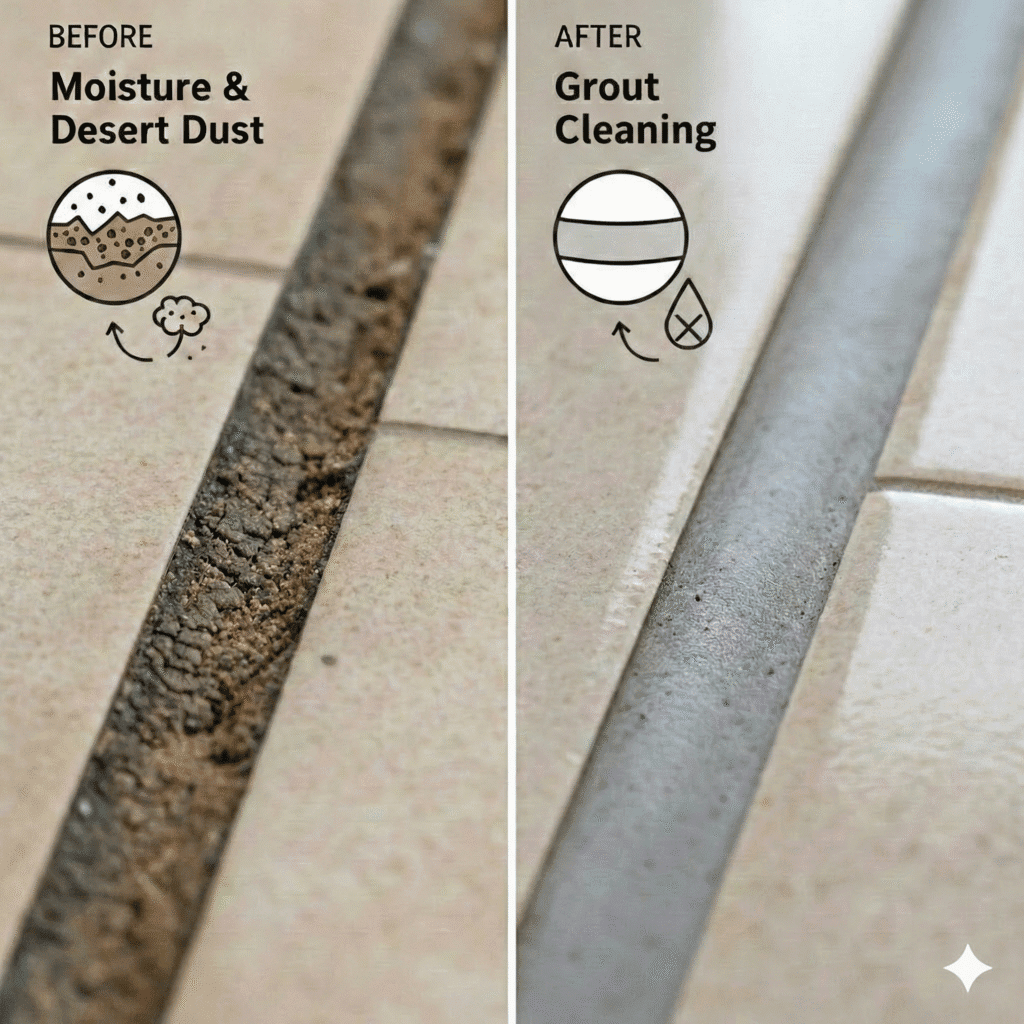
Phoenix commercial spaces face unique challenges due to the extreme heat and low humidity, which can cause grout to become brittle and crack if not properly sealed. Furthermore, the fine silt common to the Sonoran Desert can permeate grout pores more deeply than standard household dust.
When dust is combined with the occasional moisture from HVAC condensation or industrial cleaning, it can lead to “wicking”—a process where deep-seated dirt rises to the surface as the floor dries. Addressing these issues through comprehensive janitorial services in Phoenix ensures that these particulates are extracted rather than merely redistributed.
Commercial Maintenance Checklist by Facility Type
A standardized approach to grout care is not universal; it must be tailored to the specific soil loads of the environment.
| Facility Type | High-Traffic Area | Cleaning Priority | Recommended Frequency |
| Healthcare | Patient Rooms & Lobbies | Sanitization & Biohazard Removal | Quarterly Deep Clean |
| Restaurants | Kitchens & Dining Rooms | Degreasing & Odor Control | Monthly Deep Clean |
| Retail | Entryways & Checkout | Sand/Silt Extraction | Bi-Annual Deep Clean |
| Offices | Breakrooms & Restrooms | Spill Removal & Esthetics | Annual Deep Clean |
Professional Maintenance Methodologies in Phoenix
Established providers like JAN-PRO Cleaning & Disinfecting in Phoenix utilize a systematic approach to floor care that prioritizes the preservation of the existing substrate. The process typically involves:
- Pre-Treatment: Application of alkaline or acidic cleaners to break down surface tension.
- Agitation: Utilizing specialized brushes to loosen embedded desert silt.
- High-Pressure Extraction: Using heated water and vacuum systems to remove contaminants from deep within the pores.
- Sealing: Applying a hydrophobic barrier to prevent future liquid absorption and staining.
By focusing on these advanced extraction techniques, facilities can avoid the high capital expenditure of regrouting while maintaining a sterile and aesthetically pleasing environment.
Conclusion
For the majority of commercial facilities in Phoenix, professional cleaning is the most cost-effective and efficient way to maintain tile infrastructure. While regrouting is necessary for cracked or missing material, deep cleaning addresses the root causes of discoloration and slip hazards without the need for destructive demolition.
Does your facility require a professional assessment?
Maintaining the longevity of commercial flooring requires specialized equipment and expertise. JAN-PRO Cleaning & Disinfecting in Phoenix provides high-standard floor care solutions designed to protect your investment and ensure a safe environment for employees and customers alike.
Contact a certified unit franchise in Phoenix at 4511 E Broadway Rd., Phoenix, AZ, or call 602-438-1000 for a comprehensive facility assessment.