Commercial cleaning certifications are one of the most reliable ways to evaluate whether a cleaning provider can meet safety, compliance, and performance expectations. In New Castle—where businesses operate near the Christina River waterfront, along Route 9 industrial corridors, and in high-traffic areas near downtown Wilmington—cleaning is directly tied to workplace health and operational stability.
If you’re managing a facility in this region, the concern is practical: inconsistent cleaning, employee health complaints, or unclear compliance standards can quickly become operational risks. Certifications provide a framework that ensures cleaning isn’t just done—but done correctly, consistently, and in line with organizations like the Occupational Safety and Health Administration (OSHA) and the Environmental Protection Agency (EPA).
What Are Commercial Cleaning Certifications and Why Do They Matter?
Commercial cleaning certifications are formal credentials issued by recognized organizations that verify a cleaning company follows standardized procedures for safety, hygiene, and operational consistency. They ensure alignment with OSHA regulations, EPA guidelines, and structured cleaning frameworks like those developed by the Worldwide Cleaning Industry Association (ISSA).
For facility managers in New Castle, certifications answer a key question: Can this provider consistently meet compliance and health standards across your building?
Why Certifications Matter for New Castle Businesses
- Regulatory compliance: OSHA requires proper chemical handling and hazard communication
- Health protection: EPA-approved disinfectants reduce pathogen exposure
- Operational consistency: Standardized processes reduce variability between service visits
- Risk management: Documented procedures help lower liability
According to OSHA, employers are responsible for maintaining safe workplaces, including sanitation practices that directly impact employee well-being.
In Practice
A common scenario in multi-tenant office buildings near downtown Wilmington involves inconsistent cleaning between shared spaces. Without standardized certifications, one area may meet expectations while another falls short. Certified providers apply uniform protocols that eliminate this variability.
What Certifications Should a Certified Commercial Cleaning Company Have?
A certified commercial cleaning company should hold industry-recognized credentials such as ISSA CIMS, GBAC STAR accreditation, OSHA compliance training, and Green Seal certification. These certifications confirm expertise in infection prevention, environmental safety, and standardized cleaning operations.
Core Certifications to Look For
- ISSA Cleaning Industry Management Standard (CIMS): Evaluates quality control, service delivery, and management systems.
- Global Biorisk Advisory Council (GBAC) STAR Accreditation: Focuses on infection prevention and biohazard response.
- OSHA Compliance Training: Ensures proper handling of chemicals and workplace safety protocols.
- Green Seal Certification: Verifies environmentally responsible cleaning practices.
- EPA Safer Choice Program: Confirms the use of safer, approved cleaning products.
Supporting Standards
- American Society of Heating, Refrigerating, and Air-Conditioning Engineers (ASHRAE) guidelines for indoor air quality
- Centers for Disease Control and Prevention (CDC) cleaning protocols
These certifications collectively ensure that cleaning practices are not improvised but built on proven frameworks.
How Do Certifications Impact Health, Safety, and Compliance?
Certifications directly influence workplace safety, indoor air quality, and regulatory compliance by enforcing structured cleaning procedures, proper chemical use, and infection control protocols. They reduce risks tied to contamination, inconsistent cleaning, and regulatory violations.
Key Areas of Impact
Chemical Safety
Certified providers follow OSHA standards for:
- Labeling and storage of cleaning products
- Staff training on hazardous materials
- Access to Safety Data Sheets (SDS)
Infection Control
Protocols based on GBAC and CDC guidelines include:
- High-touch surface disinfection
- Cross-contamination prevention
- Defined cleaning frequencies
Indoor Air Quality
ASHRAE guidelines highlight how dust and contaminants—especially in warehouse environments near the Port of Wilmington—can impact HVAC systems and employee health. According to the Environmental Protection Agency (EPA), indoor air quality can be significantly affected by cleaning practices and product selection.
Situational Example
For instance, a healthcare clinic may require strict disinfection protocols with defined dwell times. Without certified training, cleaning staff may unintentionally reduce disinfectant effectiveness—impacting patient safety.
What Certifications Are Most Relevant for New Castle Facilities?
The most relevant certifications for New Castle facilities depend on building type, but typically include ISSA CIMS, GBAC STAR, OSHA compliance, and Green Seal. Each facility type has different operational risks, requiring specific certification combinations.
| Facility Type | Required Certifications | Why It Matters Locally | Regulatory Alignment Source |
| Medical Offices (Wilmington area) | GBAC STAR, OSHA, ISSA CIMS | Infection control for patient-facing environments | CDC / OSHA |
| Warehouses (Route 9 corridor) | OSHA, ISSA CIMS | Dust control and worker safety in high-volume operations | OSHA |
| Corporate Offices (Downtown) | ISSA CIMS, Green Seal | Consistency and indoor air quality in shared spaces | EPA / ISSA |
| Schools & Educational Facilities | GBAC STAR, Green Seal | Student health and reduced allergen exposure | CDC / EPA |
| Retail Centers (New Castle County) | ISSA CIMS, OSHA | High-touch sanitation and customer-facing cleanliness | OSHA / ISSA |
How to Verify a Cleaning Company’s Certifications
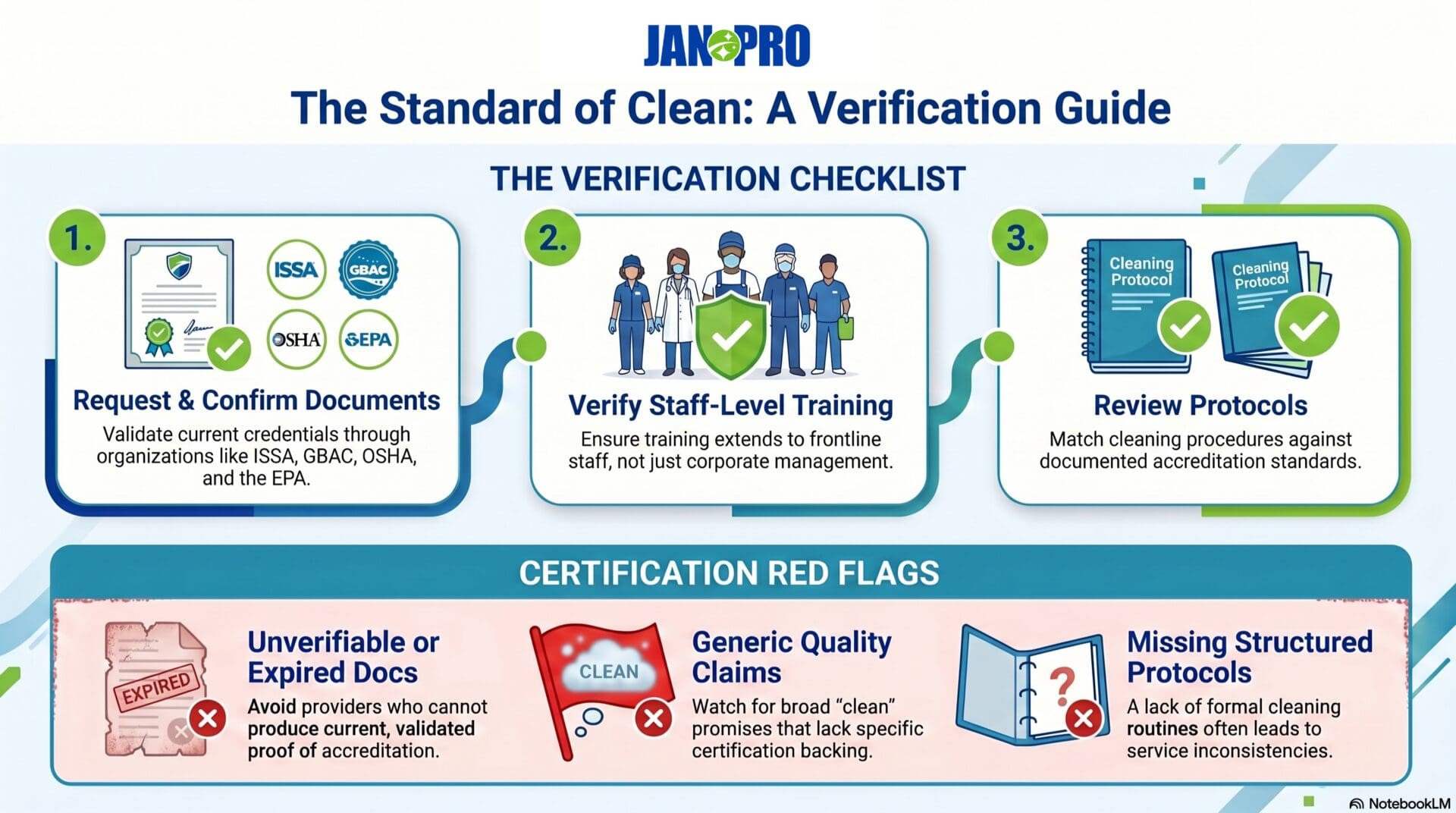
To verify a cleaning company’s certifications, request documentation, confirm credentials with issuing organizations, and ensure certifications apply to both management and frontline staff. Not all certifications guarantee consistent execution if staff are not properly trained.
Certification Verification Checklist
- Request up-to-date certification documents
- Confirm accreditation through ISSA, GBAC, or other organizations
- Verify staff-level training, not just corporate credentials
- Review cleaning procedures and documentation
- Check alignment with OSHA and EPA standards
Common Red Flags
- Expired or unverifiable certifications
- Generic claims without proof
- Lack of structured cleaning protocols
Many facility managers uncover gaps only after service inconsistencies appear, often due to missing or poorly implemented certifications.
How JAN-PRO Certifications Support Safety and Trust in New Castle Facilities
JAN-PRO Cleaning & Disinfecting franchisees follow recognized certifications and industry standards, including OSHA compliance, EPA-approved disinfecting practices, and ISSA-aligned cleaning systems. These certifications ensure that facility owners in New Castle receive consistent, verifiable cleaning processes that meet health, safety, and regulatory expectations.
For facility managers, certifications aren’t just credentials—they translate into predictable outcomes. JAN-PRO’s approach is built around structured systems designed to reduce variability and align with real-world compliance requirements across different industries.
What This Means for Your Facility
JAN-PRO Cleaning & Disinfecting in New Castle integrates certification-based processes into daily operations, including:
- OSHA-aligned safety protocols: Franchisees are trained to follow hazard communication standards, proper chemical handling, and PPE usage in line with OSHA 29 CFR 1910.1200.
- EPA-approved disinfecting systems: Cleaning products and methods align with EPA guidelines, helping reduce exposure to harmful pathogens in workplaces.
- ISSA-based cleaning methodologies: Standardized processes ensure consistent service delivery, quality control, and measurable results across facilities.
- Infection prevention practices: Procedures reflect CDC and GBAC principles for high-touch surface disinfection and cross-contamination prevention.
Why This Builds Trust Locally
In a market like New Castle, cleaning requirements vary widely. Certifications allow JAN-PRO franchisees to adapt those standards to each environment without losing consistency.
This means a facility manager doesn’t have to second-guess whether protocols are being followed. Cleaning routines are documented, staff are trained under recognized frameworks, and processes are designed to meet both internal expectations and external regulations.
By aligning with established safety standards, JAN-PRO Cleaning & Disinfecting provides a structured, transparent approach that helps businesses maintain compliance while improving day-to-day operational reliability.
Do Certifications Affect Cleaning Costs and Service Quality?
Yes, certifications influence both cost and service quality by requiring trained personnel, structured processes, and compliance with regulatory standards. While certified providers may have higher upfront costs, they typically reduce long-term operational risks.
Cost vs. Value Comparison
| Factor | Non-Certified Provider | Certified Provider |
| Cleaning Consistency | Variable | Standardized |
| Compliance Risk | Higher | Lower |
| Staff Training | Minimal | Documented |
| Long-Term Costs | Unpredictable | More controlled |
For businesses evaluating janitorial services in New Castle, certifications often explain differences in pricing and service reliability.
Conclusion
Commercial cleaning certifications provide a structured foundation for safety, compliance, and consistent service delivery. For New Castle businesses, they reduce risk, improve indoor conditions, and ensure alignment with OSHA, EPA, and industry standards. Verified certifications also make it easier to evaluate providers and maintain operational consistency across facilities.
If Your Facility Is Struggling with Inconsistent Cleaning or Compliance Gaps
If your building is experiencing uneven cleaning results, rising safety concerns, or difficulty meeting compliance requirements, it may be time to implement a structured cleaning system based on verified certifications. JAN-PRO Cleaning & Disinfecting in New Castle, located at 2417 Lancaster Ave Ste. 101, Wilmington, supports businesses across multiple locations with trained franchisees and standardized processes.
Call 302-324-5240 to implement a cleaning plan tailored to your facility type—whether you operate in a downtown office, a healthcare setting, or an industrial space along Route 9. Align your cleaning strategy with certified systems to improve consistency, reduce risk, and maintain operational standards across your workspace.
FAQs
What is the most important commercial cleaning certification?
ISSA CIMS is widely recognized for evaluating cleaning management systems, while GBAC STAR focuses on infection prevention.
Are OSHA certifications required for cleaning companies?
Cleaning companies must comply with OSHA standards, including hazard communication and safety training.
How can I verify cleaning certifications?
Request documentation and confirm credentials through organizations like ISSA or GBAC.
Do certified cleaning companies cost more?
They may cost more upfront, but often reduce long-term risks and inconsistencies.
How often should certifications be renewed?
Most commercial cleaning certifications must be renewed every 1–3 years, depending on the program. For example, ISSA CIMS is typically renewed annually, while GBAC STAR and Green Seal often follow a 1–3 year re‑accreditation cycle. OSHA‑related safety and chemical‑handling training usually requires refresher courses every 1–3 years as well. Always ask your provider for the original issue date and renewal schedule to confirm they’re maintaining current, valid credentials.
About the Author
 Jon Brodack
 Jon Brodack
Jonathan Brodack is Director of Sales & Marketing at JAN-PRO Franchise Development of the Delaware Valley. Holding an MBA from Rutgers University–Camden, he combines a data-informed approach with a focus on building enduring professional partnerships. He is dedicated to driving franchise growth and market expansion through a strategy centered on long-term relationship development.