In the busy commercial corridors of New Castle, Delaware, maintaining a pristine facility is about more than just appearances—it is about the health and safety of your workforce and customers.
Whether you are managing a high-traffic retail space near the New Castle Battery Park or an office complex bordering the Christina River, the terminology of cleanliness can often feel overlapping. Business owners frequently use “sanitizing” and “disinfecting” interchangeably, yet these processes serve distinct roles in a professional maintenance strategy.
For facility managers along the Route 13 corridor, choosing the wrong method can lead to inefficient chemical use or, worse, a failure to eliminate dangerous pathogens during peak flu and cold seasons. This guide clarifies the technical differences so you can align your cleaning protocols with the specific needs of your Delaware business environment.
What is the Difference Between Sanitizing and Disinfecting?
Sanitizing reduces the number of bacteria on surfaces to a safe level as judged by public health standards, typically killing 99.9% of germs within 30 seconds. Disinfecting uses stronger chemicals to kill nearly 100% of bacteria, viruses, and fungi listed on the product’s label, usually requiring a longer dwell time of several minutes.
While both processes aim to improve hygiene, the distinction lies in the “kill rate” and the type of pathogens targeted. According to the Environmental Protection Agency (EPA), sanitizers are designed for surfaces that come into contact with food or skin, where a reduction in bacterial load is sufficient.
In contrast, disinfectants are registered to destroy or irreversibly inactivate specific viruses and bacteria. For a warehouse or office space, understanding this hierarchy is essential for effective commercial disinfectant cleaning services in New Castle that protect against more resilient pathogens.
Comparative Technical Analysis: Sanitizing vs. Disinfecting
| Feature | Sanitizing | Disinfecting |
| Primary Goal | Reduce bacterial load to safe levels. | Completely kill/inactivate all pathogens. |
| Kill Rate | 99.9% of specific bacteria. | 99.999% to 100% of bacteria and viruses. |
| Dwell Time | 30–60 Seconds. | 3–10 Minutes (product dependent). |
| Regulatory Body | EPA (Food Contact/Public Health). | EPA (Registered Disinfectant/List N). |
| Common Pathogens | Staphylococcus aureus, E. coli. | Influenza, Norovirus, SARS-CoV-2, Fungi. |
| Surface Application | Food prep areas, breakrooms, gym mats. | Restrooms, door handles, and medical clinics. |
| Safety Profile | Generally lower chemical toxicity. | Requires specific PPE (Gloves/Masks). |
The Science of Dwell Time
One of the most overlooked aspects of professional cleaning is “dwell time“—the amount of time a solution must remain wet on a surface to be effective.
- Sanitizers: Generally require 30 to 60 seconds of contact.
- Disinfectants: Often require 3 to 10 minutes of contact to achieve full efficacy against tougher viruses like Norovirus or Influenza.
When Should Your Business Prioritize Sanitizing?
Sanitizing is the preferred method for surfaces that require frequent, rapid cleaning and where the risk of heavy viral contamination is lower. It is the standard for food preparation areas, breakroom tables, and shared workstations where the primary goal is to maintain a baseline level of hygiene without using the harshest available chemicals.
In a commercial setting, sanitizing is a “maintenance” step. For example, a shared breakroom in a facility near the New Castle Airport would be sanitized multiple times a day to manage common bacteria.
This process is governed by the Occupational Safety and Health Administration (OSHA) under various safety standards to ensure that the chemicals used do not pose a respiratory risk to employees during frequent application. By focusing on sanitization for low-risk touchpoints, businesses can maintain a healthy environment without over-applying heavy-duty disinfectants.
Common Areas for Sanitization
- Kitchenettes and Cafeterias: Countertops and tables where food is consumed.
- Gym Equipment: Handles and seats in office fitness centers.
- Reception Desks: Areas where guests briefly interact with staff.
Why is Disinfecting Critical for New Castle Facilities?
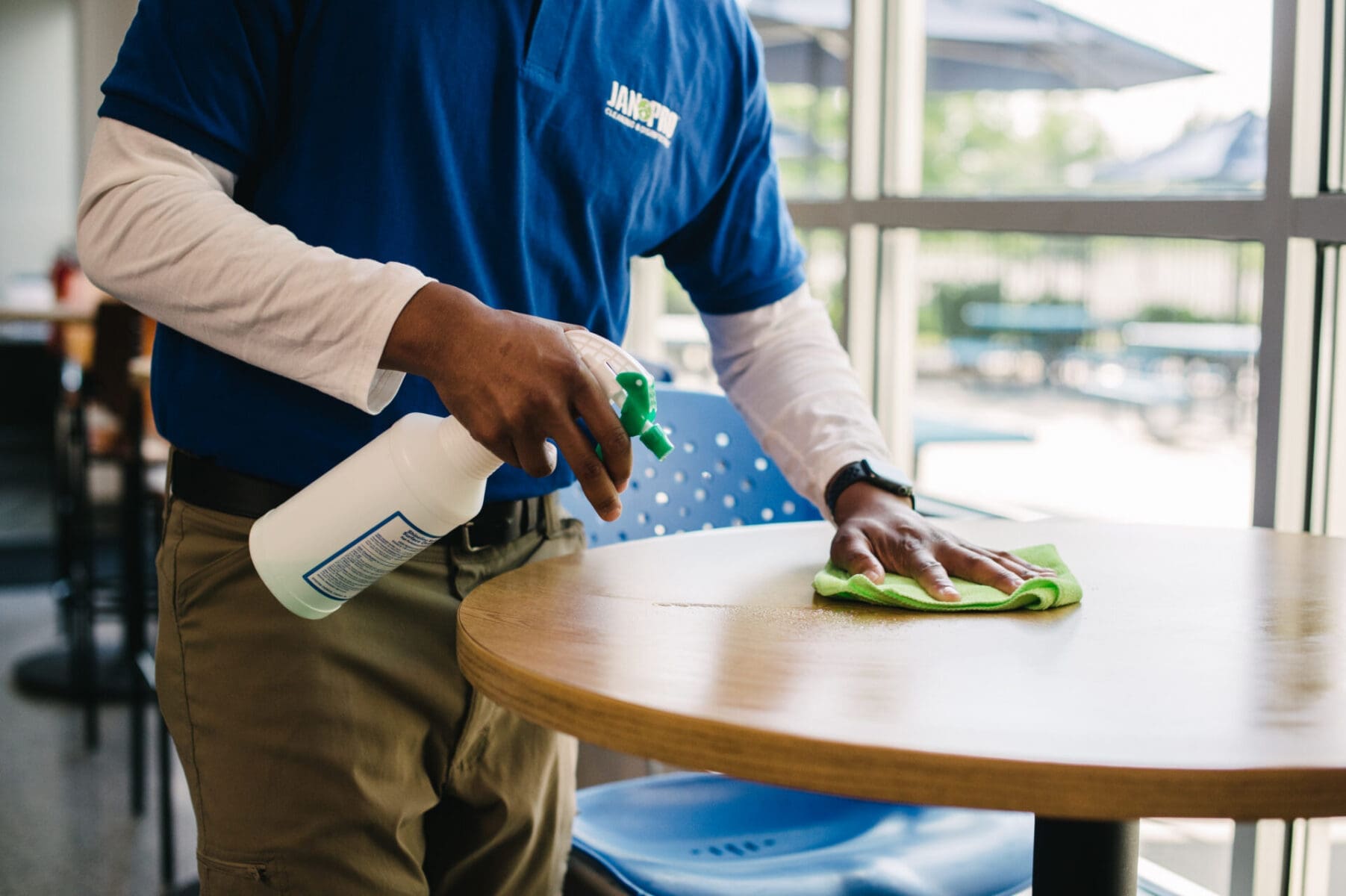
Disinfecting is necessary for high-touch surfaces and “hot spots” where germs are likely to congregate and spread, such as restrooms, door handles, and elevator buttons. This process is the only way to ensure that harmful viruses and fungi are completely neutralized, providing a higher level of protection than simple sanitizing.
For businesses operating in densely populated areas like downtown Newark or the commercial hubs of New Castle, disinfecting becomes a vital line of defense during seasonal illness outbreaks.
Using janitorial services in Newark, DE that utilize hospital-grade disinfectants ensures that your facility meets the Centers for Disease Control and Prevention (CDC) guidelines for environmental cleaning. Disinfection is not just about removing dirt; it is a chemical process that breaks down the cell walls of pathogens to prevent them from replicating.
High-Touch Disinfection Points
| Surface Type | Recommended Frequency | Protocol |
| Doorknobs/Push Plates | Daily or Twice Daily | Full disinfection with dwell time |
| Light Switches | Daily | Targeted wipe-down with disinfectant |
| Restroom Fixtures | Multiple times daily | Deep disinfection and odor control |
| Shared Keyboards | End of shift | Sanitization or light disinfection |
How Do Regulatory Standards Impact Your Cleaning Choices?
Regulatory standards from the EPA and the Association for Professionals in Infection Control and Epidemiology (APIC) dictate which products can be labeled as “disinfectants” versus “sanitizers.” Compliance requires that business owners use products with an EPA Registration Number and follow the manufacturer’s instructions to ensure the chemical performs as advertised.
In the United States, professional cleaning organizations often look to the International Sanitary Supply Association (ISSA) for the Cleaning Industry Management Standard (CIMS). This framework helps facilities in New Castle and the surrounding Delaware Valley maintain a “clean-for-health” environment rather than just a “clean-for-appearance” one. Adhering to these standards protects the business from liability and ensures that the cleaning staff—whether in-house or outsourced—is following scientifically backed procedures.
The Role of List N
During public health emergencies, the EPA maintains “List N,” which identifies disinfectants that have been tested and proven effective against emerging viral pathogens. Ensuring your cleaning provider uses List N-approved chemicals is a key part of modern facility management.
Integrating a Hybrid Approach for Maximum Efficiency
A successful facility management plan does not choose one over the other; instead, it integrates both sanitizing and disinfecting into a cohesive schedule. This hybrid approach ensures that resources are used efficiently—disinfecting where the risk is high and sanitizing where the risk is lower—to maintain a balanced, safe environment.
For a large-scale operation near the Delaware River, this might look like a daily janitorial routine focused on sanitizing common areas, supplemented by a weekly or bi-weekly deep-disinfection service.
This strategy follows the ISSA Clean Standard, which emphasizes measuring cleaning effectiveness to ensure that pathogens are being removed as intended. By rotating these methods, you extend the life of your furniture and surfaces by avoiding the over-saturation of strong chemicals while still guaranteeing a hygienic space for your occupants.
Step-by-Step Implementation
- Identify: Map out “high-touch” vs. “low-touch” zones.
- Train: Ensure staff understands dwell times for different products.
- Verify: Use ATP (Adenosine Triphosphate) testing to check for biological residues after cleaning.
Align Your New Castle Cleaning Strategy with Professional Standards
If your facility is experiencing recurring absenteeism, visible residues on high-touch surfaces, or an inconsistent cleaning schedule that leaves your team feeling unprotected, it is time to transition to a more rigorous protocol. Maintaining a business requires a localized understanding of environmental stressors and foot traffic patterns.
You can implement a plan tailored to your specific square footage and industry requirements by partnering with a certified specialist. JAN-PRO Cleaning & Disinfecting in New Castle provides the expertise needed to navigate the complexities of EPA-registered chemicals and OSHA compliance.
Whether your facility is in New Castle, Newark, or the surrounding Delaware communities, expert janitorial solutions are available to stabilize your indoor environment and improve operational consistency.
To align your cleaning strategy with the highest industry standards, contact the local office at 302-324-5240 or visit the headquarters at 2417 Lancaster Ave Ste. 101, Wilmington, DE. Professional results are just a phone call away for businesses across the entire New Castle market.
FAQs
Can a product be both a sanitizer and a disinfectant?
Yes, many products are dual-purpose. However, they usually require different instructions for each use—for example, a shorter dwell time for sanitizing and a longer one for disinfecting. Always check the EPA-approved label.
Does sanitizing kill viruses like the flu or COVID-19?
Not necessarily. Sanitizers are primarily tested against bacteria. To ensure you are killing viruses, you should use a product specifically labeled as a disinfectant that has been tested against those specific viral strains.
How often should a New Castle office be disinfected?
High-traffic areas and restrooms should be disinfected daily. In communal areas with lower traffic, sanitizing daily and disinfecting weekly may be sufficient depending on the current local health climate and building occupancy.
About the Author
 Jon Brodack
 Jon Brodack
Jonathan Brodack is Director of Sales & Marketing at JAN-PRO Franchise Development of the Delaware Valley. Holding an MBA from Rutgers University–Camden, he combines a data-informed approach with a focus on building enduring professional partnerships. He is dedicated to driving franchise growth and market expansion through a strategy centered on long-term relationship development.