Commercial cleaning services play a critical role in maintaining sanitary, safe, and productive business environments. However, commercial cleaning prices can vary significantly between facilities, even within the same city.
In Olathe and across the Kansas City metropolitan area, pricing differences often reflect the complexity of the facility, operational requirements, and the level of professional cleaning standards applied.
Understanding the variables that influence cleaning costs helps businesses interpret proposals more accurately and compare service structures rather than focusing only on surface-level numbers. The commercial cleaning industry typically bases pricing on operational scope, labor intensity, facility size, and regulatory requirements.
What “Commercial Cleaning Prices” Actually Represent
Commercial cleaning prices represent the operational cost of maintaining a facility according to defined sanitation standards. These costs include multiple elements beyond basic janitorial tasks.
Typical components included in commercial cleaning service structures include:
- Labor required to complete cleaning tasks
- Equipment and technology used in the cleaning process
- Cleaning products and disinfectants
- Facility-specific cleaning procedures
- Compliance with industry sanitation standards
- Scheduling requirements and service frequency
Professional providers delivering janitorial services in Kansas City typically evaluate these variables through a structured facility assessment before determining the appropriate service scope.
Facility Size and Layout
One of the most influential factors affecting commercial cleaning prices is the physical size and layout of the facility. Larger spaces require more labor hours, equipment usage, and cleaning materials.
Important facility characteristics include:
- Total square footage
- Number of rooms or workspaces
- Restroom quantity
- Common areas and shared spaces
- Hallways, staircases, and entryways
- High-traffic zones
Complex layouts can increase labor time because cleaning teams must navigate multiple areas requiring different cleaning protocols. For example, open office environments generally require different cleaning strategies compared to facilities with multiple enclosed offices or medical treatment rooms.
Cleaning Frequency and Service Schedule
Another key variable influencing cost structures is how often cleaning services are performed. Cleaning frequency directly affects labor allocation, scheduling logistics, and product consumption.
Common service schedules include:
| Cleaning Frequency | Typical Use Case |
| Daily cleaning | Medical facilities, schools, high-traffic offices |
| Several times per week | Medium-size corporate offices |
| Weekly cleaning | Smaller offices with limited occupancy |
| Periodic deep cleaning | Facilities requiring seasonal maintenance |
Facilities operating extended hours may also require after-hours cleaning services to avoid disrupting daily operations.
Industry-Specific Cleaning Requirements
Different industries maintain different sanitation standards, which can significantly influence cleaning procedures and operational complexity.
Examples include:
- Healthcare and medical environments: Facilities requiring medical office cleaning must follow strict disinfection protocols designed to reduce cross-contamination risks and maintain hygienic treatment areas.
- Educational facilities: Schools and childcare environments require intensive disinfection of high-touch surfaces and shared spaces.
- Industrial and manufacturing sites: Facilities may require specialized cleaning equipment to manage dust accumulation, debris, and heavy-duty floor maintenance.
Sanitation practices in commercial facilities often align with guidelines established by organizations such as the Occupational Safety and Health Administration (OSHA), which outlines workplace hygiene and safety standards for facility maintenance.
Floor Types and Surface Materials
Surface materials within a building significantly affect cleaning processes and maintenance schedules.
Different flooring materials require specialized equipment and procedures:
- Carpet requires extraction cleaning and stain treatment
- Tile floors require scrubbing and grout maintenance
- Hardwood floors may require polishing and protective treatments
- Concrete floors often require industrial scrubbing machines
Facilities containing multiple floor types require varied maintenance procedures, increasing the operational complexity of the cleaning program.
High-Touch Surface Sanitation
Modern commercial cleaning protocols place significant emphasis on high-touch surface disinfection to reduce the spread of pathogens.
Common high-contact areas include:
- Door handles
- Light switches
- Elevator buttons
- Reception counters
- Shared office equipment
- Breakroom appliances
Facilities with large numbers of employees or visitors require more frequent disinfection cycles to maintain hygienic conditions.
Key Drivers Behind Commercial Cleaning Prices
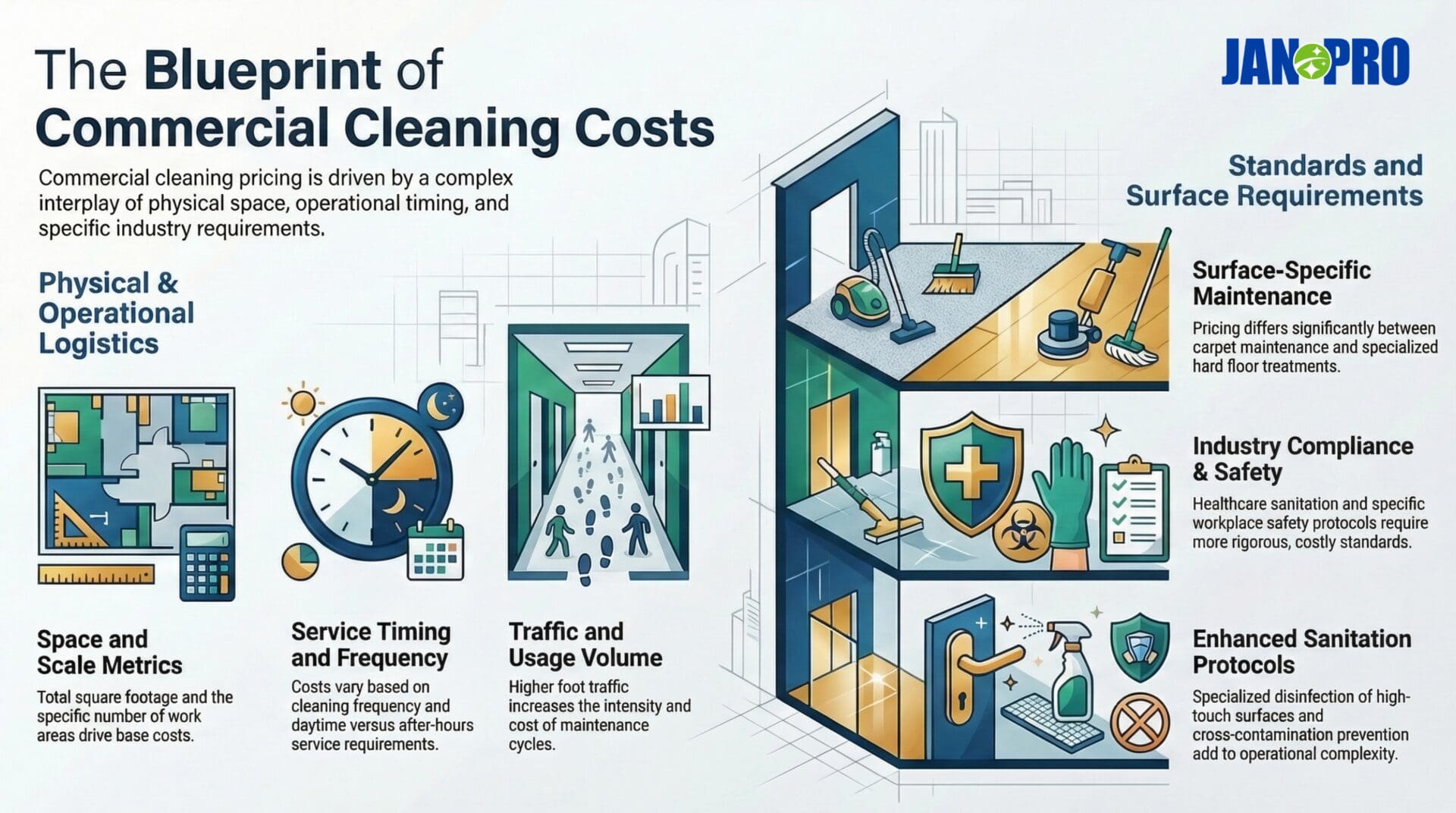
The following visual-style breakdown summarizes the primary factors affecting pricing structures in commercial cleaning services.
Location and Local Service Demand
Geographic market conditions can also influence commercial cleaning prices. Cities with higher business density or increased demand for professional cleaning services may experience different pricing structures compared to smaller markets.
Within the Kansas City metropolitan area, businesses seeking commercial cleaning in Olathe often operate in diverse facility types ranging from corporate offices to healthcare clinics and industrial buildings.
Each facility type introduces different sanitation priorities, which contributes to the variability in commercial cleaning service proposals.
Low-Cost Cleaners vs Professional Cleaning Providers
Not all cleaning services operate under the same standards or operational models. Differences in training, equipment, and process oversight often separate low-cost services from professional commercial cleaning providers.
| Factor | Low-Cost Cleaning Providers | Professional Cleaning Providers |
| Training standards | Limited or informal | Structured training programs |
| Cleaning protocols | Basic surface cleaning | Industry-standard procedures |
| Equipment | Basic household tools | Commercial-grade equipment |
| Quality control | Minimal oversight | Routine inspections |
| Sanitation processes | General cleaning | Disinfection protocols |
| Documentation | Rare | Detailed cleaning checklists |
Professional cleaning companies often implement standardized procedures designed to ensure consistency and compliance with industry sanitation expectations.
How Professional Commercial Cleaning Programs Are Developed
Established commercial cleaning providers typically design cleaning programs through structured facility assessments and operational planning.
Key planning stages include:
- Facility evaluation: Inspecting layout, traffic levels, and sanitation requirements.
- Cleaning protocol design: Defining cleaning tasks, schedules, and equipment requirements.
- Service scheduling: Aligning cleaning operations with business hours and facility needs.
- Quality control procedures: Implementing inspection systems and performance monitoring.
This systematic approach allows professional providers to maintain consistent sanitation results across different facility types.
JAN-PRO Cleaning & Disinfecting in Kansas City
Professional commercial cleaning programs are often tailored to match the operational needs of individual facilities. JAN-PRO Cleaning & Disinfecting in Kansas City provides customized commercial cleaning solutions for offices, healthcare environments, educational facilities, and industrial buildings.
Service programs are designed according to facility size, sanitation requirements, and operational schedules. This structured approach allows businesses to maintain consistent cleaning standards while supporting workplace hygiene and safety goals.
JAN-PRO of Kansas City provides high-quality commercial cleaning solutions to any office or facility, with services adapted to the specific needs of each environment. As an established professional cleaning company, JAN-PRO works with businesses throughout the Kansas City metropolitan area from its office located at 6500 West 110th Street, Suite 104, Overland Park, and can be reached at (913) 469-4060.
Frequently Asked Questions
Why do commercial cleaning prices vary between buildings of the same size?
Even buildings with similar square footage can require different cleaning programs depending on traffic levels, floor materials, restroom quantity, and sanitation requirements.
How do facility types affect commercial cleaning costs?
Medical offices, industrial buildings, and educational facilities often require specialized sanitation procedures, equipment, or regulatory compliance measures.
Does cleaning frequency influence pricing structures?
Yes. Facilities requiring daily cleaning services typically involve more labor hours and materials compared to spaces cleaned weekly or periodically.
Why are professional cleaning providers often structured differently from basic cleaning services?
Professional providers usually implement standardized procedures, trained cleaning teams, and commercial-grade equipment to maintain consistent sanitation standards.
Key Takeaways
Commercial cleaning prices vary widely because cleaning programs are designed around facility-specific operational needs rather than fixed service packages. Factors such as building size, sanitation standards, cleaning frequency, and industry regulations all influence how cleaning services are structured.
Businesses evaluating commercial cleaning services often benefit from understanding these operational variables, as they provide clearer insight into how professional cleaning programs are developed and maintained.
About the Author
Carter James
 Carter James is Vice President of Strategy & Development, leading growth strategy, acquisitions, and multi-market expansion within a facility services platform. His background includes corporate strategy, M&A integration, and franchise development. He partners with senior leadership to drive disciplined execution, scalable operations, and long-term value through data-driven, high-accountability leadership.