If you manage a business in the Birmingham area, you already know a restroom can make or break a first impression in about thirty seconds. What’s less obvious is what specifically to check, buy, or ask a provider about — which is the exact set of questions we hear most often from business owners across Central Alabama. This guide answers them directly, based on what our teams see on the ground every week providing janitorial services in Central Alabama.
Why Restroom Maintenance Is a Business Decision, Not Just a Cleaning Task
According to Bradley Company’s 2026 Healthy Handwashing Survey, 68% of Americans are more likely to return to — and spend more at — a business with a clean, well-maintained restroom. 86% say the quality of a business’s restroom reflects the quality of its products and services, and 84% say an unclean or poorly stocked restroom damages a business’s image. Put together, that means a restroom problem isn’t a hidden issue; it’s something the large majority of your visitors notice and let it shape how they see your entire business.
For businesses in Birmingham, Hoover, Vestavia Hills, and the surrounding communities, that translates into a practical question: what should you actually be checking, buying, and asking a provider for?
What Should Businesses Look for in a Restroom Supplies Provider?
Look for a provider who can guarantee consistent stock levels, supplies sized to your actual foot traffic, and a restocking schedule that matches your busiest hours — not a generic weekly drop-off.
In more detail, that means:
- Fill-rate reliability. A provider should track usage patterns per location, not deliver a flat quantity to every account regardless of traffic.
- Product fit for your facility. A 20-person office and a 200-seat restaurant need different dispenser types, refill frequency, and product grades.
- Responsiveness between visits. Ask what happens if you run low between scheduled service days — a provider limited to a fixed weekly route can leave you short during a busy stretch.
- Transparency on what’s included. Confirm whether restocking is bundled into your janitorial contract or billed as a separate line item; this is a common point of confusion in commercial cleaning agreements.
What Are the Key Features of an Effective Commercial Restroom Cleaning System?
An effective system combines a documented cleaning checklist, touch-free fixtures where practical, a defined inspection cadence, and a contractor who flags maintenance issues (not just cleanliness issues) before they become bigger problems.
The features that matter most:
- A written, repeatable checklist — not “clean the restroom,” but specific tasks (fixtures, floors, mirrors, dispensers, trash) with a defined frequency for each.
- Touch-free fixtures on high-contact points: stall locks, flushers, sink handles, soap and towel dispensers. The same Bradley Company research found 70% of customers said they were more likely to return to a business with this kind of touchless technology.
- Scheduled inspections, separate from routine cleaning, to catch things routine cleaning won’t — a loose floor tile, a soap dispenser losing suction, a toilet sensor that’s starting to miss.
- A communication loop with your contractor, so issues get reported and tracked instead of discovered by a customer first.
Which Hygiene Products Should a Small Business Start With?
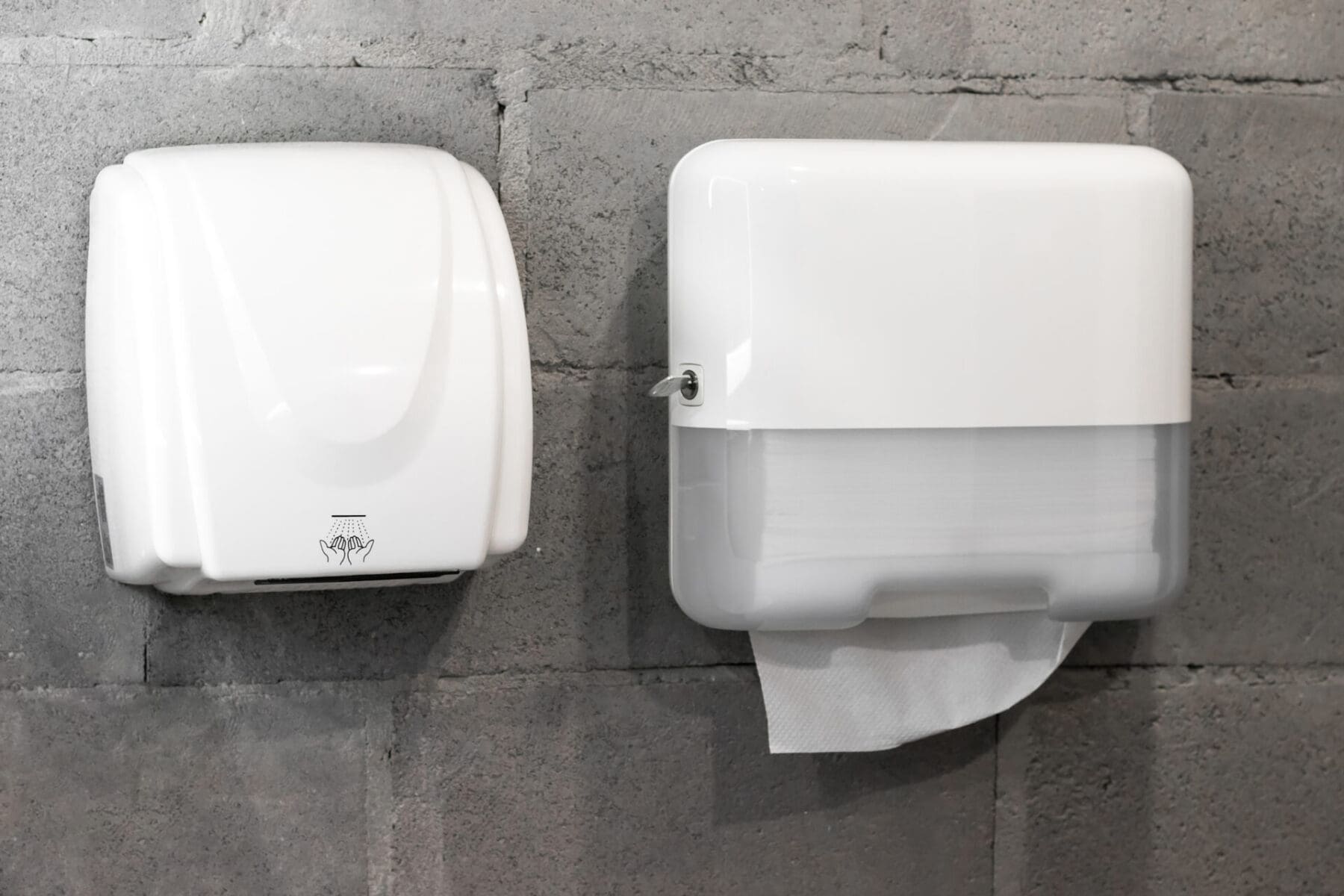
If you’re building a restroom hygiene program from scratch, a reasonable starting kit looks like this:
- Touch-free or low-touch soap and paper towel dispensers
- A trash receptacle with a lid, sized to your restroom’s actual traffic
- A discreet, timed air freshener
- Backup supply stock stored on-site (not just what’s loaded in the dispensers)
- A simple daily supply-check routine assigned to a specific staff member
This is a starting point, not a ceiling — a commercial cleaning provider can help you scale up from here as your traffic or facility size grows.
A Field Note From Our Central Alabama Team
One pattern our franchise owners run into often: a business assumes restroom complaints mean their contractor isn’t cleaning enough, when the real issue is a mismatch between the restocking schedule and the business’s actual peak hours. A lunch-rush restaurant and a 9-to-5 office have completely different “empty dispenser” risk windows, but both often get put on the same generic weekly service plan.
When our teams walk a new account, one of the first things we look at isn’t the cleaning checklist — it’s the traffic pattern. Adjusting when a restroom gets checked, not just how often, is usually what actually fixes the “we keep running out of paper towels” complaint, more than adding extra cleaning visits does.
Restroom Cleaning for Office Buildings vs. Other Facility Types
Office buildings, restaurants, medical facilities, and retail spaces all need restroom maintenance — but not the same version of it.
- Office buildings typically see steady, predictable traffic during business hours, so a scheduled after-hours or early-morning service window usually covers it, with a mid-day supply check as backup.
- Restaurants and retail see sharp traffic spikes tied to meal times or store hours, which is where day porter or post-rush service visits matter more than a fixed daily schedule.
- Medical facilities carry stricter disinfection requirements given higher concern about germ exposure, which usually calls for a more frequent, documented disinfecting routine rather than standard cleaning alone.
Whatever you call it, restroom, washroom, or facility hygiene program, the planning question is the same: does the service schedule match how your specific building is actually used?
Building a Restroom Maintenance Program That Holds Up Over Time
A restroom maintenance program that works long-term usually has four parts:
- A daily in-house check — a staff member responsible for a quick supply and spill check between service visits.
- A professional cleaning schedule matched to your traffic pattern, not a generic default.
- Periodic deep cleaning, often scheduled during a slower season, to handle grout, buildup, and wear that routine cleaning doesn’t fully address.
- A feedback loop with your janitorial provider so small issues (a sticking lock, a slow drain) get flagged before they turn into bigger repairs or complaints.
Programs that skip the daily in-house piece tend to have the most recurring complaints — professional service handles the deep work, but the day-to-day gaps are usually caught by whoever is actually in the building.
How JAN-PRO Cleaning & Disinfecting in Central Alabama Supports Your Restroom Maintenance Program
JAN-PRO Cleaning & Disinfecting in Central Alabama works with businesses across Birmingham and the surrounding area to build restroom maintenance plans around how a specific facility is actually used — not a one-size-fits-all route. That includes:
- Customized service schedules (after-hours, weekly, or day porter support for high-traffic periods)
- Green cleaning product options for businesses with sensitive staff, customers, or sustainability goals
- Deep cleaning scheduled around your slow season
- Ongoing communication from your local franchisee about developing maintenance issues, not just cleanliness
Frequently Asked Questions
How often should a commercial restroom be professionally cleaned?
It depends on traffic. A low-traffic office may only need daily cleaning with a weekly deep clean, while a high-traffic restaurant or retail restroom often needs multiple check-ins per day plus a more frequent professional cleaning schedule.
Do touch-free fixtures actually reduce complaints?
They tend to help, mainly because they reduce contact points where germs spread and are associated with customers feeling more comfortable returning — though results vary by facility and traffic type.
What’s the difference between restroom cleaning and restroom maintenance?
Cleaning covers surface-level sanitation on a schedule. Maintenance is broader — it includes supply management, fixture inspection, and catching small mechanical issues before they become larger repairs.
Are green cleaning products an option for commercial restrooms?
Yes. Businesses can choose cleaning products that meet recognized green-cleaning standards or certifications, depending on their facility requirements and purchasing goals. When evaluating a product, look at the specific ingredients, certifications, intended use, and manufacturer instructions rather than relying solely on terms such as “green” or “eco-friendly.”
Ready to build a restroom maintenance plan around how your business actually runs?
Call JAN-PRO Cleaning & Disinfecting in Central Alabama at 205-767-7435, or request a free estimate through our Central Alabama janitorial services page. Our franchisees serve Birmingham and the surrounding communities and can walk your facility with you before recommending a plan.
About the Author
Carter James
 Carter James is Vice President of Strategy & Development, leading growth strategy, acquisitions, and multi-market expansion within a facility services platform. His background includes corporate strategy, M&A integration, and franchise development. He partners with senior leadership to drive disciplined execution, scalable operations, and long-term value through data-driven, high-accountability leadership.