Running a business in Tucson means managing heat, dust, and a high-traffic environment that puts constant pressure on your facility. The Santa Cruz River basin’s desert climate generates fine particulate matter that settles on every surface, HVAC filters, and hard floor finish year-round.
If your commercial cleaning company isn’t built for that reality, the gap between what they’re doing and what your facility actually needs grows quietly — until a client notices, an OSHA inspector flags something, or your staff starts calling in sick more often.
Most Tucson business owners don’t switch cleaning companies because of a dramatic failure. They stay too long because the problems are gradual. Here are seven signs the relationship has already run its course.
1. They’re Not Accounting for Tucson’s Dust Problem
Tucson sits at 2,389 feet in the Sonoran Desert. Between haboob season (June through September) and the city’s notorious caliche dust, fine particulate infiltration is a year-round operational issue — not a seasonal inconvenience.
A commercial cleaning company that doesn’t use HEPA-filtered vacuums and doesn’t adjust cleaning frequency around monsoon and dust storm activity is leaving your facility dirtier than it appears to the naked eye.
If your cleaner is running a standard upright vacuum without HEPA filtration, they’re redistributing particulates rather than removing them. That directly affects indoor air quality, employee respiratory health, and the lifespan of your HVAC system. For medical offices near St. Mary’s Hospital or UA Health Sciences, this isn’t a minor inconvenience — it’s a compliance concern.
The signal: You notice dust accumulation within 24–48 hours of a cleaning visit, particularly on horizontal surfaces, vents, and equipment.
2. You’ve Never Seen a Documented Cleaning Protocol
A professional commercial cleaning company should be able to hand you a written, facility-specific cleaning plan — zone by zone, task by task, product by product. If your current provider operates on verbal agreements or a generic checklist, you have no baseline to hold them to and no paper trail if standards slip.
This matters especially for Tucson businesses in regulated industries. Healthcare facilities near Tucson Medical Center, labs connected to the University of Arizona, and food-adjacent operations in the Mercado District face audit risk when cleaning documentation is absent. “We clean it every week” is not a compliance record.
The signal: You’ve asked for a cleaning scope or service record and received something vague, verbal, or nothing at all.
3. Turnover Means a Different Crew Every Visit
High staff turnover is endemic to the traditional janitorial service model — and it has real consequences for your facility. A rotating crew means retraining on your layout, security protocols, and sensitive areas every few weeks. It also means institutional knowledge about your building never accumulates.
The certified franchise owner model addresses this structurally. When the person cleaning your facility has an ownership stake in the outcome of every visit, consistency follows. For businesses in office parks along Oracle Road or near the Tucson Airport industrial corridor, this kind of accountability is the difference between a vendor and a partner.
The signal: You regularly see unfamiliar faces, need to re-explain access protocols, or notice variation in quality between visits with no clear explanation.
4. Disinfection and Cleaning Are Being Treated as the Same Thing
They’re not. Cleaning removes visible soil and debris. Disinfection kills pathogens on surfaces after cleaning. A company that skips the distinction — or uses a general-purpose spray on every surface regardless of dwell time — is giving you the appearance of hygiene without the microbial reality.
This gap is most dangerous in high-touch environments: medical waiting rooms, dental offices, fitness centers, and shared workspaces in downtown Tucson’s emerging tech district. EPA-registered disinfectants require specific dwell times to be effective. If your cleaner is wiping immediately after spraying, the product hasn’t done its job.
The signal: Your team experiences above-average sick days, or you’ve never been told what disinfectant products are being used or how they’re applied.
5. Floor Care Has Become Cosmetic

Tucson’s hard floor surfaces — tile, polished concrete, vinyl composite — take a beating from foot traffic, sand, and caliche tracked in from parking lots. Proper commercial floor care involves stripping old finish layers, applying new wax, and periodic deep scrubbing with appropriate pH-balanced solutions. What many providers deliver instead is surface mopping that builds up residue over time, dulls the finish, and eventually damages the substrate.
If your lobby floors look dull under fluorescent light, if the grout lines in your restrooms have darkened despite regular mopping, or if the finish on your VCT tile is peeling or yellowed, your current cleaner has been providing cosmetic maintenance — not real floor care.
The signal: You haven’t been offered — or can’t remember the last time you received — a floor strip, recoat, or deep scrub service.
6. They Don’t Know What OSHA or Industry Compliance Requires for Your Facility
A commercial cleaning company serving Tucson’s healthcare sector, manufacturing facilities in the Aerospace Parkway corridor, or educational institutions like Pima Community College needs to understand the regulatory environment their clients operate in.
OSHA’s bloodborne pathogen standards, CDC environmental hygiene guidelines, and AORN standards for surgical environments aren’t optional reading — they’re the baseline for any facility where cleaning directly intersects with health and safety obligations.
If your provider can’t articulate which standards apply to your facility type, they almost certainly aren’t meeting them. That exposure lands on you, not them.
The signal: Your cleaning provider has never asked about your industry’s compliance requirements and has never referenced relevant standards in their service agreement or cleaning plan.
7. Problems Get Acknowledged but Never Fixed
Every service provider has an off night. What separates a professional operation from a careless one is what happens next. A cleaning company worth keeping has a documented corrective process: you report the issue, it’s logged, a supervisor verifies the fix, and you receive confirmation. A company that apologizes and hopes you forget has no accountability infrastructure.
If you’ve raised the same issue — a consistently missed restroom, a lobby that smells stale, equipment surfaces left untouched — more than twice with no structural change, you’re not dealing with an isolated mistake. You’re dealing with a process failure that won’t self-correct.
The signal: You’ve had the same conversation more than once, and the improvement lasts one or two visits before reverting.
How to Switch Cleaning Companies Without Disrupting Your Operations
The main reason Tucson businesses stay with underperforming providers is the perceived friction of switching. In practice, a well-run transition takes less than a week and causes zero downtime if handled correctly.
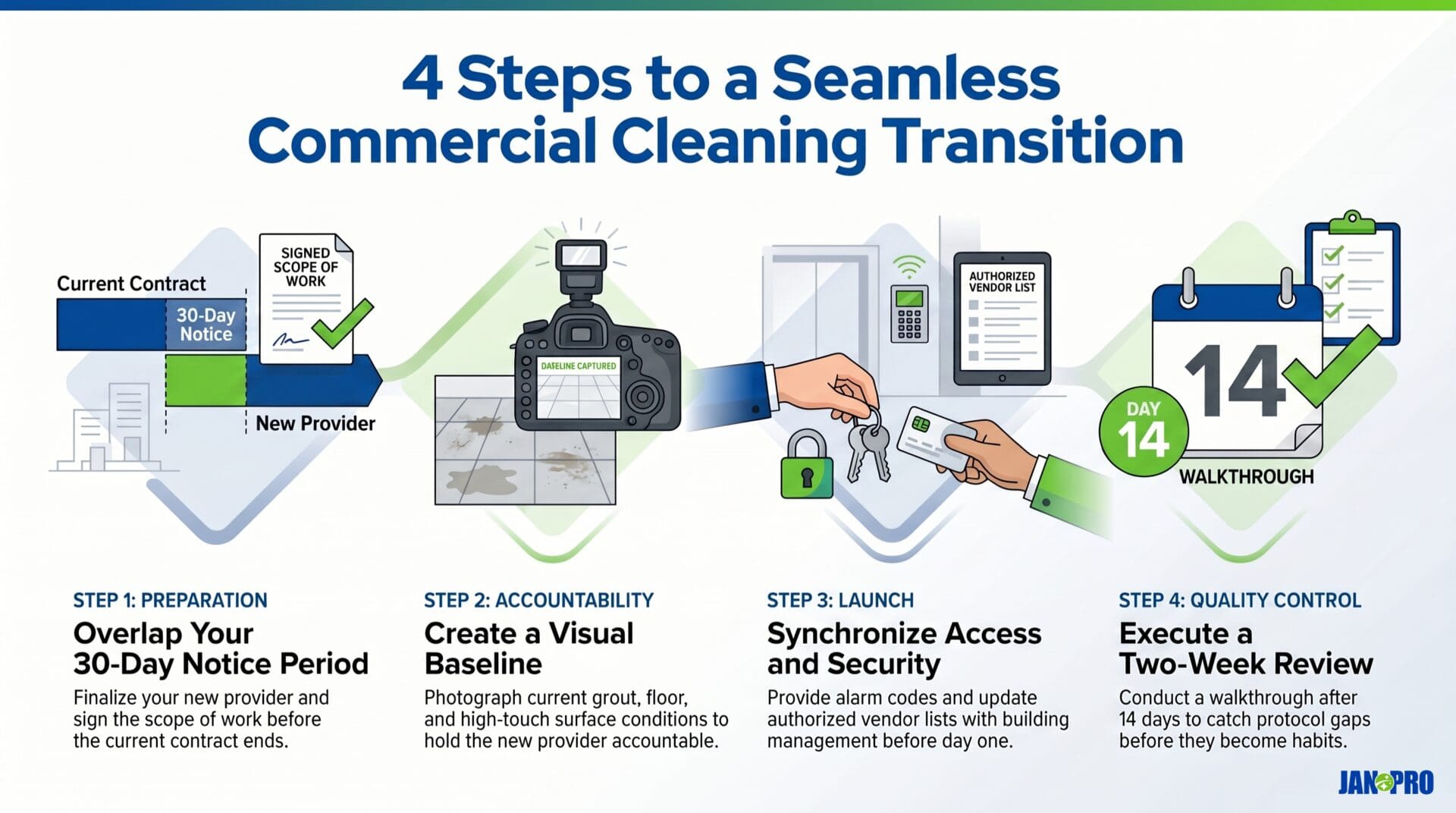
Step 1: Overlap your notice period
Most commercial cleaning contracts require 30 days’ notice. Use that window to finalize your new provider, complete the facility walkthrough, and have the new scope of work signed before your current contract ends. You should never have a gap in service.
Step 2: Document your facility’s current state
Walk through with your phone and photograph areas of concern — floor condition, grout lines, high-touch surfaces, restroom fixtures. This becomes the baseline your new provider is accountable to from day one.
Step 3: Brief your new provider on access and security
Provide key codes, alarm instructions, and a contact list before the first visit. For multi-tenant buildings in downtown Tucson or Oracle Road office parks, coordinate with building management to update authorized vendor lists.
Step 4: Schedule a review after the first two weeks
Don’t wait 90 days to evaluate. A walkthrough after two weeks catches protocol gaps early, before they become habits.
The Real Cost of Staying with the Wrong Provider
The visible cost of switching is one month of parallel attention. The invisible cost of staying is harder to quantify but real: employee sick days attributable to poor indoor air quality typically run 1.5–2 additional days per employee per year in facilities with inadequate cleaning — a material labor cost for any Tucson business with more than 10 staff.
Floor damage from improper maintenance compounds annually; a VCT floor that needed a $400 strip and recoat two years ago may now need $2,000 in restoration. And for regulated facilities, a single compliance citation triggered by inadequate cleaning documentation can exceed the annual cost of a professional cleaning program many times over.
Inertia is the most expensive option on the table.
What a Real Switch Looks Like for Tucson Businesses
JAN-PRO Cleaning & Disinfecting serves businesses across Tucson through certified franchise owners who operate under the JP Signature Clean system: documented, zone-specific protocols, HEPA-filtered equipment, EnviroShield disinfection, and measured performance on every visit.
Whether you operate a medical practice near Banner – University Medical Center Tucson, a corporate office off Interstate 10, or a warehouse in the Tucson Airport Authority area, the program is built around your facility’s actual requirements — not a generic checklist.
If two or more of the seven signs above describe your current provider, the cost of switching is lower than the cost of staying.
Request a free estimate for commercial cleaning services in Tucson: call (520) 885-9600 or visit our office at 4221 S Santa Rita Ave Suite 101, Tucson.
About the Author
Carter James
 Carter James is Vice President of Strategy & Development, leading growth strategy, acquisitions, and multi-market expansion within a facility services platform. His background includes corporate strategy, M&A integration, and franchise development. He partners with senior leadership to drive disciplined execution, scalable operations, and long-term value through data-driven, high-accountability leadership.