Commercial floor care plays a critical role in maintaining safe, professional, and long-lasting environments in office buildings. Floors in commercial properties experience continuous foot traffic, rolling office chairs, and daily wear that can gradually damage surfaces if proper maintenance procedures are not implemented.
In Wilmington office buildings, facility managers typically oversee a variety of flooring materials such as carpet, luxury vinyl tile (LVT), ceramic tile, and polished concrete. Each surface requires specialized cleaning techniques designed to preserve durability while maintaining appearance standards expected in professional environments. Implementing structured floor maintenance practices supports workplace safety, protects flooring investments, and contributes to overall facility cleanliness.
Why Commercial Floor Care Matters in Office Environments
Commercial flooring is exposed to constant stress in professional workplaces. Dirt, moisture, and abrasive particles tracked indoors can degrade protective finishes, stain surfaces, and shorten the lifespan of flooring materials.
Effective commercial floor care programs address several key operational priorities:
- Surface longevity: Preventing premature deterioration of flooring materials
- Workplace safety: Reducing slip hazards caused by residue or moisture
- Professional appearance: Maintaining clean, uniform surfaces in public and employee areas
- Facility asset protection: Preserving long-term building investments
Industry organizations such as the Occupational Safety and Health Administration (OSHA) emphasize the importance of maintaining clean, dry floors to reduce workplace slip hazards in commercial environments. Guidance on workplace walking surfaces can be found through the OSHA safety standards.
In busy office settings, systematic floor maintenance is therefore considered an essential component of facility management.
Common Flooring Types Found in Wilmington Office Buildings
Office buildings throughout Wilmington commonly feature multiple flooring materials within a single facility. Understanding the characteristics of each surface helps determine the most appropriate maintenance approach.
Carpet
Carpet remains one of the most widely used flooring options in office environments due to its sound absorption and comfort.
Key maintenance practices include:
- Routine vacuuming using commercial HEPA filtration equipment
- Periodic deep extraction cleaning to remove embedded soil
- Immediate spot treatment for spills and stains
Regular carpet maintenance prevents soil buildup that can degrade fibers and reduce indoor air quality.
Hard Surface Flooring
Hard surface floors appear in lobbies, hallways, breakrooms, and restrooms. These materials require consistent maintenance to maintain protective finishes and prevent dulling.
Common hard flooring materials include:
- Luxury vinyl tile (LVT)
- Ceramic tile and grout
- Polished concrete
- Natural stone
- Rubber flooring
Maintenance strategies often include dust mopping, neutral cleaning solutions, periodic scrubbing, and finish restoration when necessary. Specialized commercial floor cleaning procedures are often used to address deeper soil accumulation, surface restoration, and finish maintenance.
Core Components of an Effective Floor Care Program
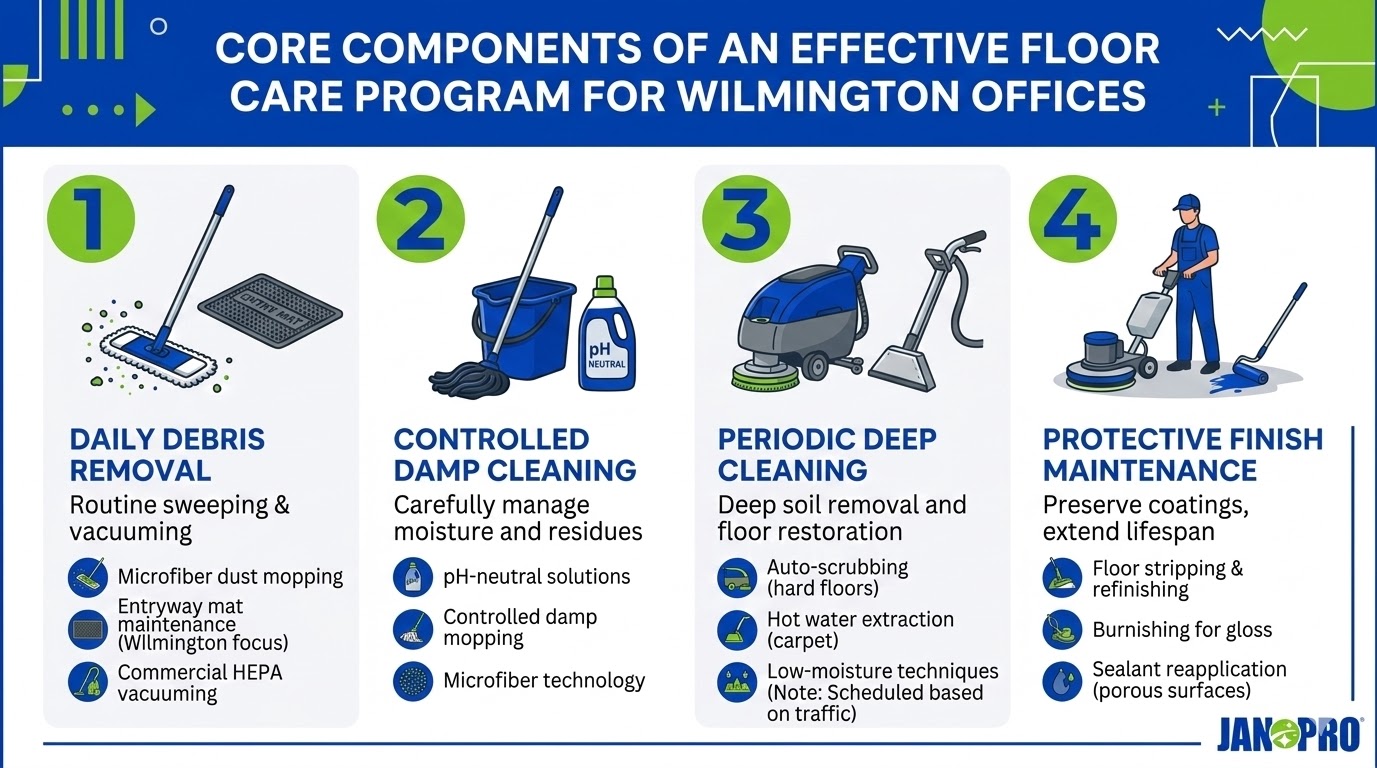
Commercial floor care programs in professional facilities typically follow structured maintenance cycles designed to balance routine cleaning with periodic restoration.
1. Daily Debris Removal
Dust, sand, and grit act as abrasives that gradually scratch flooring surfaces.
Routine debris removal typically involves:
- Microfiber dust mopping
- Entryway mat maintenance
- Commercial vacuuming
Entry mats play a particularly important role in Wilmington buildings by capturing outdoor debris before it reaches interior floors.
2. Controlled Damp Cleaning
Hard surface floors require careful moisture control to prevent residue buildup and surface damage.
Professional maintenance programs generally utilize:
- pH-neutral cleaning solutions
- Controlled damp mopping systems
- Microfiber mop technology
These methods help remove soil without leaving behind chemical residue that could dull finishes or create slippery surfaces.
3. Periodic Deep Cleaning
Over time, routine cleaning alone cannot remove deeply embedded soil or restore the floor’s appearance.
Periodic maintenance may include:
- Auto-scrubbing equipment for hard surfaces
- Hot water extraction for carpet
- Low-moisture carpet cleaning technologies
Scheduled deep cleaning intervals vary depending on traffic levels within the building.
4. Protective Finish Maintenance
Many commercial floors rely on protective coatings that help resist stains and surface damage.
Maintenance procedures may involve:
- Floor stripping and refinishing
- Burnishing for gloss restoration
- Sealant reapplication for porous surfaces
Maintaining protective finishes helps extend the lifespan of flooring materials and preserves a consistent appearance.
High-Traffic Zones That Require Additional Attention
Not all areas of an office building experience the same level of wear. High-traffic zones typically require more frequent cleaning and maintenance.
Common priority areas include:
- Building entrances and reception areas
- Elevator lobbies
- Hallways connecting departments
- Breakrooms and kitchens
- Conference room corridors
These spaces accumulate soil more quickly and can significantly influence overall building appearance. Many facility managers implement targeted cleaning schedules that increase maintenance frequency in these locations.
Environmental Considerations in Floor Maintenance
Modern commercial cleaning programs increasingly emphasize environmentally responsible practices. Sustainable floor care strategies can help reduce environmental impact while maintaining performance standards.
Examples of environmentally conscious practices include:
- Using low-VOC cleaning solutions
- Implementing microfiber cleaning systems that reduce water consumption
- Maintaining high-efficiency vacuum equipment
- Using automated equipment that improves cleaning consistency
These methods support sustainability initiatives while maintaining effective cleaning outcomes.
How Structured Cleaning Systems Support Floor Maintenance
Consistent results in commercial floor care often depend on structured operational systems used by professional cleaning providers.
These systems typically include:
- Detailed floor maintenance checklists
- Scheduled inspection programs
- Documented cleaning procedures for each flooring type
- Staff training in equipment use and surface-specific techniques
Structured systems allow facility managers to track maintenance progress and ensure floors receive the appropriate level of care.
Organizations offering janitorial services in New Castle often incorporate these standardized procedures to maintain consistent cleaning quality across office environments.
Coordinating Floor Care with Office Cleaning Programs
Floor care rarely operates independently from other building cleaning activities. Instead, it functions as part of a broader facility maintenance strategy.
Cleaning programs frequently integrate:
- Restroom sanitation
- High-touch surface disinfection
- Waste removal
- window and glass cleaning
- carpet maintenance
For example, routine office cleaning in Elsmere often includes coordinated floor maintenance schedules designed to address both carpet and hard surfaces throughout office environments. Integrated cleaning strategies ensure that floors remain clean while supporting overall workplace hygiene.
How JAN-PRO Cleaning & Disinfecting in New Castle Supports Commercial Floor Care
Professional cleaning providers often implement specialized systems designed to maintain commercial floors across different building environments.
JAN-PRO Cleaning & Disinfecting in New Castle has more than three decades of experience supporting facility maintenance across the region. Certified franchisees apply structured cleaning processes designed for commercial properties with diverse flooring types.
These processes may include:
- Surface-specific cleaning procedures for carpet, vinyl, tile, and concrete
- Scheduled maintenance cycles for high-traffic office environments
- Commercial-grade equipment designed for consistent results
- Routine inspections that help maintain cleaning quality
Businesses seeking experienced facility maintenance support can learn more about cleaning programs offered by JAN-PRO Cleaning & Disinfecting in New Castle. The regional office is located at 2417 Lancaster Ave, Ste. 101, Wilmington, and can be contacted at 302-324-5240 for additional information about commercial cleaning services throughout the area.
Conclusion
Commercial floor care is a critical component of maintaining safe, professional office environments. Floors experience continuous wear from daily activity, making structured maintenance essential for preserving both appearance and durability.
Effective floor maintenance programs typically include routine debris removal, controlled damp cleaning, periodic deep cleaning, and protective finish restoration. These practices help extend flooring lifespan while supporting workplace safety and cleanliness.
In Wilmington office buildings, implementing structured cleaning systems and partnering with experienced commercial cleaning providers can help ensure that flooring surfaces remain well-maintained, functional, and visually consistent across the entire facility.
About the Author
 Jon Brodack
 Jon Brodack
Jonathan Brodack is Director of Sales & Marketing at JAN-PRO Franchise Development of the Delaware Valley. Holding an MBA from Rutgers University–Camden, he combines a data-informed approach with a focus on building enduring professional partnerships. He is dedicated to driving franchise growth and market expansion through a strategy centered on long-term relationship development.