
For the prestigious private academies of Tampa Bay—from the historic campuses in South Tampa to the modern facilities in Westchase—academic excellence is the baseline. However, a school’s reputation is increasingly tied to its biological security.
Despite daily “surface-level” cleaning, student absenteeism remains a persistent challenge. Recent environmental health data from the Florida Department of Health (2025-2026) indicates that 1 in 6 Americans still contract foodborne or surface-linked illnesses annually, with schools being the primary vector for community spread. In Tampa’s unique climate, a “clean-looking” classroom can still be a microbial breeding ground.
8 Hidden Germ Reservoirs You’re Missing
Standard janitorial checklists often ignore the complex architecture of modern private schools. Here is where the “invisible threat” actually hides.
1. The Aerosolizing Sink P-Trap
A shocking revelation at the NFMT East 2026 Conference highlighted that sink drains are not just for waste—they are staging grounds. Biofilms (slimy colonies of bacteria) grow inside the P-traps of school restrooms. When a student runs the tap to wash their hands, the air displacement aerosolizes these pathogens, landing them on the student’s face, clothes, and the very hands they just “cleaned.”
- The Science: Research shows E. coli can travel up to 3 feet from a drain during a 10-second hand wash.
- The Prevention: Specialized enzyme-based drain treatments are required to break down biofilms before they aerosolize.
2. Digital Surface Contamination (EdTech)
The modern Tampa classroom is digital. While desks get wiped, the styluses for interactive whiteboards, VR goggles, and shared tablet cases are often skipped to avoid damaging the hardware.
- The Danger: These accessories harbor more pathogens than the school’s front door handles because they are gripped tightly for long periods, transferring oils and bacteria directly into the “T-zone” (eyes, nose, mouth).
3. The Humidity Trap: Soft Furnishings
In Tampa Bay’s humid environment, moisture is a constant battle. Soft furnishings in “collaborative learning zones”—couches, bean bags, and rugs—absorb sweat and respiratory droplets. Unlike hard surfaces, these fibers trap moisture, creating a micro-climate for mold and bacteria to thrive deep within the padding.
4. Acoustic Panels & Quiet Zones
Modern flexible classrooms use fabric-covered acoustic panels to dampen noise. In Tampa’s 70%+ humidity, these panels act as massive sponges for Aerosolized Pathogens. Because they are vertical surfaces, they are rarely vacuumed, allowing them to “off-gas” allergens and pathogens back into the air when students brush against them.
5. Water Bottle Trays and Hydration Stations
The shift toward sustainability means every student has a reusable bottle. However, the plastic crates or shelves where these are stored are rarely disinfected. Drips of backwash and condensation pool at the bottom, creating a “communal soup” of germs that students touch every time they grab their drink.
6. The Grip Points of Furniture
Cleaners often wipe the flat top of a desk. However, students spend their day gripping the edges of the desk and the top back of the chair to pull themselves in or out. These “grip points” accumulate layers of skin oils and pathogens that routine wiping misses entirely.
7. Communal Dry-Erase Bins
Whiteboards are wiped, but the markers and erasers are touched by dozens of students daily. These porous plastic barrels are rarely disinfected and serve as a primary bridge for the common cold and flu viruses to move between students and teachers.
8. Playground and Outdoor Rails
Post-rain, outdoor equipment becomes a magnet for pollen and bacteria. These surfaces are often considered “self-cleaning” by the sun, but audits show high pathogen survival in shaded outdoor areas.
The “Invisible” Germ Count: Campus Audit Data
| Surface Area | Typical Germ Count (per sq/in) | Primary Pathogen Risk |
| Sink P-Trap (Aerosolized) | 1,000,000+ | E. coli / Legionella |
| Bottle Filler Tray | 25,000+ | Bacterial “Bio-soup” |
| VR Headsets / Goggles | 12,500+ | Staph / Conjunctivitis |
| Gym Mats | 10,000+ | MRSA / Ringworm |
| Acoustic Wall Panels | 4,200 | Mold / Respiratory Irritants |
| HVAC Vents | Variable | Airborne Mold Spores |
The Tampa Climate Catalyst: Why Humidity Changes the Rules
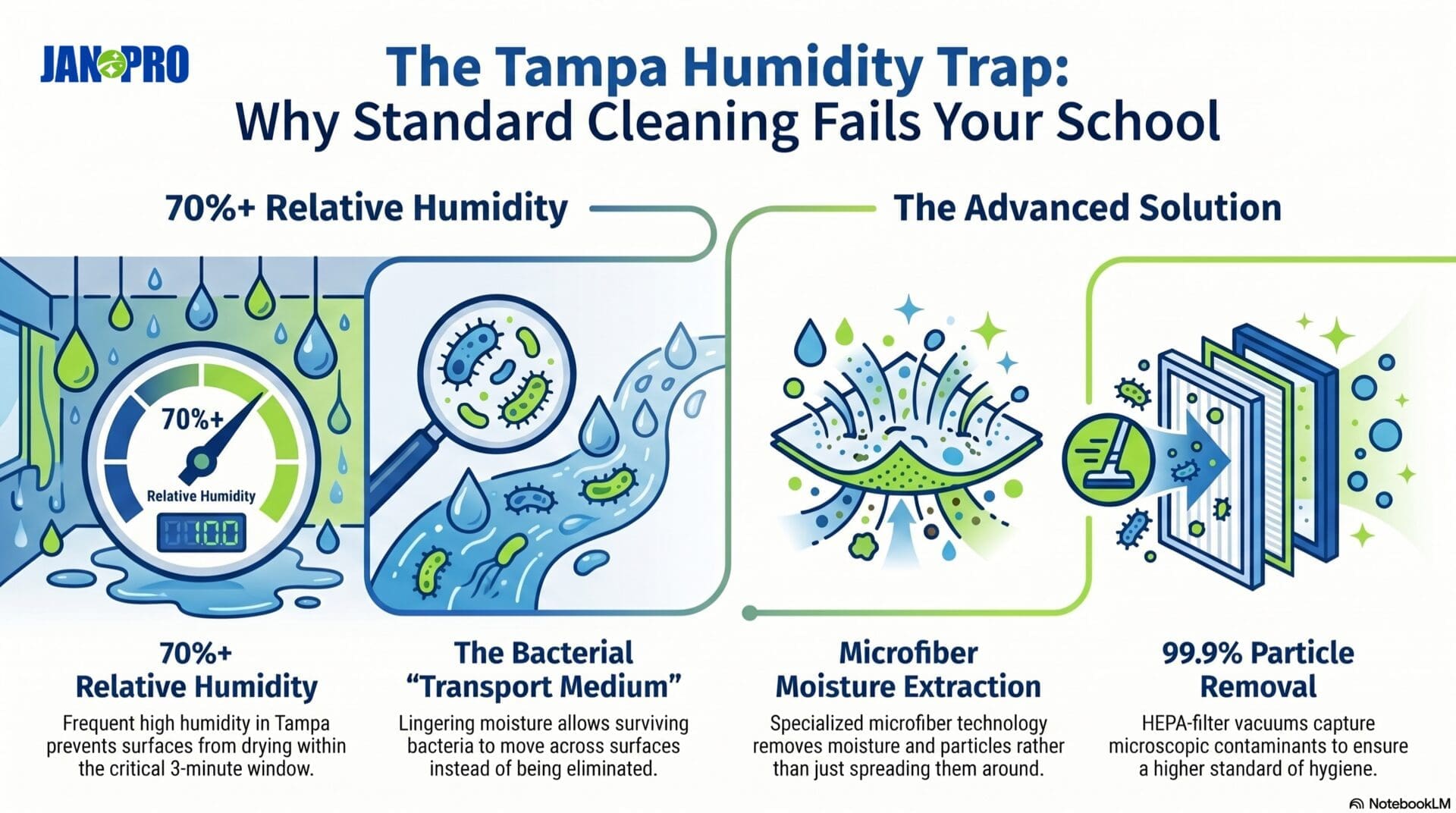
In the Tampa Bay area, relative humidity often exceeds 70%. For a private school, this isn’t just a comfort issue—it’s a sanitization crisis.
Most cleaning companies use “wet-and-wipe” methods. In Tampa, if the surface doesn’t dry within 2-3 minutes due to high humidity, the moisture actually acts as a transport medium for surviving bacteria to move across the surface.
This is why a local cleaning company utilizes HEPA-filter vacuums and microfiber technology that removes moisture and 99.9% of particles rather than just spreading them.
Frequently Asked Questions
How often should private schools be professionally cleaned?
While daily maintenance is required for restrooms and cafeterias, high-traffic private schools benefit from a weekly deep-disinfection cycle using electrostatic technology to reach hidden surfaces, such as the undersides of desks and tech accessories.
Can professional cleaning reduce student absenteeism?
Yes. According to a 2025 study on IAQ (Indoor Air Quality), classrooms with optimized ventilation and high-frequency disinfection of grip points saw a 13% increase in cognitive development indicators and a significant drop in sick-day call-outs.
Does a clean smell mean a classroom is safe?
No. Many “clean” scents come from Volatile Organic Compounds (VOCs) that can actually irritate students’ lungs. True sanitization is often odorless. Professional janitorial services in Tampa Bay focus on hospital-grade disinfectants that leave no toxic residue.
The JAN-PRO Difference: Science-Led School Sanitization
At JAN-PRO Cleaning & Disinfecting in Tampa Bay, we don’t just clean for appearance—we clean for health. Our proprietary systems are designed to address the specific biological challenges of the Florida climate.
- EnviroShield® System: Our electrostatic sprayer provides 360-degree coverage, wrapping around chair legs, keyboards, and locker vents to kill 99.9% of bacteria and viruses.
- MedMetrix® Standards: We bring hospital-grade cleaning protocols to the educational environment, ensuring your school meets the same hygiene standards as a surgical center.
- HEPA-H13 Air Filtration: Our vacuums don’t just pick up dirt; they trap allergens and airborne pathogens, improving the air your students breathe.
Protect Your Reputation and Your Students
If your school is relying on outdated cleaning methods, you are leaving your students vulnerable to invisible outbreaks. Contact JAN-PRO Cleaning & Disinfecting in Tampa Bay today at 6908 W. Linebaugh Ave., Tampa—call (813) 864-1940 to schedule expert disinfection.
About the Author
 Laura Ricchino
 Laura Ricchino
Laura Ricchino is Regional Director at JAN-PRO Cleaning Systems of Tampa, based in Florida. She supports operational excellence and growth across the commercial cleaning sector. With a focus on leadership, consistency, and client satisfaction, she works closely with teams to ensure high service standards and strong performance throughout the Tampa Bay region.