

Most of our new accounts in San Diego are not new facilities. They have had a cleaning company last month, and another before that, and the carpet has been quietly absorbing every decision those companies made.
Which is why our first walkthrough is never really about the carpet’s appearance. It is about reading what has been done to it.
A few months back we walked a professional office off Sorrento Valley Blvd — a few thousand square feet, mid-grade cut pile, replaced maybe six years ago. The office manager met us at the door and said some version of what we hear constantly: the carpet gets cleaned, it looks great for three days, then it looks worse than before. She was frustrated. She assumed the carpet was simply finished and she needed a capital budget to replace it.
It wasn’t finished. It was waterlogged with detergent from three years of under-rinsed extractions, and every cleaning was pulling that old residue back to the surface. We were able to correct it. But nobody had told her that, because nobody had looked.
Here are the carpet problems JAN-PRO Commercial Cleaning most often identifies when taking over new commercial cleaning accounts throughout San Diego.
1. Spots that come back three days later
This is the single most common complaint we inherit, and it is almost never a stain problem.
Wicking is what happens when soil and cleaning solution have soaked past the carpet fibers into the backing and the pad. Extraction cleans the top of the pile. Then, over the next 24 to 72 hours, moisture travels back up the fibers as the carpet dries and carries the contamination with it. The spot reappears in roughly the same shape.
The companion problem is detergent residue. Carpet cleaning chemistry has to be rinsed out. When it isn’t — usually because the crew was moving too fast, or was using a machine without enough recovery — what’s left behind is sticky. It attracts soil aggressively. Carpet cleaned with too much soap gets grimy faster than carpet that was never cleaned at all.
When an office tells us their carpet looks worse a week after cleaning than it did before, residue is where we start.
2. Dark lines along the baseboards and under the doors
We find this in a majority of the facilities we walk, and it gets misdiagnosed constantly. Office managers assume the cleaner skipped the edges.
Filtration soiling is caused by airflow, not by neglect. When a property is under pressure, air gets pushed through whatever gaps exist — the seam where carpet meets baseboard, the gap under a closed door, the edge of a raised floor. The carpet fibers act as a filter, trapping airborne particulates. Over months and years, you get a sharp, dark, perfectly straight line.
It matters because it tells us something about the premises, not just the carpet: unbalanced HVAC, return air paths that aren’t doing their job, or gaps that need sealing. We can remove filtration soiling — it takes a specific process, and it’s slow work — but if nothing changes upstream, it comes back. That’s a conversation to have with facilities, and we would rather have it early than let it look like our cleaning failed.
3. Sand and decomposed granite ground into the traffic lanes
This one is specific to where we work.
San Diego soil is sandy and heavy in decomposed granite. It doesn’t behave like the clay soil in the Midwest or the salt-and-slush mix in the Northeast. DG is sharp and abrasive, and once it works down into the base of the pile it acts like sandpaper against the fibers every time someone walks across it.
The visible result is a traffic lane that looks permanently gray. The invisible result is worse: the fibers get scratched and lose their ability to reflect light evenly, so even after a perfect extraction the lane still reads dull. That’s not soil anymore; that’s wear.
We see it worst in facilities near active construction, near landscaped courtyards with overspray from irrigation, and in any suite with a door directly to an outdoor walkway — which in San Diego is most of them.
The fix is not more aggressive cleaning. The fix is frequency: dry soil has to come out with vacuuming before it gets ground in and turns into abrasion.
4. An entry matting system that isn’t doing anything
Almost every facility we take over has entry mats. Very few have enough of them.
The mats in most lobbies are decorative — a three-foot runner inside a glass door. A person walking normally takes several steps to release the majority of what’s on their shoes, which means a short mat catches a fraction of the soil and the rest goes straight into the carpet at the busiest point in the premises.
Industry guidance is generally to aim for enough matting that a person takes several full steps on it before reaching carpet, using both a scraper-type mat outside and an absorbent mat inside.
We bring this up on the walkthrough because it is the cheapest lever available. Soil that never enters the facility doesn’t have to be cleaned out of it.
5. Over-wetting damage: delamination, seam separation, and odor
Some of what we find can’t be cleaned out because it isn’t grime. It’s damage.
Delamination is the secondary backing separating from the primary backing — it happens when carpet is saturated repeatedly and the latex adhesive breaks down. You feel it before you see it: the carpet has a loose, rippling give underfoot. Seam separation shows up the same way, usually first at doorways and along corridor joins.
Then there’s odor. This is where our coastal accounts differ from our inland ones. In Oceanside, Carlsbad, and the other coastal communities, the marine layer keeps ambient humidity high enough that a carpet cleaned in the evening may still be damp the next morning.
A crew that over-wets in those conditions is creating a microbial problem, not solving a soil problem. When we scope commercial carpet cleaning in Oceanside, we plan around drying time deliberately — airflow, dwell, and schedule — because the same process that works fine in El Cajon in August does not work the same way three blocks from the water in June.
We have walked facilities where the previous cleaner was extracting monthly with no air movers. The carpet never fully dried between visits. That is a rare case, but the milder version of it is common.
6. Damage that gets blamed on the last cleaner but isn’t their fault
We try to be straight about this, because it affects what we’re willing to promise.
Pile reversal, sometimes called shading or watermarking, is a permanent change in the direction the fibers lie. It shows up as irregular light and dark patches that look wet. It is not soil; it is not a cleaning defect, and no cleaning process reverses it. It’s a characteristic of certain cut-pile carpets, and it’s not curable.
Fiber loss from age is the other one. Carpet has a service life. Once the pile is worn down to the backing in a traffic lane, cleaning restores whatever color is left and nothing more.
We flag both of these during the walkthrough and put them in writing before we start. It is a worse conversation to have after the first cleaning, when the client is expecting a result that was never physically available.
7. No maintenance history, and a warranty that may already be void
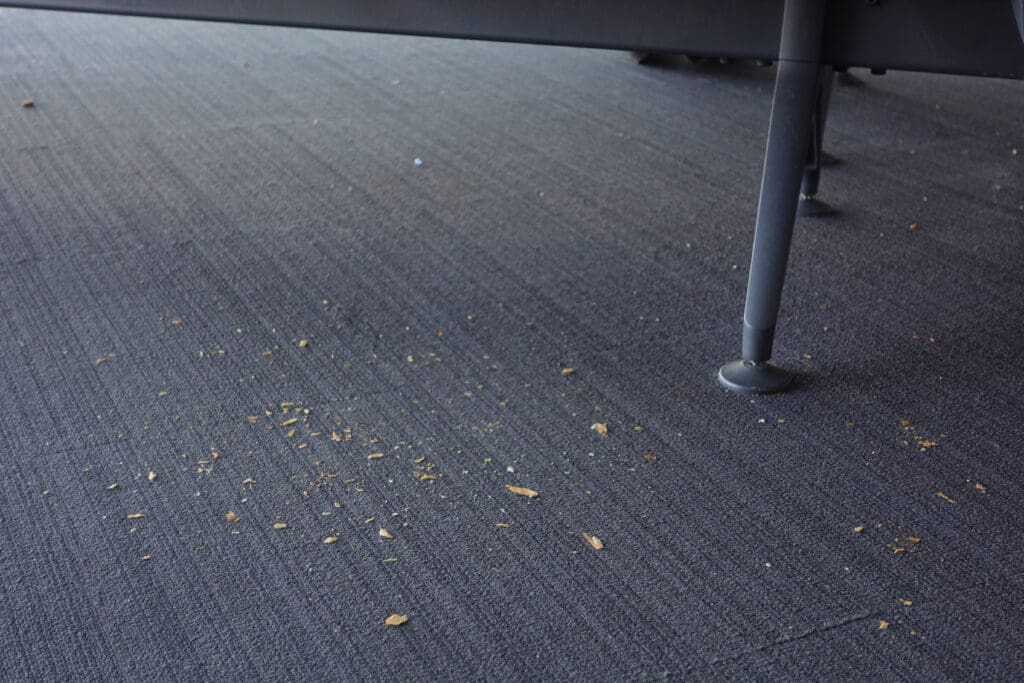
The last thing we ask for is records: when was the carpet installed, what is it made of, when was it last professionally extracted, and by whom.
We rarely get answers to all four.
This matters for two reasons. First, fiber type dictates chemistry — nylon, olefin, polyester, and wool tolerate very different pH ranges, and using the wrong one is how carpet gets bleached or yellowed. Second, most carpet manufacturers condition their warranty on documented professional hot water extraction at a defined interval, commonly every 12 to 18 months. A property that has gone four years on interim cleaning alone may have lost warranty coverage without anyone realizing it.
Part of what we set up in the first month is simply a record: what the carpet is, what condition it’s in on day one, what we did, and when. It costs nothing, and it protects the asset.
What JAN-PRO Commercial Cleaning Does During the First 30 Days of a New Account
- Walk and document. Photographs, fiber identification where possible, and a written condition report by area, including anything we don’t think we can fix.
- Correct the vacuuming before anything else. Most carpet problems we inherit are dry-soil problems. Right machine, right height setting, right frequency, filters actually changed.
- Run a restorative extraction with a full rinse. On properties with heavy residue history, that means a rinse pass specifically to pull out what the last company left.
- Fix the entry points. Matting recommendations go in the first report.
- Set the interval and write it down. Traffic lanes and entries on a different schedule than private offices, because they don’t soil at the same rate.
None of this is exotic. It’s just done in order and documented, which is the part that tends to be missing.
The honest version
Not every carpet we inherit can be brought back. Some of them are past it. At JAN-PRO Commercial Cleaning, we would rather explain that a carpet has reached the end of its service life than promise results no cleaning company can realistically deliver.
But the majority of “this carpet is ruined” calls we get in San Diego turn out to be residue, dry soil, and airflow; three correctable problems. The carpet usually isn’t the issue. The maintenance program was.
Talk to us about your facility
Every commercial carpet tells a story. Some problems are simply wear, while others point to maintenance issues that can be corrected before replacement becomes necessary.
At JAN-PRO Commercial Cleaning, every new account starts with a detailed walkthrough to identify the cause of recurring carpet problems and recommend the right maintenance plan for your facility.
If your San Diego office has recurring stains, worn traffic lanes, or other carpet concerns, call (858) 210-6413 to schedule a walkthrough or learn more about our commercial cleaning services in San Diego.
Frequently Asked Questions
Why do carpet stains come back a few days after cleaning?
Carpet stains that return within 24 to 72 hours are usually caused by wicking, not failed stain removal. Wicking occurs when soil or cleaning solution remains below the carpet fibers and rises back to the surface as the carpet dries. The solution is a thorough hot water extraction with a complete rinse to remove the underlying residue rather than repeated spot treatment.
What causes the dark lines along baseboards and under doors?
Dark lines along baseboards and under doors are typically caused by filtration soiling. As air moves through small gaps around walls, doors, or flooring, carpet fibers trap airborne dust and particles, creating dark lines over time. While professional cleaning can remove them, the underlying airflow or property-pressure issue should also be corrected to help prevent them from returning.
How often does commercial carpet in a San Diego office need professional extraction?
Commercial carpet should be professionally cleaned based on foot traffic, carpet type, and facility conditions. High-traffic areas such as entrances and corridors often require cleaning more frequently than private offices, especially in San Diego premises with direct outdoor access or nearby construction. Most carpet manufacturers also recommend professional hot water extraction every 12 to 18 months to help maintain warranty coverage.
Can a new cleaning company fix carpet the previous company damaged?
It depends on the type of damage. Problems such as detergent residue, wicking, filtration soiling, and ground-in soil can often be corrected with proper cleaning. However, structural damage like delamination, seam separation, pile reversal, or worn fibers cannot be reversed through cleaning. A professional walkthrough should identify which issues are restorable before work begins.
Will better entry mats actually reduce our cleaning costs?
Yes. A properly designed entry matting system helps keep sand and moisture from entering the premises, reducing wear on commercial carpet and lowering the need for restorative cleaning. The most effective systems use scraper mats outside and absorbent mats inside with enough length for several steps before occupants reach the carpet.
About the Author
Keith Olmo
 Keith Olmo is Chief Executive Officer of JAN-PRO in San Diego and a visionary C-suite leader with a proven record of building and scaling profitable organizations across multiple industries. A two-time startup founder, he is known for ethical innovation, strong sales leadership, and creating award-winning cultures that drive sustained revenue growth.