One of the questions facility managers ask us most often isn’t about pricing or scheduling. It’s surprisingly simple: “What products do your crews actually use?” After years of providing commercial cleaning services throughout Oklahoma City, Edmond, Norman, and Yukon, we’ve tested hundreds of products under real-world conditions.
Most didn’t last. The products that remain in our program aren’t there because of marketing — they’re there because they’ve consistently performed in offices, schools, healthcare facilities, and gyms night after night.
During walkthroughs, facility managers often point us to a shelf of half-used products collected over the years: three glass cleaners, two disinfectants with different dwell times, and floor chemicals meant for completely different surfaces. One of the first things we do is simplify that closet so every product has a clear purpose. This article is us opening ours.
What Cleaning Products Do Professionals Actually Use?
The short answer: professionals don’t buy “all-purpose” anything. Commercial cleaning is built on category-specific products, each chosen for a measurable job:
- Hospital-grade disinfectants with EPA registration and documented dwell times
- Color-coded microfiber systems that prevent cross-contamination between areas
- pH-appropriate floor care chemistry matched to the actual flooring material
- HEPA-filtration vacuums that trap fine particles instead of recirculating them
- Neutral cleaners and enzyme treatments for restrooms and drains
What separates a professional program from a supply closet full of retail products isn’t the brand names; it’s the system behind them. Here’s how the two approaches differ at a glance:
| Category | Typical retail approach | Professional approach |
| Disinfectant | Spray and immediately wipe | Apply, wait full dwell time, then wipe |
| Mopping | Cotton string mop and bucket | Flat microfiber, one clean pad per area |
| Vacuum | Household upright | HEPA-filtration backpack |
| Chemicals | One all-purpose cleaner | Surface-specific, dilution-controlled |
| Cloths | One rag for the building | Color-coded by zone |
Floor Care: Why Chemistry Matters More in Oklahoma
We’ll start with floors, because nowhere do Oklahoma’s conditions raise the stakes higher. Our red dirt is one of the most aggressive soils a carpet or hard floor can face, and the wind that carries it doesn’t take days off. Add winter ice-melt residue tracked in from parking lots, construction dust from a metro that never stops building, and the fine grit that follows crews back into oilfield and warehouse offices, and OKC floors take a beating most national cleaning specs never account for.
What professionals use here:
- Neutral pH cleaners for daily hard-floor maintenance, because harsh degreasers strip floor finish and dull VCT
- Encapsulation carpet chemistry for interim cleaning, which crystallizes red-dirt soil for extraction instead of grinding it deeper into fibers
- Autoscrubbers over mop-and-bucket in large spaces — a mop bucket is dirty water after the third dip; a scrubber lays down clean solution and recovers it immediately
- Ice-melt neutralizers in winter months, because the white chloride film left by melt products dulls the finish and corrodes it over time
One of the quickest ways we evaluate a floor-care program during an assessment is by looking at the recovery tank on the autoscrubber. If it’s packed with sludge, it’s usually a sign the equipment isn’t being cleaned or maintained consistently—and inconsistent equipment maintenance almost always leads to inconsistent floor care.
During one walkthrough of a multi-tenant office building in Oklahoma City, the facility manager asked why the entry floors always looked dirty by mid-afternoon despite being mopped every day. The problem wasn’t the floor cleaner—it was that the same cotton mop and bucket were being used throughout the building, spreading soil instead of removing it. After switching to a flat microfiber system, an autoscrubber, and the appropriate floor-care chemistry, the entryways stayed cleaner throughout the day without increasing cleaning frequency.
We’ve seen similar situations across Oklahoma City. In many cases, floors that owners assumed needed replacement simply needed the right chemistry, equipment, and maintenance process.
Disinfectants: The Category Where Most Buildings Get It Wrong
If we could fix one thing in every building we walk into, it would be disinfection practice. The most common failure we see isn’t the product — it’s the dwell time. Every EPA-registered disinfectant requires a specific number of minutes of wet contact to kill the pathogens on its label. We’ve watched in-house crews spray a surface and wipe it dry in three seconds. That’s not disinfecting; that’s redecorating the germs.
Professional teams choose disinfectants that are EPA-registered for the pathogens that matter in their facilities, then build procedures around the label: apply, let it sit for the full dwell time, then wipe. In medical offices and schools, this is the difference between a cleaning program that protects people and one that just smells like it does.
Microfiber: The Test That Made Us Switch
When microfiber became standard in commercial cleaning, we compared it directly against traditional cotton cloths in occupied office buildings. The difference was obvious within days — not just in soil removal, but in how much less chemical and water crews needed for consistent results. Cotton pushes soil around; quality commercial microfiber lifts and holds it.
The professional detail most people miss is color-coding. In our operation, cloths used in restrooms never touch a breakroom counter, because the colors make cross-contamination impossible to miss. If your current crew carries one gray rag from the toilet to the conference table, that single observation tells you everything about the program.
Restroom Products: Fragrance Is Not a Strategy
Restrooms generate more product marketing than any other category, and most of it is odor cover-up. Professionals attack odor at its sources — drains, grout, and fixture caulk lines — using enzyme-based treatments that digest the organic buildup causing the smell, and acid-appropriate bowl cleaners used only where the surface can handle them.
The test we apply is simple: if a restroom needs air freshener to be tolerable, the cleaning program has already failed. A properly maintained restroom smells like nothing.
Equipment: What the Pros Invest In
The best cleaning products for commercial use get the attention, but equipment quietly determines results:
- HEPA-filtration backpack vacuums: faster in furnished spaces, and they capture fine dust and allergens instead of exhausting them back into the air, which matters in a city where wind-blown dust and long pollen seasons never really let up
- Flat-mop systems with charged pads: one clean pad per area, no dirty water returning to the floor
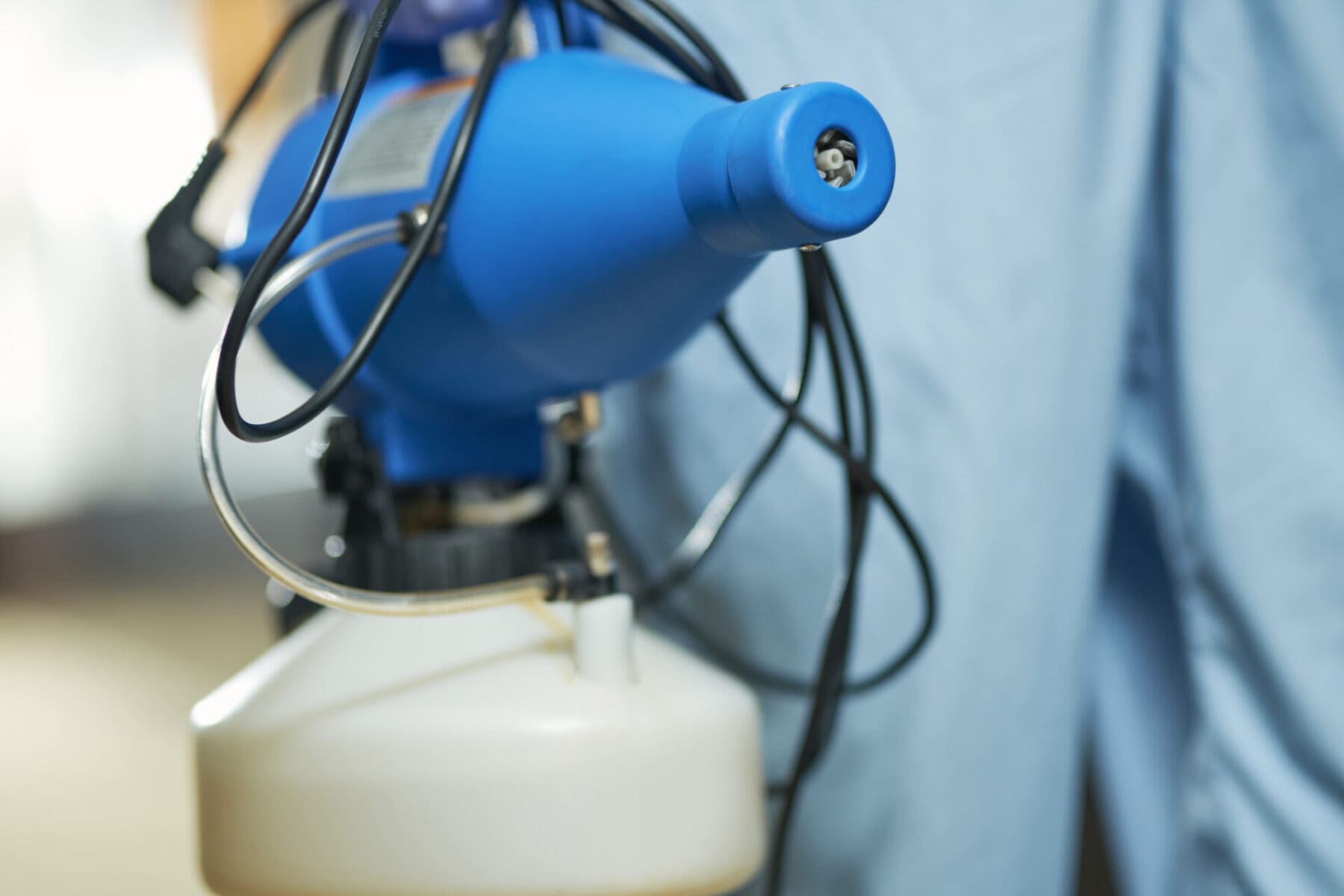
- Electrostatic sprayers for enhanced disinfection, wrapping charged disinfectant around high-touch surfaces during outbreak response
None of this is exotic. It’s simply the difference between tools built for eight hours a night and tools built for a Saturday at home.
Products We No Longer Use and Why
Just as telling as what’s in our program is what we’ve removed from it over the years:
- Cotton string mops for routine cleaning. They redistribute soil and bacteria after the first few dips, and they hold moisture that keeps floors wet too long.
- Heavy fragrance deodorizers. If a space needs perfume, something underneath isn’t clean. Fragrance also triggers complaints in occupied offices more than almost any product category.
- One-size-fits-all floor chemicals. We watched “universal” cleaners dull finished VCT and streak polished concrete in the same building. Surface-specific chemistry costs slightly more and saves floors worth thousands.
- Consumer-grade spray bottles and triggers. They fail mid-shift, and inconsistent spray patterns mean inconsistent chemical coverage. Commercial dilution-control systems ended that problem.
- The single all-purpose rag. The fastest way to move germs from a restroom to a desk. Color-coded microfiber made this practice indefensible.
What Works Best in Large Office Spaces?
For large office buildings, the most effective commercial cleaning solutions are the ones that scale without losing consistency: autoscrubbers instead of mops for expansive hard floors, backpack HEPA vacuums that let one person cover more square footage per hour, dilution-control systems that dispense chemicals at the exact ratio every time, and color-coded microfiber assigned by zone.
In a 100,000-square-foot building, product performance matters less than product repeatability — a solution that works only when applied perfectly will fail by the third floor. That’s why large-office programs are built around equipment and dilution control rather than stronger chemicals.
Are Green Cleaning Products Professional Grade?
Yes, this stopped being a trade-off years ago. Third-party certified products (Green Seal, EPA Safer Choice) now perform at commercial standards, and in occupied buildings, they’re often the smarter choice: lower odor, lower VOCs, safer for staff who work around them nightly. Many of the schools and medical facilities we service across the OKC metro specifically request certified-green programs, and we’ve never had to sacrifice results to deliver one.
The Real Answer: Products Don’t Clean Buildings, Systems Do
Here’s the honest conclusion after all these years: you can buy every product on this page and still have a dirty building. The best commercial cleaning products only perform inside a system; trained people, documented procedures, correct dilution, correct dwell times, and inspections that verify all of it actually happened.
That system is what you’re really evaluating when you choose a cleaning partner.
Want to See What Professional Products Look Like in Your Building?
If you manage a facility in Oklahoma City, Edmond, Norman, or anywhere in the metro, we’ll show you rather than tell you. Call JAN-PRO of Oklahoma City at (405) 606-3300 for a free, no-obligation walkthrough — we’ll assess what your current program is using, what it’s missing, and exactly what we’d do differently. You’ll get a straight answer either way, from a local team that cleans these buildings every night.
Frequently Asked Questions
Can I buy the same cleaning products professionals use?
Mostly yes — commercial disinfectants, microfiber, and floor chemistry are sold through janitorial supply distributors, and some through retail. What you can’t buy is the system: correct dilution, dwell-time procedures, and trained application. The same product used incorrectly delivers retail results.
Are commercial cleaning chemicals stronger than retail products?
Not necessarily stronger — more specific. Commercial products are formulated for a defined surface and soil type, sold as concentrates with controlled dilution, and backed by EPA registration data. Retail products trade that precision for convenience.
Why don’t professionals use bleach everywhere?
Because bleach is corrosive to many surfaces, produces fumes in occupied spaces, loses effectiveness quickly once diluted, and can’t clean and disinfect in one step — surfaces must be cleaned first. Professionals reserve it for the few situations where it’s the right tool.
Why don’t professionals use one cleaner for every surface?
Because chemistry that works on one surface damages another: degreasers strip floor finish, acid cleaners etch stone, ammonia streaks glass coatings. Surface-specific products cost slightly more per bottle and dramatically less per year in avoided damage.
Are expensive cleaning products worth it?
Price isn’t the signal — fitness for the job is. A commercial concentrate often costs less per diluted gallon than retail spray. The expensive mistake isn’t buying premium products; it’s buying the wrong product for the surface, or using the right one incorrectly.
Where can I find commercial cleaning services near me in Oklahoma City?
JAN-PRO of Oklahoma City provides commercial cleaning services throughout the OKC metro, including Edmond, Norman, and Yukon. Call (405) 606-3300 to schedule a free, no-obligation walkthrough.
About the Author
Carter James
 Carter James is Vice President of Strategy & Development, leading growth strategy, acquisitions, and multi-market expansion within a facility services platform. His background includes corporate strategy, M&A integration, and franchise development. He partners with senior leadership to drive disciplined execution, scalable operations, and long-term value through data-driven, high-accountability leadership.