
A commercial cleaning walkthrough is an on-site assessment of a facility before a cleaning provider proposes a scope of work. During the visit, the provider documents square footage, floor surfaces, restroom and breakroom fixtures, traffic patterns, access requirements, and any areas that need specialized handling. In Oklahoma City, an initial assessment also accounts for local conditions such as red clay soil, wind-driven dust, and seasonal weather. These conditions change how quickly entrances, floors, and HVAC-adjacent surfaces collect debris. The walkthrough turns a general request for “office cleaning” into a defined, measurable cleaning plan.
What Is a Commercial Cleaning Walkthrough?
A commercial cleaning walkthrough, also called an office cleaning assessment or site survey, is a structured inspection of a building’s interior. A cleaning provider conducts it before preparing a proposal. It is not a cleaning session. Its purpose is to collect the information needed to define tasks, frequencies, and service windows.
A typical walkthrough involves:
- The facility contact: an office manager, property manager, or business owner who knows how the space is used day to day
- The cleaning provider’s representative: someone trained to identify surface types, workload drivers, and scope gaps
- A documented record: notes, measurements, and sometimes photos that become the basis for the written cleaning plan
The walkthrough answers four practical questions: what needs to be cleaned, how often, when the work can happen, and what conditions affect the work.
Why the Walkthrough Comes Before the Cleaning Plan
Square footage alone does not describe an office’s cleaning workload. Two 10,000-square-foot offices can require very different labor. One may be an open floor plan with carpet tile and a single restroom pair. The other may have private offices, a client lobby with glass partitions, multiple breakrooms, and polished concrete.
A plan written without an on-site visit tends to rely on assumptions. Those assumptions often surface later as missed tasks, unclear responsibilities, or frequencies that do not match actual use. The walkthrough replaces assumptions with observed conditions.
Seven Things a First Walkthrough Reveals
1. Cleanable Square Footage vs. Leased Square Footage
Leased square footage includes areas that may not need regular service, such as storage rooms, mechanical spaces, or vacant suites. The walkthrough separates cleanable space from total space. It also identifies areas that need service on a different schedule.
2. Floor Types and Transitions
Floors are often the largest single driver of cleaning time. A walkthrough records each surface type, including carpet, carpet tile, luxury vinyl tile (LVT), vinyl composition tile (VCT), sealed concrete, ceramic, and stone. It also notes where these surfaces meet. VCT requires periodic stripping and refinishing, which carpet does not. Transitions between surfaces show where soil migrates from one area to the next.
3. Entry Points and Traffic Patterns
Main entrances, employee side doors, loading areas, and parking garage connections each bring in a different amount of soil. The walkthrough maps which entrances carry the most foot traffic and whether matting is in place. It also identifies the hallways and break areas that see the most daily use.
4. Restroom and Breakroom Fixture Counts
Restroom workload depends on fixture count (toilets, urinals, sinks, dispensers) and usage, not on room size. Breakrooms vary just as much. A kitchenette with a sink and microwave is a different task from a full kitchen with a dishwasher, refrigerators, and shared appliances. These counts directly affect labor estimates and supply needs.
5. High-Touch Surfaces
Door handles, light switches, elevator buttons, stair rails, and restroom fixtures are touched many times each day. The Centers for Disease Control and Prevention recommends cleaning high-touch surfaces regularly and cleaning other surfaces when visibly dirty. CDC also suggests that high-traffic spaces may call for more frequent cleaning or disinfecting in addition to cleaning. The walkthrough identifies where these surfaces are concentrated so they can be assigned a defined frequency.
6. Access, Security, and Service Windows
Most office cleaning happens after hours. The walkthrough confirms:
- Key, fob, or badge access
- Alarm system procedures
- Restricted areas
- Building management rules on service hours
It also identifies spaces that cannot be serviced while occupied, such as medical suites, records rooms, or executive offices.
7. Specialty Areas and Exceptions
Some areas need distinct handling:
- Server rooms with restricted access
- Glass-heavy conference rooms
- Client-facing lobbies held to a higher appearance standard
- Areas with sensitive documents
- Tenant-specific requests in multi-tenant buildings
Identifying these during the first visit keeps them from becoming unresolved questions after service begins.
Walkthrough Findings at a Glance
| Walkthrough area | What is observed | How it shapes the cleaning scope |
| Square footage | Cleanable vs. non-serviced space | Defines the service area |
| Floors | Surface types and transitions | Determines daily tasks and periodic floor care |
| Entrances | Traffic volume, matting | Sets entry-area frequency |
| Restrooms/breakrooms | Fixture and appliance counts | Drives labor and supply planning |
| High-touch surfaces | Location and density | Assigns touchpoint frequency |
| Access/security | Keys, alarms, restricted zones | Sets service windows and procedures |
| Specialty areas | Glass, server rooms, executive suites | Adds exceptions and special instructions |
Oklahoma City Conditions That Shape an Office Cleaning Assessment
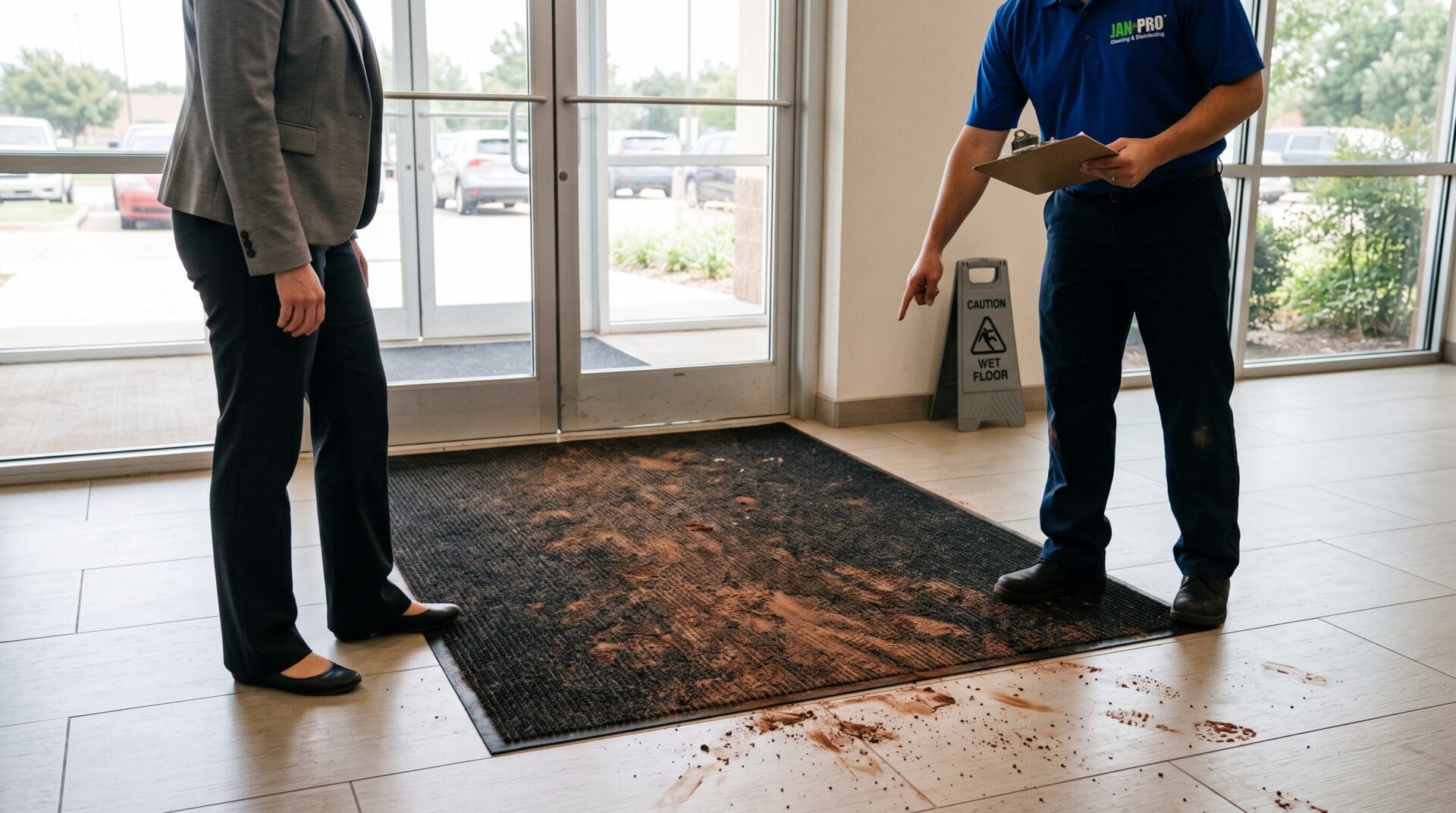
Local climate and building stock affect what an office cleaning walkthrough needs to document in Oklahoma City.
- Red clay soil: Oklahoma’s red clay tracks easily from parking lots and landscaping into lobbies, especially after rain. Entrances and light-colored carpet near doors often need closer attention.
- Wind and dust: Persistent wind carries fine dust indoors through entrances and loading doors. It settles on horizontal surfaces, vents, and window sills.
- Seasonal weather: Spring storm season brings mud and moisture. Winter ice events bring sand and ice-melt residue that can dull hard floors and stain carpet near entries.
- Seasonal pollen: Cedar pollen in late winter and early spring adds to the dust load on surfaces and in entry areas.
- Building variety: Offices range from downtown and Bricktown high-rises with building-managed access, to converted older buildings in Midtown, to suburban office and flex space along the Memorial Road and Northwest Expressway corridors. Each building type has different access rules, floor surfaces, and traffic patterns.
A walkthrough that accounts for these factors produces a scope that reflects how a specific Oklahoma City office actually gets dirty, not a generic template.
What to Expect During a Commercial Cleaning Walkthrough
The process generally follows a consistent sequence:
- Scheduling: The visit is arranged at a time when the facility contact can walk the space and answer questions.
- Initial conversation: The provider asks about headcount, operating hours, current cleaning concerns, and any prior service issues.
- Room-by-room inspection: Each area is reviewed for surfaces, fixtures, traffic, and condition.
- Exception review: Restricted areas, sensitive spaces, and special requests are documented.
- Scope development: Findings are converted into a written cleaning plan with tasks, frequencies, and service windows.
Facility managers can make the walkthrough more productive by preparing:
- A floor plan or approximate square footage by area
- Headcount and typical daily visitor volume
- Building access and security procedures
- A list of current cleaning gaps or recurring complaints
- Any tenant or landlord requirements that affect service hours
How JAN-PRO Cleaning & Disinfecting in Oklahoma City Approaches the Walkthrough
JAN-PRO Cleaning & Disinfecting has worked in commercial cleaning for more than 30 years. Its approach to the initial site visit centers on documentation and accountability. The walkthrough is used to build a cleaning plan specific to the facility rather than to apply a standard package to every office.
During the assessment, JAN-PRO Cleaning & Disinfecting in Oklahoma City reviews surface types, traffic patterns, high-touch areas, and access requirements. These findings are translated into defined tasks and frequencies. Service is then delivered by certified franchise owners, with the goal of having the same reliable franchisee consistently servicing the account. This continuity helps keep the details recorded during the walkthrough reflected in day-to-day service. Organizations evaluating commercial cleaning services in Oklahoma City can use the walkthrough as a reference point for comparing how thoroughly each provider assesses the space.
From Walkthrough to a Commercial Cleaning Quote in Oklahoma City
A commercial cleaning quote is only as accurate as the information behind it. Proposals prepared without a site visit often omit periodic floor care, underestimate restroom workload, or miss specialty areas. These gaps tend to surface after service begins.
The walkthrough connects observed conditions to the factors that determine service cost, including floor types, fixture counts, cleaning frequency, and access constraints. A detailed explanation of these factors is available in this overview of commercial cleaning prices in Oklahoma City.
Key Takeaways
- A commercial cleaning walkthrough is an on-site assessment that defines scope, frequency, and service windows before any cleaning plan is written.
- Square footage alone does not determine workload. Floor types, fixture counts, traffic, and access rules matter as much or more.
- High-touch surfaces should be identified and assigned a defined cleaning frequency.
- Oklahoma City conditions, including red clay soil, wind-driven dust, seasonal weather, and pollen, shape entrance and floor care needs.
- A documented walkthrough produces a more accurate scope and a more reliable quote than an estimate based on square footage alone.
Planning an Office Cleaning Assessment with JAN-PRO Cleaning & Disinfecting in Oklahoma City
Oklahoma City organizations preparing to change cleaning providers, or establish service for a new space, can begin with an on-site walkthrough. This creates a clear, written scope before service starts. JAN-PRO Cleaning & Disinfecting in Oklahoma City conducts facility assessments for offices and other commercial environments across the metro. Service is delivered by certified franchise owners using quality products and a documented cleaning plan. The Oklahoma City office is located at 1105 Sovereign Row, Oklahoma City, and can be reached at (405) 606-3300 to arrange a walkthrough.
Frequently Asked Questions
What is a commercial cleaning walkthrough?
A commercial cleaning walkthrough is an on-site assessment of a facility conducted before a cleaning provider proposes a scope of work. It documents square footage, floor types, fixtures, traffic patterns, access requirements, and specialty areas.
Why is a walkthrough needed before a commercial cleaning quote?
Square footage alone does not reflect cleaning workload. A walkthrough identifies floor types, restroom and breakroom fixture counts, high-touch surfaces, and access constraints, which all affect the tasks and labor required.
What should a facility manager prepare for an office cleaning walkthrough?
Useful items include a floor plan or approximate square footage, headcount and visitor volume, building access and security procedures, a list of current cleaning concerns, and any landlord or tenant requirements that affect service hours.
How do Oklahoma City conditions affect office cleaning needs?
Red clay soil, wind-driven dust, spring storms, winter ice-melt residue, and seasonal pollen increase the soil load at entrances and on hard floors, carpets, and horizontal surfaces. These conditions influence entry-area and floor care frequency.
What happens after a commercial cleaning walkthrough?
The provider converts the walkthrough findings into a written cleaning plan that defines tasks, frequencies, service windows, and special instructions. This plan becomes the basis for the proposal.
About the Author
Carter James
 Carter James is Vice President of Strategy & Development, leading growth strategy, acquisitions, and multi-market expansion within a facility services platform. His background includes corporate strategy, M&A integration, and franchise development. He partners with senior leadership to drive disciplined execution, scalable operations, and long-term value through data-driven, high-accountability leadership.