

The first question almost every prospective client asks us is some version of “how big is the job?” — and they answer it themselves, in square feet. It’s an understandable instinct. Square footage is the number on the lease, the number the landlord quotes, the number that feels like it should settle everything.
But at JAN-PRO Cleaning & Disinfecting in Louisiana, after 30 years of walking commercial buildings across the state with a clipboard and a flashlight, we can tell you plainly: square footage is one of the least reliable predictors of how long a building actually takes to clean.
We’ve bid two buildings on the same street, in the same office park off Interstate 12, both listed at right around 12,000 square feet. One took a two-person crew a little over two hours a night. The other took the same crew nearly twice that. Same footprint, same city, same climate. The difference had nothing to do with size and everything to do with what was inside the square footage — and what Louisiana does to it.
Square footage measures the floor. It doesn’t measure the work.
Here’s the thing a tape measure can’t see: cleaning time is driven by touchpoints and obstacles, not open area. An empty 20,000-square-foot warehouse with a sealed concrete floor and one restroom can genuinely be quicker to service than a 6,000-square-foot medical office subdivided into fifteen exam rooms, four restrooms, a lab, a break room, and a waiting area full of chairs, end tables, and a children’s corner.
Every wall you add creates corners. Every corner collects dust. Every private office adds a door handle, a light switch, a trash can, a desk, and a phone — each one a thing a person has to physically stop and wipe. The medical office isn’t harder to clean because it’s more valuable; it’s harder to clean because it has roughly ten times the number of surfaces a human hand has to touch to do the job right. Open square footage cleans fast. Divided square footage does not.
Then there’s Louisiana.
We could give you the touchpoint conversation anywhere in the country. What makes it a Louisiana conversation is the environment the building sits in, and this is where our local experience changes the math in ways a national franchise reading off a rate card would miss.
Humidity rewrites the schedule
In a dry climate, a lobby floor cleaned Friday still looks clean Monday. In Baton Rouge or Houma in July, that same floor can develop a hazy film and that faint, musty smell over a single humid weekend, because moisture in the air keeps residue and biofilm active on surfaces long after they’d have dried out somewhere else.
A building that would need three cleanings a week in Denver often needs five here to hold the same standard. The square footage didn’t change. The air did.
The soil is different, and it’s tracked in constantly
A lot of Louisiana sits on soft, damp ground, and our clients’ employees and customers track that in on their shoes all day. A retail entrance in Slidell after a rainy week isn’t dealing with dry dust; it’s dealing with a fine, sticky mud that bonds to tile grout and entry mats and requires actual scrubbing, not a quick dust mop.
Two identical entryways, one in a dry inland strip mall and one near the Northshore lakefront, are simply not the same job.
Storm season is a variable, not an exception
Any honest Louisiana cleaning company builds hurricane and heavy-rain disruption into how it staffs and schedules. A building that floods its parking lot every time a tropical system rolls through has an entryway and lobby that need a completely different level of attention for weeks afterward. That’s not in the square footage either — but it’s absolutely in the real cost and time of keeping the place clean.
What we actually count when we walk a building
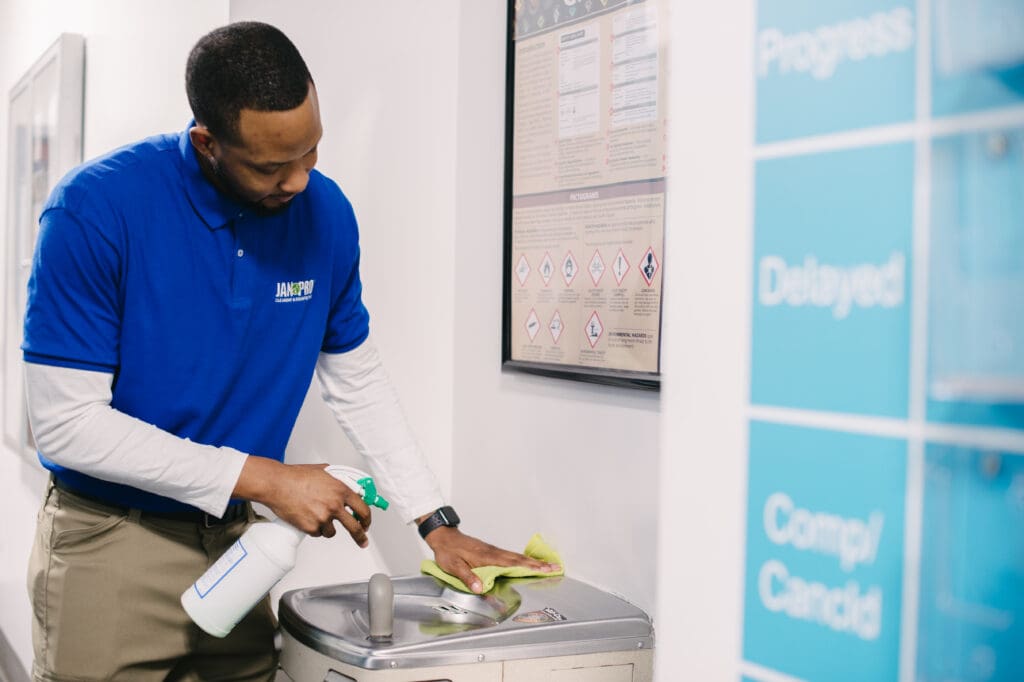
When one of our JAN-PRO Cleaning & Disinfecting teams in Louisiana does a walkthrough, the square footage goes on the form first and then gets mentally set aside. What we’re really counting is the stuff that drives labor hours:
- Restroom count and fixtures. Restrooms are the single most time-intensive area in almost any commercial building. Four restrooms in a 5,000-square-foot building will out-work a single restroom in a 15,000-square-foot one, every time.
- Floor type and finish. Sealed concrete, carpet, vinyl tile, and hardwood each demand different equipment and different amounts of time — and in our humidity, some finishes need far more frequent attention to stay presentable.
- Fixture and furniture density. How many desks, chairs, partitions, and touchpoints stand between the crew and a finished room.
- Industry and compliance. A medical clinic, a food-adjacent facility, and a standard office all carry different disinfection and documentation requirements. Compliance takes time, and it’s non-negotiable.
- Traffic and use. A 24/7 call center gets used around the clock; a professional office empties at 5 p.m. Same size, very different wear.
- Access and security. Badge-in protocols, alarm procedures, and rooms that can only be entered at certain hours all add real minutes to a shift.
None of those show up on a lease. All of them show up in how long the building takes.
Why this matters to you, not just to us
This isn’t an academic point. It’s the difference between a cleaning program that holds up and one that quietly fails. When a vendor quotes purely off square footage — so many cents per foot, sight unseen — one of two things happens. Either they’ve priced for the easy version of your building and will cut corners to make the math work once reality sets in, or they’ve padded the number to protect themselves, and you’re overpaying for a job that didn’t need it.
The reason we insist on walking a building before we quote it is that a walkthrough is the only way to see the touchpoints, the floor types, the restroom load, and the Louisiana-specific realities that a square-foot rate pretends don’t exist. It’s also why our quality system documents each visit against a real standards audit rather than a stopwatch: the goal is a clean building, measured, not a certain number of minutes logged.
So the next time someone gives you a cleaning price based on nothing but your square footage, it’s worth asking what they think is in that square footage — and whether they’ve accounted for the fact that your building is in Louisiana.
Frequently Asked Questions
What actually determines how long a commercial building takes to clean?
Touchpoints and obstacles, not open floor area. The biggest drivers are restroom count, floor type, fixture and furniture density, foot traffic, and industry compliance requirements, not total square footage.
Does a bigger building always take longer to clean?
No. Layout matters more than size. A large open warehouse with sealed concrete and one restroom often cleans faster than a smaller office divided into many rooms, each adding doors, desks, and restrooms that require hands-on attention.
Why do two buildings the same size get different cleaning quotes?
Because square footage is only one input. Restroom count, floor type, foot traffic, industry, security access, and cleaning frequency all change the labor hours involved. A quote based on a real walkthrough reflects those factors; a per-square-foot quote usually does not.
Does Louisiana’s climate affect commercial cleaning frequency?
Yes. High humidity keeps residue and biofilm active on surfaces longer, so floors and restrooms can need more frequent cleaning than the same building in a drier climate to hold the same standard.
Get a quote built on your actual building
If you want a cleaning program priced on what your building really needs, the team at JAN-PRO Cleaning & Disinfecting in Louisiana will come walk it with you. Explore our commercial cleaning services in Louisiana, or call us directly at (504) 434-3949 for a free, no-obligation walkthrough and quote.
About the Author
Carter James
 Carter James is Vice President of Strategy & Development, leading growth strategy, acquisitions, and multi-market expansion within a facility services platform. His background includes corporate strategy, M&A integration, and franchise development. He partners with senior leadership to drive disciplined execution, scalable operations, and long-term value through data-driven, high-accountability leadership.