A medical office is not a smaller, quieter version of a corporate office. It is a regulated clinical environment where the wrong product, the wrong cloth, or the wrong sequence of steps can carry pathogens from one exam room into the next.
We’ve walked into general office buildings across Ridgeland and Flowood where a janitorial crew wipes every desk with the same rag and calls it a day. That approach does not hold up in a pediatric clinic, a dental practice, or an urgent care center in the Jackson area, and understanding why is the first step toward protecting patients, staff, and a practice’s reputation.
The Core Difference: Bioburden, Not Just Dust
Office cleaning is primarily about appearance and general hygiene. Vacuumed carpets, empty trash cans, and streak-free glass are the usual benchmarks. Medical cleaning, often called environmental services or “EVS” in healthcare settings, is about reducing bioburden, meaning the presence of blood, bodily fluids, and microorganisms capable of transmitting infection between patients.
Facts:
- The Centers for Disease Control and Prevention (CDC) publishes environmental infection control guidance for healthcare facilities that separates routine cleaning from disinfection of high-touch surfaces.
- The Occupational Safety and Health Administration (OSHA) Bloodborne Pathogens Standard applies to workplaces where employees may contact blood or other potentially infectious materials, which covers many medical and dental offices.
- The Environmental Protection Agency (EPA) maintains a registry of disinfectants approved for use against specific pathogens, commonly referenced in healthcare settings as List N.
According to the CDC, on any given day, about 1 in 31 hospital patients has at least one healthcare-associated infection (HAI). While outpatient medical offices differ from hospitals, the same infection prevention principles—proper cleaning, disinfection, and environmental hygiene—help reduce the risk of pathogen transmission across healthcare settings.
Inference:
Because a general office cleaning crew is typically trained around appearance standards rather than infection control protocols, applying that same training inside a clinical setting can create real exposure risk for patients and staff, even when the intent behind the work is good.
How Training Actually Differs
A technician cleaning a law office and a technician cleaning a dental practice need different training, not just different supply carts. In a standard office program, training centers on efficiency, product use for finishes and fabrics, and customer service. In a medical program, training has to additionally cover:
- Bloodborne pathogen exposure control, including what to do if a technician is exposed to blood or bodily fluid during cleaning.
- Personal protective equipment (PPE) selection, matched to the task, such as gloves and eye protection for disinfecting an exam room versus standard gloves for a waiting room.
- Disinfectant dwell time, meaning the manufacturer’s required period a surface must stay visibly wet for the product to work as labeled. Wiping a surface dry before dwell time is complete does not disinfect it, it only cleans it.
- Zone separation, so equipment used in one type of space never crosses into another.
We build this training into every medical account we service in Central Mississippi before a technician is ever assigned to a route, not as a one-time orientation but as an ongoing part of the account’s standard operating procedure.
Cross-Contamination Zones Change Everything
In a corporate office, a cleaning cloth can reasonably move from a break room counter to a conference table without much consequence. In a medical office, that same movement between an exam room and a waiting room can spread contamination from one patient population to another.
We train our teams at JAN-PRO of Central Mississippi to think in zones: exam rooms, waiting areas, restrooms, and staff break spaces each get their own color-coded microfiber cloths and mop heads, and those colors never cross zones. Color coding is a widely recognized infection control practice in healthcare environmental services, and it is one of the clearest visible differences between a medical cleaning program and a standard office program.
High-touch surfaces also multiply in a clinical setting. A general office has door handles, light switches, and shared keyboards. A medical office adds exam tables, blood pressure cuffs, pulse oximeters, waiting room chair arms, check-in counters, and payment terminals touched by dozens of patients a day, each requiring disinfection at the labeled dwell time rather than a quick wipe.
Five Common Issues We Find During Medical Office Cleaning Walkthroughs
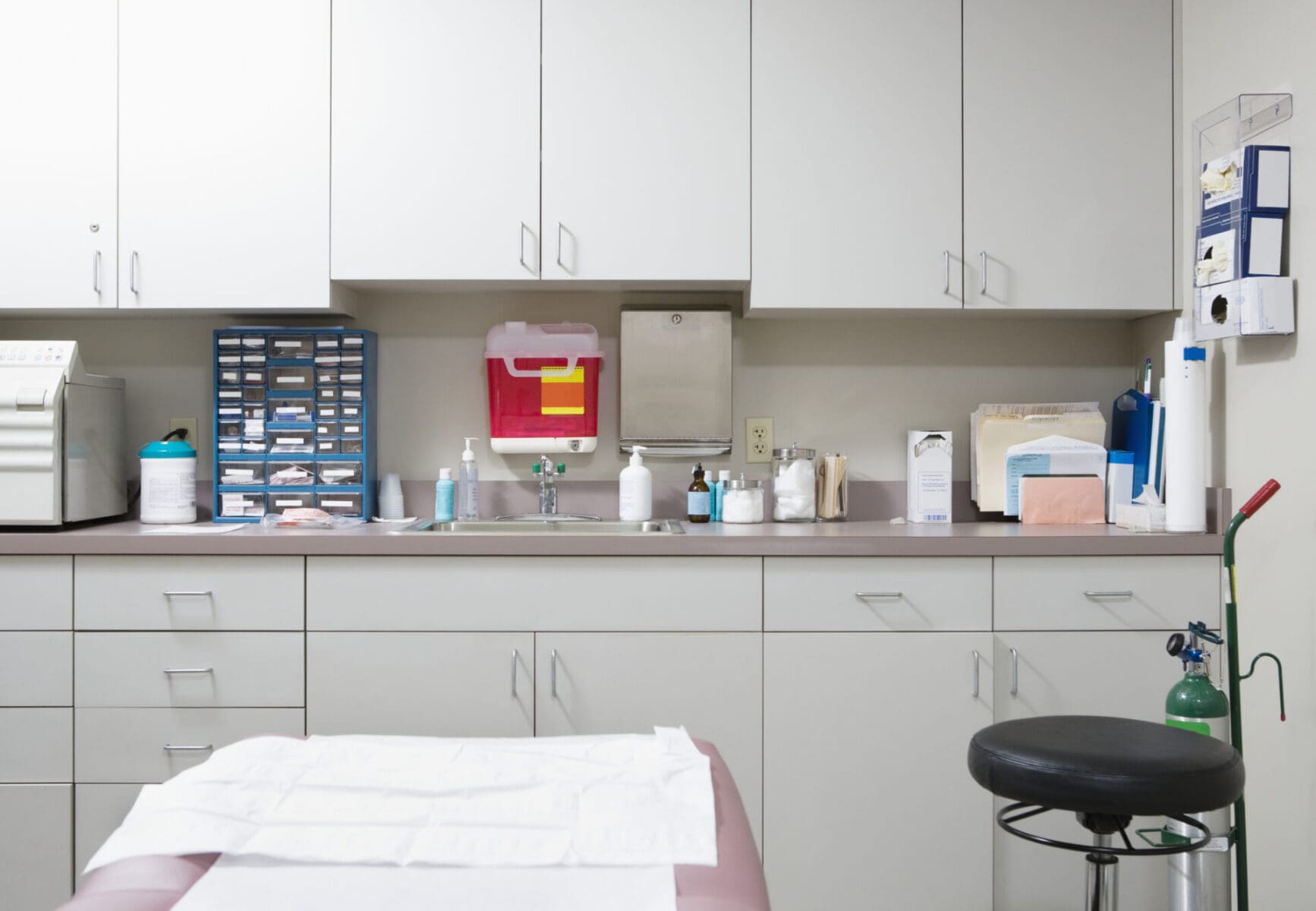
When we evaluate a new medical office, the biggest issues usually aren’t obvious. More often, we find small process gaps that can increase the risk of cross-contamination or inconsistent cleaning. The most common include:
- Using the same mop or microfiber cloth in multiple areas without a zone system.
- Removing disinfectants before the manufacturer’s required dwell time.
- Storing cleaning supplies where clean and used equipment can mix.
- Cleaning exam rooms with the same routine used for standard office spaces.
- Having no documented cleaning checklists or procedures for high-touch surfaces.
Most of these issues can be corrected with better training, standardized protocols, and a cleaning program designed specifically for healthcare environments.
Regulated Medical Waste Is Not Office Trash
A medical office generates regulated medical waste, and a cleaning crew handling it incorrectly creates legal exposure for the practice, not just a cleanliness problem. Sharps containers, biohazard bags, and certain contaminated materials fall under state and federal regulations for medical waste handling and disposal, separate from routine trash removal.
A cleaning provider working in Jackson area medical offices needs to know exactly where its responsibility ends and where a licensed medical waste disposal vendor’s responsibility begins, and that boundary should be written into the cleaning scope of work from the first day of the contract.
Office Building Cleaning vs. Medical Office Cleaning: A Side-by-Side Look
| Element | Standard Office Building | Medical Office |
| Primary goal | Appearance and general hygiene | Reducing bioburden and infection risk |
| Equipment | Shared carts and cloths across areas | Color-coded, zone-specific equipment |
| Disinfectant use | General purpose cleaner, wipe and go | EPA-registered disinfectant, full labeled dwell time required |
| Staff training | Efficiency and customer service | Bloodborne pathogen exposure control, PPE selection, dwell time protocol |
| Waste handling | Standard trash removal | Regulated medical waste, handled by a licensed disposal vendor |
| Documentation | Basic service log | Cleaning checklist plus exposure control plan, often reviewed during compliance audits |
An Anecdote From the Field
A few years ago, our team was brought in to review the cleaning setup at a small family practice in the Jackson metro after a patient raised a concern about the waiting room. Walking through with the office manager, the issue was not visible dirt. It was a single mop bucket being used across the entire building, from the restrooms to the exam room floors, because the previous cleaning vendor had never separated zones or color-coded equipment.
The fix was not complicated. It came down to introducing zone-based equipment, retraining the walkthrough sequence so exam rooms were cleaned before common areas rather than after, and posting a checklist with disinfectant dwell times in the supply closet. That visit is a good reminder of why every new medical account gets its own risk assessment rather than a copy of a standard office building program.
What Practice Managers in Jackson, Ridgeland, Madison, and Flowood Should Ask a Cleaning Vendor
Central Mississippi has a growing base of medical, dental, and outpatient facilities, and many of them are still cleaned under contracts written for general office buildings. Before signing or renewing a cleaning contract, a practice manager should ask:
- Are staff trained specifically on bloodborne pathogen exposure control, and can that training be documented?
- Is there a written color coding or zone system in place, and is it followed consistently across shifts?
- What EPA-registered disinfectants are used, and are labeled dwell times actually followed on-site?
- Who handles regulated medical waste, and is that responsibility separated from the janitorial scope in writing?
- Is there a documented exposure control plan the practice can reference during a compliance review?
If your current provider cannot answer these clearly, that is worth addressing before it becomes a compliance or patient safety issue.
Why This Matters for Your Practice
A cleaning program built for a corporate office will eventually create a gap in a medical setting, whether that gap shows up as a failed compliance review, a patient complaint, or an actual exposure incident. The safest path is a cleaning partner that treats your practice as a clinical environment from the start, not one that adapts a generic template after something goes wrong.
JAN-PRO Cleaning & Disinfecting in Central Mississippi builds every medical account around zone-based cleaning, documented dwell times, bloodborne pathogen-trained staff, and a clear division of responsibility for regulated medical waste.
If you manage a medical, dental, or outpatient facility in the Jackson area and want a walkthrough of how your current cleaning program measures up, visit our team at 104 Business Park Drive, Suite HI, Ridgeland, MS, or call (601) 900-3000 to schedule a walkthrough of your facility. You can also review our office cleaning services in Jackson to see how our medical and commercial cleaning programs are structured.
Frequently Asked Questions
Why does a medical office need different cleaning than a regular office building?
A medical office involves bloodborne pathogen exposure risk, regulated high-touch clinical surfaces, and regulated medical waste, none of which apply to a typical corporate office. Cleaning protocols must address infection control, not just appearance.
What is zone-based cleaning in a medical office?
Zone-based cleaning assigns separate, color-coded equipment, such as microfiber cloths and mop heads, to distinct areas like exam rooms, restrooms, and waiting rooms, so contamination is not carried from one zone to another.
What does disinfectant dwell time mean, and why does it matter?
Dwell time is the period an EPA-registered disinfectant must remain visibly wet on a surface for it to work as labeled. Wiping a surface dry before that time is complete means the surface was cleaned but not disinfected.
Who handles regulated medical waste in a cleaning contract?
Regulated medical waste, such as sharps and biohazard materials, typically falls to a licensed medical waste disposal vendor, separate from the janitorial cleaning scope. This division of responsibility should be documented in the cleaning contract.
About the Author
Chrystal Coleman
 Chrystal Coleman is a business owner at JAN-PRO of Mississippi, leading a dedicated team that has expanded the company across Central Mississippi and the Coast. Raised in a close-knit community, she combines a strong work ethic with a passion for entrepreneurship, building a reputation for excellence in commercial cleaning and customer satisfaction.